Skip to the article

Training foundations · Video lesson

Puppy Training Guide – Small Steps = Big Results

Make the next step small enough for your puppy to find a way to win.

In This Video

Small steps make for smooth moves. Like learning a dance, training works when you perform the right moves in the right order at the right time. This video explains why every skill gets broken into small, achievable steps, why you start with what your dog can do right now, and why rushing ahead leads to a confused dog who quits trying, using the example of teaching a dog to settle on a bed for 20 minutes during dinner.

Key Moments

  • 0:04 — Small steps make for smooth moves
  • 0:35 — Every behavior is a choreographed series of steps
  • 1:05 — Start with what your dog can do right now
  • 1:35 — Consistency and repetition: don't skip a step
  • 2:06 — Rushing ahead: why confused dogs quit trying
  • 2:38 — Example: settling on a bed during dinner
  • 3:38 — Celebrate each small step along the way
Full Transcript

Small steps make for smooth moves. Have you ever taken a dance class? If you've ever tried to master the waltz, or even just learn the Macarena, you know that you have to perform the right moves in the right order at the right time. If you miss a step, or if you try to rush ahead of the music, you have to go back to the moves choreographed for you and start over. So what does dancing the Macarena have to do with dog training?

Each of our DogSense Online videos will show you a carefully choreographed series of steps for you and your dog to learn together to achieve a skill. You want to teach your dog to sit? We have steps for that. With time and patience, you and your nimble dog can achieve great things. The trick is to make sure you learn all the steps. In fact, the secret to successful dog training is to break every process down into very small, achievable steps. And just like in dance, you need to take it one step at a time.

What's the first step? We like to start with what your dog can do right now. Then we add steps. We repeat each step and reward your pooch for every success he has in that step. It's important to focus on the exact behavior your dancing-queen doggy must exhibit in order to get paid. We repeat this step again and again until your dog is ready to move on to the next one.

Consistency and repetition are what make professional dancers great, and that's what we're striving for. You may think your dog is tripping the light fantastic, but it's important not to skip or shortchange a step. The Hokey Pokey isn't difficult, but you still have to put your right foot in before you shake it all about. As with any highly choreographed series of movements, a misstep can result in a stumble.

When you forge ahead because you think your dog has got it, it's very easy to get stuck. It's a common mistake for dog parents to be in a rush. Remember, the process is a duet, and both you and your dog must be in the moment together. Dance the dance and stick to each behavior plan, step by step. If you decide to bust a move and sweep your pooch along to the next step before she's ready, she might become confused. Just like us, when dogs are confused by what we want, they quit trying. Your end goal will be achieved more quickly when you get down with the plan in each video, small step by small step.

So how do you teach your quick-stepping fellow to lie on his bed for 20 minutes while you enjoy your dinner? We first must teach your dog to lie down on cue. This behavior of lying down when we ask will require small steps all on its own. Then, once your hip-hop hound has crushed that, we start introducing distractions. Even if a ball is tossed, your pup must learn that chilling actually pays off more. When your dog is a cool customer in the distractions department, it's time to move on. Then we'll groove slowly into the extended version, until he can hold the pose for the full 20 minutes.

Think about how much time and repetition celebrity dancers put in to win the Mirrorball Trophy. Fortunately, teaching your dog to lie still will certainly not take near the time or effort, but you can employ the same discipline and small, achievable steps those amazing dancers use to get to your finale sooner. In time you'll get to celebrate your dog's big successes, but remember to celebrate each groovy small step you achieve along the way. More important than anything else: dance, and enjoy your dog.


Updated written companion · October 2026. The earlier video demonstrates building skills in small steps. The guide below reflects Go Anywhere Dog® 5.0.

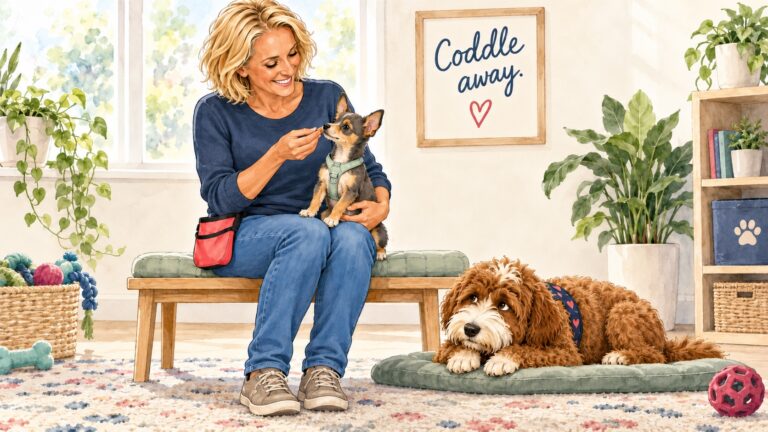
New puppy sitting between woman's legs doing Go Anywhere Dog signature Peek-a-boo training skill
  • Tiny, joyful reps teach faster than long, perfect ones.
  • When it’s hard, make the next rep easier, shorter, or simpler.
  • Ladder skills: home → yard → public → real life.

Small Steps, Big Results: A Gentle Puppy Training Guide

Puppies learn like toddlers—through safety, play, and a thousand tiny reps. Expecting a perfect sit-stay out of the gate is like handing a kid a crayon and asking for perfect cursive. We build skills the same way we build trust: one small, successful step at a time.

Why tiny reps beat “be perfect”

Frequent achievable attempts give your puppy something useful to repeat. If the next step falls apart, make it easier, shorter or simpler, and check how your puppy is feeling.

Micro-win checklist

  • Can my puppy succeed at this in 2 seconds?
  • Can I reward instantly?
  • Is the environment easy enough (few distractions)?
  • Can I stop while it’s going well?

The Small-Step Method (start today)

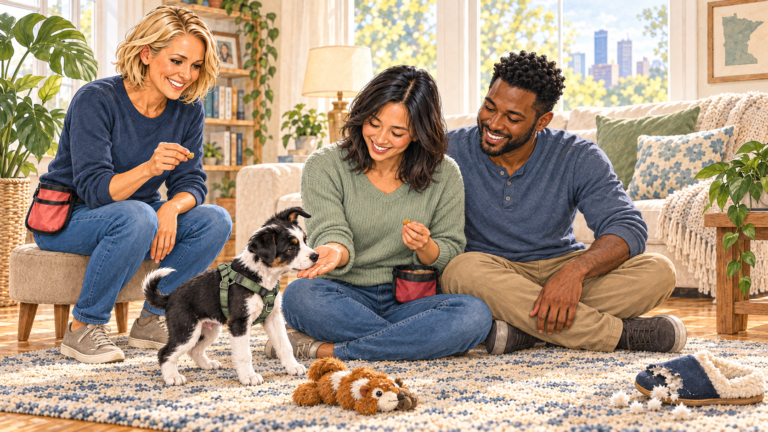
  1. Pick one behavior: a hand target, a sit or turning toward you. Build the movement first; add the word once the response is predictable. If the cue is already taught, practice it in an easy setting.
  2. Make it tiny: ask for 1–2 seconds, at home, with a handful of treats.
  3. Mark and pay: “Yes!” → treat. Think 10 rapid wins, not one long rep.
  4. Reset: toss a treat to make another easy attempt possible. Use the cue only if it already means something to your puppy.
  5. Quit early: leave a little on the table so your puppy wants more next time.

If your puppy struggles, it is information for the teacher. Check the step, the setup, the reward and the learner. You can change the plan.

Build the ladder: home → yard → real life

  • Stage 1 (Home): 10–20 tiny wins in a quiet room.
  • Stage 2 (Yard/Driveway): same skill, short leash, same tiny rep.
  • Stage 3 (Public): add mild distractions; keep reps short and cheerful.
  • Stage 4 (Real-world routines): front door, car, vet lobby—practice where it matters.

Rewards that teach faster (and feel better)

  • Pay the behavior you want, generously, especially at the beginning.
  • Food is useful teaching currency. Change its frequency and mix in play or access as the response becomes dependable in that context. Reinforcement continues; it does not graduate out of the program.
  • Layer in praise, play, and life rewards (go outside, greet a friend) as your puppy learns.

Read the Feeling and Adjust the Lesson

An upset puppy may have a harder time using the skill you are asking for. Learning continues. Check needs, make room, and help with the feeling before arranging a manageable next attempt. A sniff break, some distance or a pause can help; watch the puppy rather than a thirty-second deadline.

Make the next useful response easier to practice.

When Practice Gets Stuck

  • A familiar skill fails outside: choose a quieter spot and make the task easier.
  • No interest in food: check appetite, reward value, distractions and possible worry. Better food sometimes helps; an upset puppy may need space or support.
  • Pulling returns: practice a few easy, rewarded steps, with room for sniffing too.
  • Recall struggles: shorten the distance in a secure setting and reward generously. Keep management in place.

How Coached Practice Helps

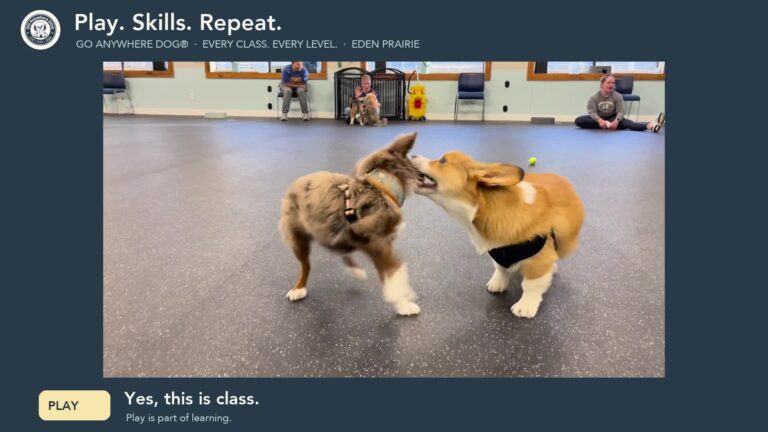
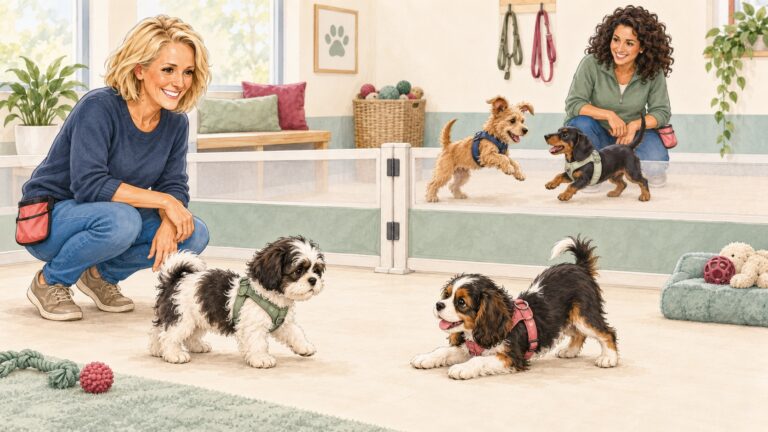
Group play and coached reps help pups learn social skills and emotional regulation, not just “obedience.” Our off-leash format lets puppies practice real manners around real distractions—safely.

Fast FAQ

How long should I train each day?

5–10 minutes total, split into tiny 1–2 minute bursts.

When do I fade food rewards?

As reps become easy in that context, switch to intermittent food + praise/play, and start paying more for harder environments.

Is my puppy being “stubborn”?

Check upset, understanding, practice in this setting and competing payoffs before calling it stubbornness. The answer tells us whether to support, teach, change the setup or apply an appropriate consequence.

Puppies starting under 16 weeks begin in Puppy & Me, and dogs 16 weeks to a year start in Life Skills 101 — both at our Eden Prairie school. For dogs of any age, we also come to you with in-home training.

Until next time, have fun and enjoy your dog.
— Jody & your Dog Life Coaches

Jody Karow holding Vanna

The person behind the post

Jody Karow, CTC

Dog trainer, writer, and founder of Go Anywhere Dog®. Working professionally with dogs since 2004, and helping people understand the dog in front of them.
Meet Jody & explore more articles

Bring the learning home

You can have a person beside you.

Off-leash classes in Eden Prairie. Private puppy training and behavior help in Minneapolis and nearby suburbs. Jeannie can help you find your next step.

Talk with Jeannie