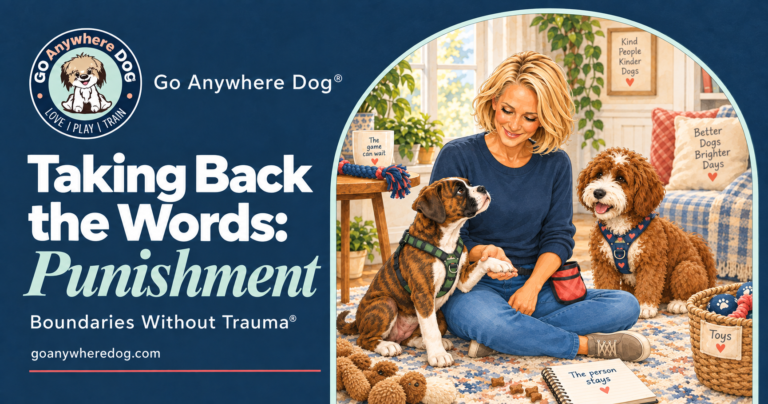
Taking Back the Words is our series on vocabulary the dog training industry broke — and why we refuse to stop using it. Some trainers throw out a word once it’s been corrupted. We’d rather take back the truth of it. Through mechanism, with a dash of humor and love.
The question
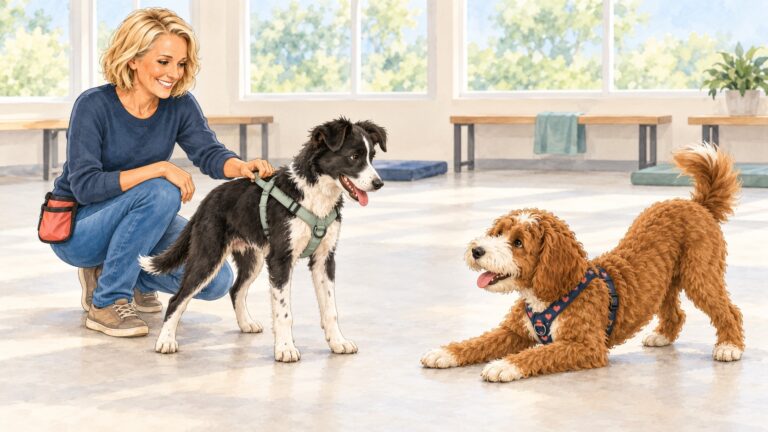
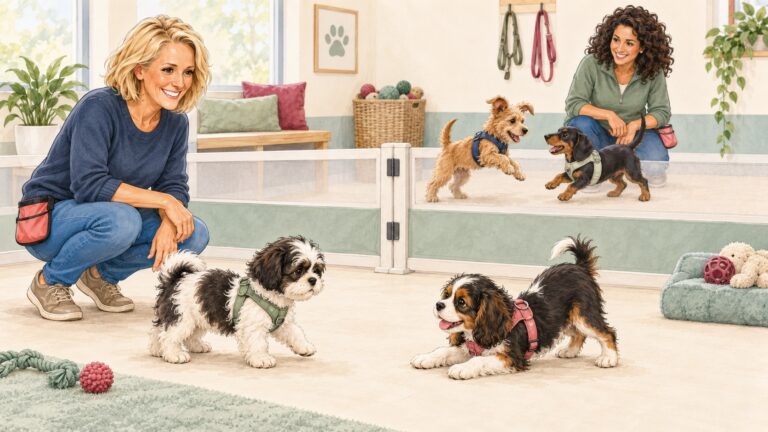
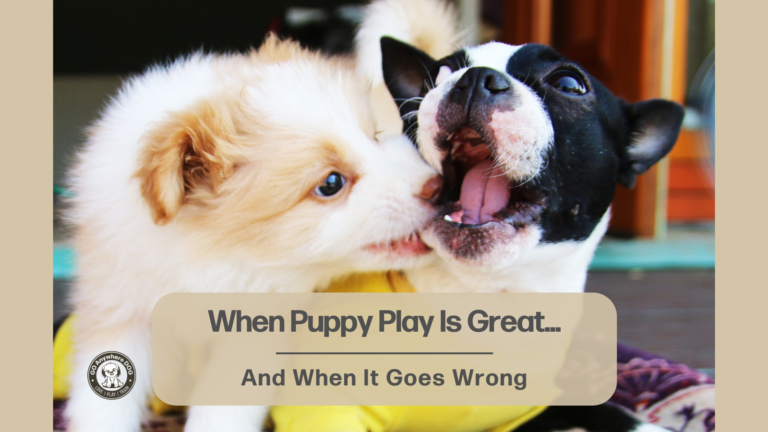
Off-leash play, twelve puppies, one of them a fourteen-week-old who cannot find the off switch. His person raises a hand.
"How about holding my puppy down on his side until he calms down?"
He hasn’t done it. He’s asking. That matters, and we’ll come back to it. But the room goes quiet the way rooms do when everyone is waiting for the lecture.
Here’s what he gets instead: "We don’t do that here, ever. And I’ll tell you why."
The why is the rest of this post. But notice the shape of the answer first, because it’s the whole subject: a rule, and a reason. Firm, and warm. He asked how to be the leader, and the answer was to show him one.
The people who saw it first
The idea that a dog needs a boss has a paper trail. It’s shorter than people think, and the people who wrote it kept trying to take it back.
Basel, 1948. Rudolf Schenkel spent years watching wolves at the zoo — unrelated adults, thrown together in an enclosure, fighting over rank. He wrote it up as how wolves live. It was how captive wolves live. The alpha was born in a pen.
Berkeley, 1966. Diana Baumrind, studying human families, described three ways to raise a child. The parent who rules without warmth. The parent who warms without rules. And the parent who does both — sets the boundary, explains the reasoning, and stays the person the child runs to. Sixty years of follow-up have said the same thing again and again: the third kind produces the secure, resilient, self-regulating kids. The first kind produces the ones who comply until they’re big enough not to.
1970. David Mech published The Wolf, and "alpha" walked out of the zoo and into the culture.
1978. The Monks of New Skete wrote a bestselling training book and put the alpha roll in it: pin the dog on his side or back until he submits. Millions read it.
Ellesmere Island, 1999. Mech again — after thirteen summers on the tundra, a meter from wild wolves — corrected his own record in print. A wild pack is a family. The "alpha pair" is mom and dad. Nobody fights for rank at dinner, because the babies follow the parents, and the parents are where food, safety, and answers live. He spent the rest of his career asking people to stop using the word — including his own publisher, who kept printing The Wolf over his objections until 2022.
2002. The Monks took the alpha roll out of the second edition. Too risky, they wrote, and too demanding for the average dog owner.
2004 to 2012. Cesar Millan’s Dog Whisperer ran for nine seasons on National Geographic and taught more people about dogs than every book above combined. Its whole vocabulary was the pen: the human as pack leader, the dog in a calm-submissive state, walk through the door first, eat first, and if he forgets his place, put him on his side. The science it stood on had been retracted by its own author five years before the first episode aired. The show carried a warning not to try these techniques at home. People tried them at home. That’s what a podium does.
Corvallis, 2022. Monique Udell’s lab at Oregon State ran Baumrind’s three styles on forty-eight dog owners and then tested their dogs. The dogs of the warm-and-firm owners were the securely attached ones, the social ones, and the only ones who solved the puzzle. The dogs of the boss-style owners were insecurely attached to them. The dogs of the permissive owners followed a stranger’s cues over their own person’s.
Eight witnesses. The two who invented the pen took it back. The two who studied parents found the boss loses. The one with the TV show is the only one who never changed his mind.
What the science says
Start with the pin, because it’s the thing the man asked about.
In dogs, going onto the side is a message. A dog puts himself there. It says I’m done, I’m not a threat, we’re okay — and it means something only because he chose to send it. Force it and you haven’t sent the message; you’ve started a fight he can’t win, and the thing he learns is that his person’s hands mean being pinned. The person becomes the signal. And "until he calms down" is the tell — the endpoint of a pin is the dog who stopped fighting because nothing he did worked. We spent last week on what that stillness actually is. It isn’t calm.
Now the real thing. Watch a puppy mid-play break off, turn, and find his person’s face. Nobody asked him to. That check-in is the oldest behavior in the attachment literature: a small one referencing a safe one before deciding what the world means. Sorce and Campos put one-year-olds on a glass table with a visual drop-off and watched them look up at their mother’s face to decide whether to cross. When she smiled, fourteen of nineteen crossed. When she posed fear, none of seventeen did. And when the researchers lowered the drop until it was obviously safe, three-quarters of the babies never looked at her at all — they check in when they’re unsure. The puppy is doing the same thing. He’s asking we good? — and he asks because hundreds of times in a row, looking at his person paid. Snacks happened. Safety happened. Good information happened.
Behavior goes where the pay is; Herrnstein measured it to the decimal. Which means "worth following" isn’t a personality trait or an energy. It’s a reinforcement history, and you build it the way you build anything: rep by rep, by being the safest, most reliable, most interesting thing in every room.
Baumrind’s three styles, in a dog’s terms:
Boss without warmth. Control, no attunement. The dog learns to manage his person instead of reference him. Looks obedient at eight months. Falls apart at eighteen.
Warmth without rules. Attunement, no structure. The person is lovely and the environment runs the schedule — the counter pays, the squirrel pays, the other dog pays. The dog follows whoever’s paying, which is why the permissive owners’ dogs followed the stranger.
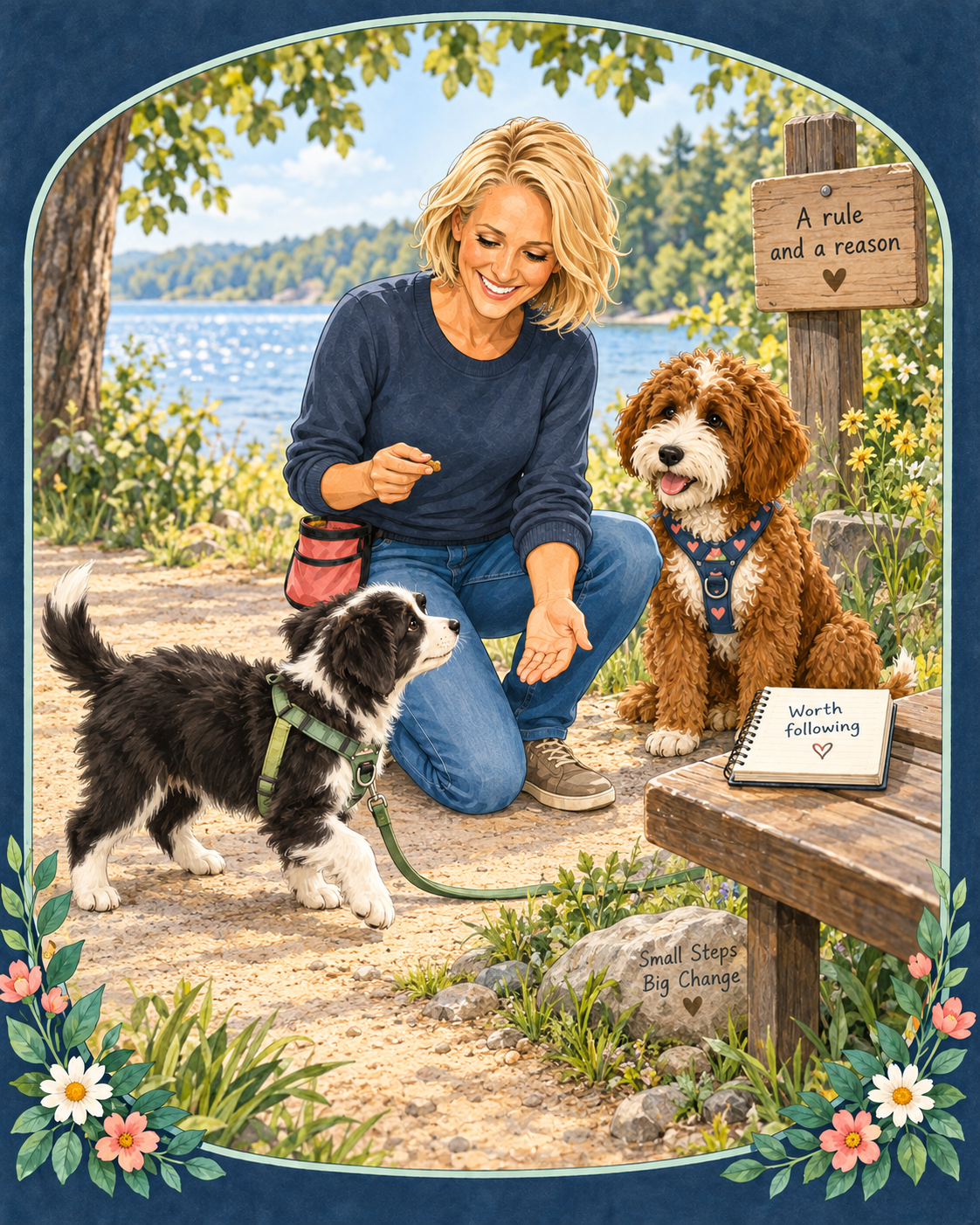
Both. The boundary is set by someone the dog can still come toward. That’s the only one of the three where leader and safe are the same person — and it’s the one with all the outcome data.
Our one line, and you can keep it: you don’t become the leader by being the boss. You become the leader by being worth following.
Two rooms, same mechanism
The dog. The check-in is the proof, and you can see it in any class we run. But the best example of leadership we know isn’t a person at all — it’s a good mother dog with a puppy who’s being too much. She doesn’t correct him. She moves away. If she has the ability, she leaves the nursery pen entirely, and the puppy learns the price of too much the same way he’ll learn it from us: the game ends, the mother is still his mother, nothing arrived.
When we whelped litters, we built the pen so the mother could always get out and the puppies couldn’t. Because the mothers who can’t make that choice escalate — on the puppy. Hold onto that for the video you’re about to see.
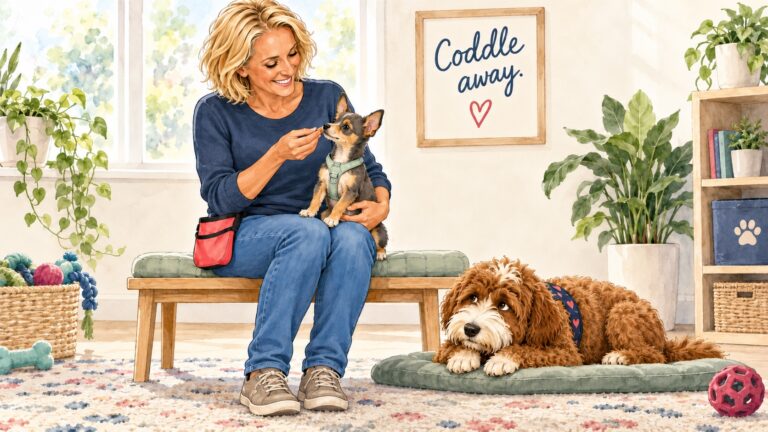
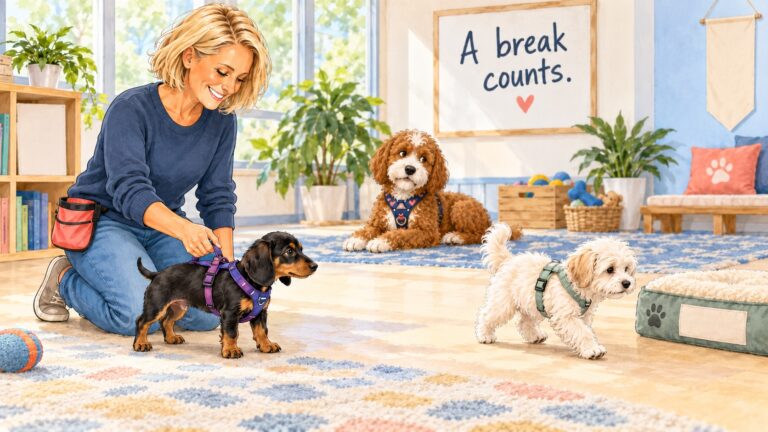
And the leader in our room does what the mother does. When it gets too loud for a puppy, the person doesn’t stand her ground and project energy. She gets silly, turns, and goes — and takes him with her. Reading the room and moving is leadership. Standing in the doorway is furniture.
The human. Three parents. One would pin you. One would let you. One would hold the line and still be the person you ran to. You already know which one you’d follow into the next room if nobody made you.
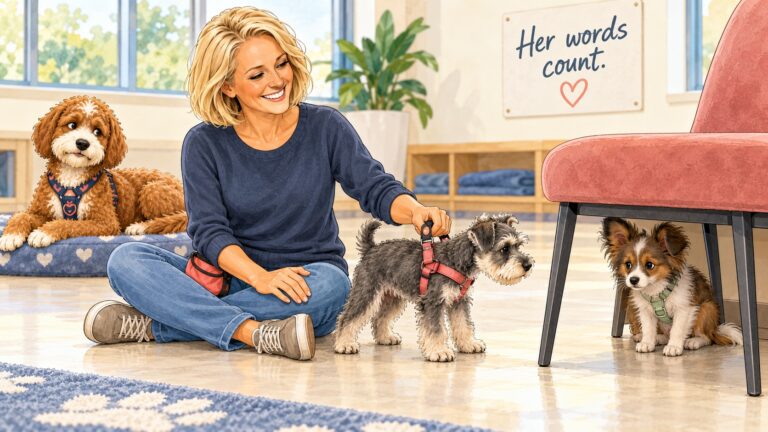
And the trainer who answered the man — we don’t do that here, ever, and I’ll tell you why — was being the third one, in front of the whole class. A rule and a reason. He got his answer about leadership by getting led.
The prediction
You’re going to hear it. At a barbecue, from a vet tech, from a rerun: he needs a leader. And they’re going to be right. They’re just going to describe the wrong job.
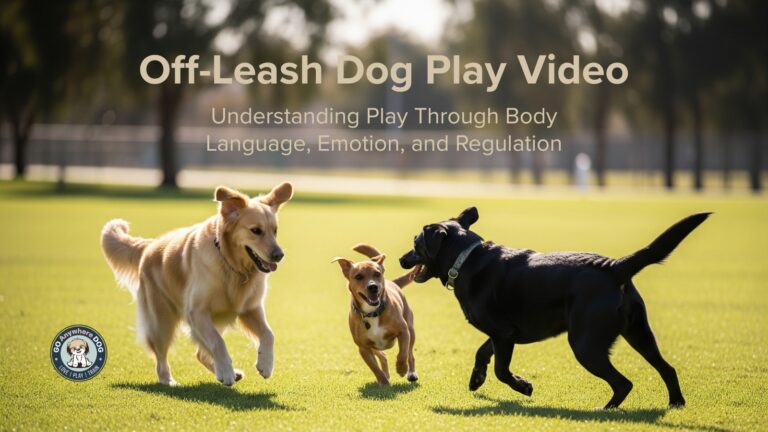
You’re also going to see a video of a mother dog "correcting" a puppy, captioned natural. Here’s what you’re watching: a mother with no door. A mother with skills moves away; a mother who can’t escalates. Not all mothers are good mothers, in any species, and a dog mom never got the memo because there was no memo to get. The test is the puppy’s next move. Does he come back?
So here’s the test for you, and it’s the same one:
Does he look at you when he’s unsure — or when he’s afraid of you? Does he come toward you, or brace? Would he follow you into the next room if there were no leash?
We’re keeping the word. Leader — the real kind. Not the one he submits to. The one he’d choose.
The man who asked about the pin wanted a puppy who could settle, and he was right to want it. He just needed a better manual than the one with the podium. So here’s the question we’d hand him, and you: three ways to raise a being that depends on you. The research already picked. What type of leader do you want to show up as?
Next week: the word the other side banned. Naughty.
— Jody & your Dog Life Coaches
The stance behind the series: The Go Anywhere Dog® Manifesto. The machinery: Our Methodology. Earlier in the series: Taking Back the Words: Calm.
Want to practice this kind of leading with your own dog? Puppy classes in Eden Prairie, or in-home training across Minneapolis and nearby suburbs.
Sources
- Schenkel, R. "Ausdrucks-Studien an Wölfen: Gefangenschafts-Beobachtungen." Behaviour, 1(1), 81–129 (1948). Observations at the Basel Zoo, 1934–1942.
- Baumrind, D. "Effects of authoritative parental control on child behavior." Child Development, 37(4), 887–907 (1966). Baumrind, D. "Child care practices anteceding three patterns of preschool behavior." Genetic Psychology Monographs, 75(1), 43–88 (1967).
- Mech, L. D. The Wolf: The Ecology and Behavior of an Endangered Species. Natural History Press, 1970; in print until 2022. Mech’s own statement on the book’s printing history: davemech.org.
- Monks of New Skete. How to Be Your Dog’s Best Friend. Little, Brown, 1978; revised 2nd ed., 2002 (the alpha roll removed).
- Mech, L. D. "Alpha status, dominance, and division of labor in wolf packs." Canadian Journal of Zoology, 77(8), 1196–1203 (1999). Mech, L. D. "Whatever happened to the term alpha wolf?" International Wolf, Winter 2008.
- Dog Whisperer with Cesar Millan. National Geographic Channel, 2004–2012.
- Brubaker, L. & Udell, M. A. R. "Does pet parenting style predict the social and problem-solving behavior of pet dogs (Canis lupus familiaris)?" Animal Cognition, 26(1), 345–356 (2023).
- Sorce, J. F., Emde, R. N., Campos, J. J. & Klinnert, M. D. "Maternal emotional signaling: Its effect on the visual cliff behavior of 1-year-olds." Developmental Psychology, 21(1), 195–200 (1985).
- Bowlby, J. A Secure Base: Parent–Child Attachment and Healthy Human Development. Basic Books, 1988.
- Herrnstein, R. J. "Relative and absolute strength of response as a function of frequency of reinforcement." Journal of the Experimental Analysis of Behavior, 4(3), 267–272 (1961).