Our dog training methodology builds emotional safety, regulation and real-life skills together. Safety is the foundation we keep protecting as skills grow. This is Boundaries Without Trauma®.
At Go Anywhere Dog® in Eden Prairie, we teach Twin Cities families through reward-based practice, trainer-guided off-leash play and clear boundaries without pain or fear.
Fifteen years of teaching real dogs in real rooms produced a method — registered, refined, and running in every class we teach: Boundaries Without Trauma®. It's built on behavior science, developmental reality, and one governing principle: Regulation before obedience. Always.
And regulation is not one approved state. We don't pick a feeling and label it "good dog" — the excitement of play isn't just allowed in our classes, it's required. Big feelings are inevitable in a young dog; families here learn to help their puppy navigate all of them. Calm is one skill in that range — the hardest one, and the one nobody's born with. You cannot cue a dog into calm. You build it, rep by rep, until the whole trip — up, down, and okay at every stop — is just who he is.
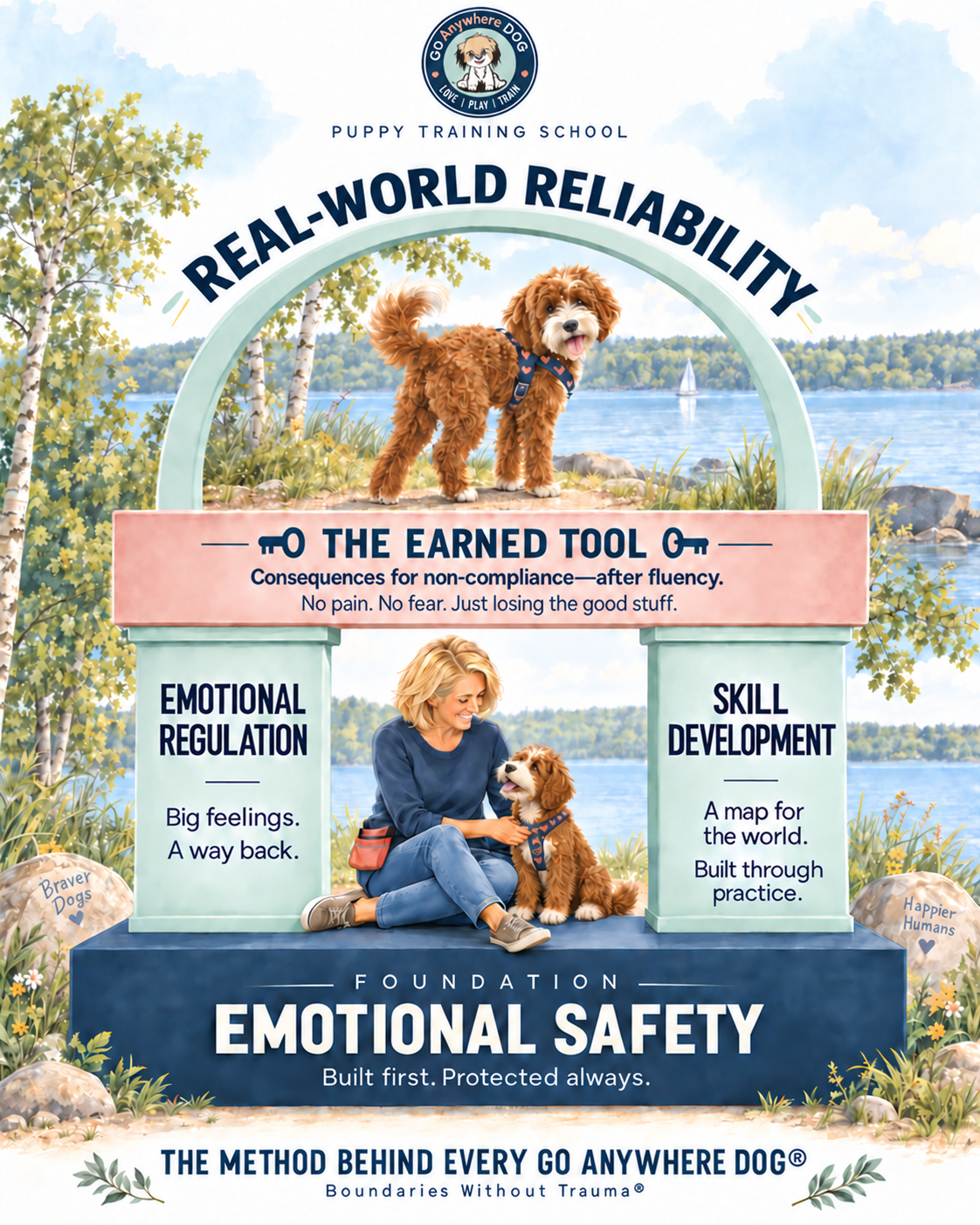
The method has a shape: a foundation, two ongoing pillars, an earned tool and the real-world skills they support.
Early experiences help lay the maps a puppy brings into the next encounter. In class, we orchestrate those repetitions: excitement, a little conflict, a pause, a skill, another chance. We adjust the pairing, intensity and human response as it unfolds. Homework extends that learning; it cannot recreate everything we can coach in the room.
We cannot prevent every bad experience. Nobody gets to live in a bubble. We teach people how to provide safety, support and connection when life gets difficult, so their dog can recover and try again. That supported recovery is part of building resilience.
We cannot make life trouble-free. We can help them find their way through it.
Boundaries Without Trauma® is the Go Anywhere Dog® training method: emotional safety is the foundation we protect throughout; emotional regulation and skill development are its two ongoing pillars. Consequences are already teaching. Our deliberate loss-of-access response to a missed cue comes after relevant fluency. The goal is real-world reliability.
The foundation
Emotional safety.
Built first. Protected always.
Learning continues during upset. What the learner can manage—and the support we provide—can change.
Nothing in our room is designed to run on fear. Not for him, and not for you. That is the load-bearing part. A puppy braced for trouble is still learning what predicts trouble; a person braced for judgment is learning about us, too. We make the next useful response easier to practice while protecting safety.
FOR HIM
“Is he upset?” comes first.
A growl is information, not defiance. Fear is a state, not a character flaw. The first question we ask about any behavior — before any tool — is is he upset?, because the answer changes everything that follows.
FOR YOU
Small stakes. Real reps. No shame.
A stressed, embarrassed human has a harder time using what they know, just as an upset dog can. Both are still learning. So we teach people the same way we teach puppies: small stakes, real reps, no shame, plenty of jokes. If we occasionally inform you that your treats suck, it is said with love. You will laugh, and then you will get better treats. That is the whole system working as designed.
AND WHEN IT GETS TESTEDThat week-four-or-five wobble? We tell you it’s coming.+
Around week four or five, many families notice a shift: the new-environment caution wears off and the puppy gets bigger and bolder. The dog is not broken. Development, practice and the new payoffs available all matter. We prepare you for the wobble so you have useful choices when it comes.
Built from the beginning. Protected as the learner grows.
Pillar one
Big feelings. A way back.
Emotional regulation
Every class runs it, every transition, on purpose: snacks out → connect → attune → help them come down.
Coming out of play is hard for little ones — hearts racing, adrenaline high. Our job is to help them land. It looks like management. It's actually the single most repeated regulation rep in the entire program: dozens of chances per class for a young dog to practice the skill that matters most — going from up to down and being okay there.
You'll feel it the first time your puppy starts doing it on his own. It's puppy-life changing. Everything gets a little easier after that.
Every transition. On purpose.
01Snacks out.
02Connect.
03Attune.
04Help them come down.
The Settle
We practice the descent with real excitement in the room: play, big feelings, a pause, connection and a way back. This is part of the teaching. We adjust the intensity so the learner can practice the transition with support.
Pillar two · Skill development
A map for the world. Built through practice.
Play time isn’t a break. It is class.
01
Off leash, on purpose.
Play is a puppy's language, and our classes are built so he gets to speak it. Off-leash play in rooms split by size and play style, with trainers reading it live — because socialization is not proximity to other dogs. It's successful communication with other dogs, and that can't happen six feet apart on a tight leash. Play time isn't a break from class. It is class. Body language, consent, "too much," recovery — taught from whatever is unfolding in front of the room, because the best curriculum in the world can't compete with the thing your puppy is actually doing right now.
02
Build first, name later.
Your dog learns the behavior first — owns it, reliably — and only then does it get a word. Naming something a dog can't do yet isn't training; it's nagging with extra steps. So early on, we capture and reward what's already happening. Later, we attach the name to a behavior that already exists. By the time you say it, he can do it — which is why our cues work instead of becoming background noise he's learned to ignore.
03
Reps on purpose, lenses that change.
Yes, we run the same core exercises every week. Reps are the point — that's how nervous systems learn, not through novelty. What changes is the lens: each session, we ask you to watch something different. Your energy. Your timing. The distance. And in the final week, the payoff — you count the seconds on your own dog's recall and compare it to week one. You don't take our word that he got faster. You see it, with your own count, on your own dog.
04
In the order his brain can hold it.
The curriculum maps a progression: first build the game, then practice useful responses at home, then expand distractions, distance and duration through Life Skills 201, 301 and Outings. We adjust the next step to the learner in front of us. There is a map on our classroom wall for exactly that.
From first snack to real life
Puppy & Me
Life Skills 101
Life Skills 201
Life Skills 301
Outings ↗
Nobody skips a floor.
One tool. Earned.
Missed-cue feedback. After fluency.
No pain. No fear. Just losing the good stuff.
We build and maintain the wanted response with reinforcement. Out in the world, the counter pays, the squirrel pays, the other dog pays too. We teach for that competition, arrange access thoughtfully and use clear, humane limits. Consequences are happening whether we planned them or not.
Something the dog wanted leaves: the game, the opportunity, access to play. We do not add pain, fear or intimidation. For a missed cue, the tool waits for fluency: the dog responds to the hand signal or word among the relevant distractions, at the distance and duration life requires. We also consider what the dog can manage right now. Confusion needs teaching. Distress needs support. Protection and appropriate social boundaries begin from the start.
↔
The rule that holds it together
A time-out can protect the room, stop rough play and give both ends of the leash a breather. The parent joins when their presence can comfort. Sometimes the adult is upset too, and space helps them both. We read the dog, the human and everyone sharing the room, then arrange the next workable attempt. Safety and connection guide the decision; proximity depends on what helps.
The result · Real-world reliability
The proof is out there.
The patio.The hardware store.The dog park.Thanksgiving at grandma’s.
Reliability needs practice where life happens: at the vet, at the lake, at eighteen months and at three years. Development changes the learner; new places change the demands. We keep building the skill and the ability to recover alongside it.
The proof was never a test in a hallway. It's the patio, the hardware store, the dog park, Thanksgiving at grandma's — the places our program actually ends, on purpose, because that's where reliability either exists or doesn't.
We didn't choose this method because it's gentle — though it is. We use it because it's what holds.
And the quietest proof of all: the phone calls we don’t get about our grads at twenty months.
Start here
Start where your dog is.
Start where your dog is. The path is mapped and grounded in how learning works. We help you build the skills, recovery and connection that make more of real life workable together.