Taking Back the Words is our series on vocabulary the dog training industry broke — and why we refuse to stop using it. Some trainers throw out a word once it’s been corrupted. We’d rather take back the truth of it. Through mechanism, with a dash of humor and love.
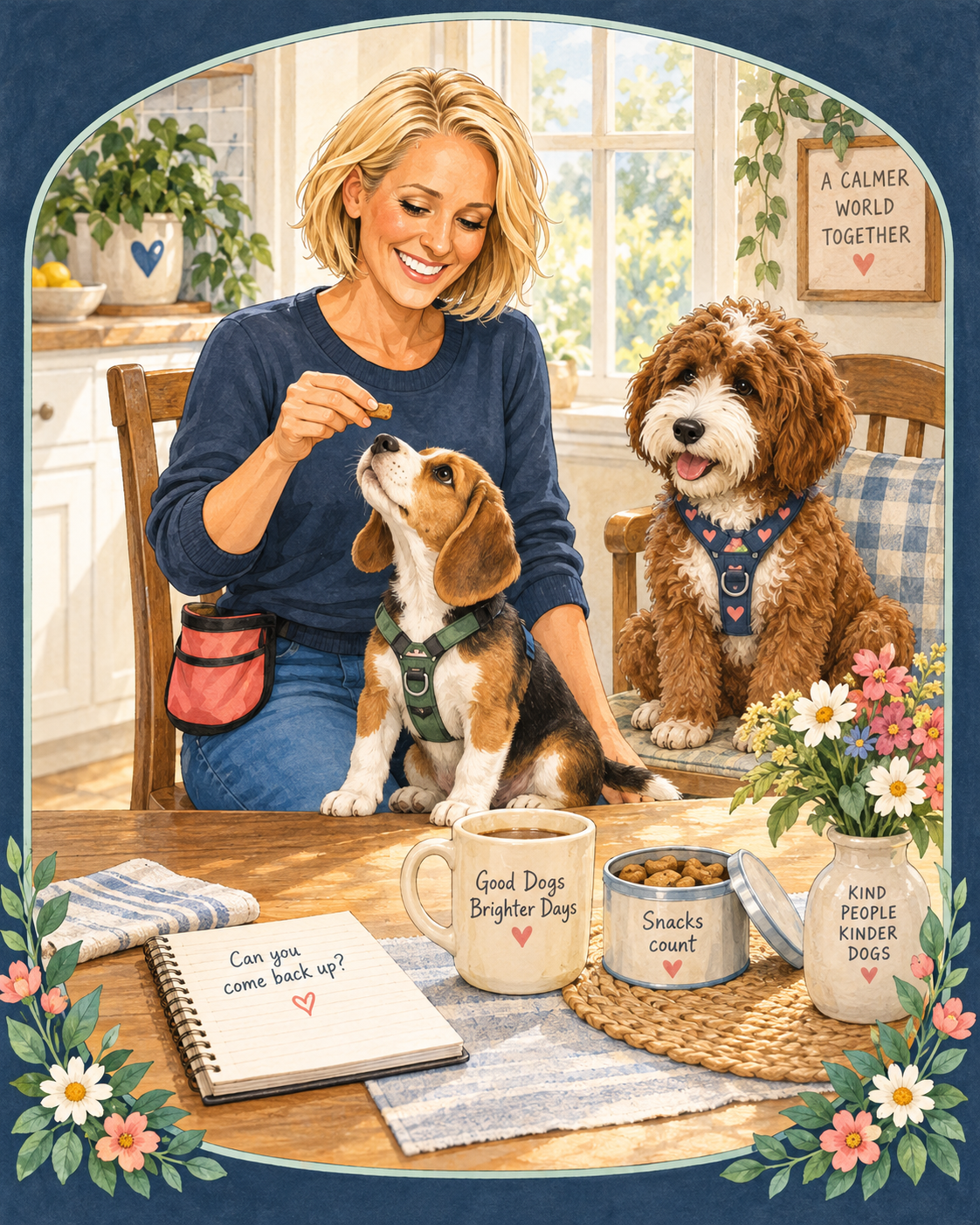
The kitchen table
It’s 11pm. The puppy is finally asleep on your foot, and you’ve got two tabs open.
One tab is a man with a very good camera and a very calm voice, and a dog lying flat on a raised board. There’s a vest. There’s a collar with a little box on it. The caption says calm. The other tab is a woman in a fleece explaining that the man is the problem, and her dog is calm too, and hers is the real kind.
They’re both confident. They’re both filmed well. Each one says the other is the reason your dog is a mess. And you’re going to go with whichever one sold it better — not because you’re gullible. Because you’re tired, and they’re the ones who showed up.
We used to tell people not to Google. That loses to the tab every time.
So instead, here’s what you’re looking at.
The people who saw it first
Nobody in dog training discovered this. It’s been on the record for a hundred years — mostly in rooms with no dogs in them.
Leningrad, September 1924. A flood reached Ivan Pavlov’s kennels in the middle of a storm. The dogs had to be made to swim, in groups, a quarter mile to the laboratory, where they were kept huddled together on the first floor — and Pavlov noticed that not one of them fought, which for dogs packed together was unheard of. Some went back to work unbothered. Three did not. One was restless and wouldn’t settle on the stand. One went lethargic. One would freeze at the smallest change in the room, or fall asleep over its plate. What the three had in common: they would not eat. A dog that had worked for the buzzer for years turned its head away from the food dish and kept it turned for three days. Its reflexes came back only when the experimenter stayed in the room with it — and vanished again the moment he left. Two months to recover. Eight, for the second dog. The third never did. Pavlov did not write any of this down as rest. He called it inhibition — and he called the stillness a reflex of passive self-defence: the animal going motionless so the enemy won’t notice it.
A foundling home, 1945. René Spitz studied infants who were fed, clean, and left alone in their cribs. Over the months, they stopped crying, and stopped reaching. Quiet babies are easy to read as content babies. Spitz gave the condition a name — hospitalism — and in his follow-up a year later, counted the ones who didn’t survive it.
A hospital ward, 1952. James Robertson filmed a two-year-old whose parents were allowed only short visits. First she protested. Then she despaired. Then she went quiet and held herself together — quiet enough, Robertson wrote, "to seem settled to busy ward staff." When her mother came, she didn’t reach for her. Robertson and Bowlby named the three phases — protest, despair, and the one they’d come to call detachment — and pointed out that hospitals had been reading the third one as a success for as long as there had been hospitals.
Harvard, 1953. B. F. Skinner, the man who mapped how consequences shape behavior, spent a chapter on punishment — and here’s where it pays to be precise, because that word covers two very different things and he studied one of them. Working from rats and shock, he found that delivered pain doesn’t remove a behavior. It suppresses it. The behavior comes back when the threat leaves, and it brings emotional side effects with it. Pain, in other words, buys quiet on credit. Taking something away — the toy, the attention, the shot at the treat — is a different animal entirely, and the industry has spent decades confusing the two. We’ll take that word back properly in its own post.
Wisconsin, the 1960s. Harry Harlow’s monkeys raised in total isolation — hunched, rocking, silent. From across the lab, not a sound. Nobody who walked up close called it calm. Years later Harlow and Stephen Suomi brought some of them back — not with training. With a younger monkey who would sit with them and cling.
Pennsylvania, 1967. Martin Seligman and Steven Maier gave dogs shocks they couldn’t escape. Later, when escape was easy — one hop over a low barrier — those dogs didn’t try. They lay down and took it. From the doorway, the stillest dogs in the building.
And the modern name for the state — the one Pavlov called passive self-defence in 1927 — from Stephen Porges and Deb Dana: immobilization. Dorsal shutdown. Not the body’s resting place. The body’s last resort.
Seven witnesses, a hundred years, four species. Every one of them looked calm from a distance.
What the science says
We’ll keep this short and let the researchers do the talking.
Skinner in 1953, and then Nathan Azrin and Werner Holz in 1966 when they reviewed a decade of shock studies, catalogued what delivered aversives produce: the suppression is temporary and depends on the punisher being around, and it comes with escape, avoidance, aggression — and a suppression that spreads. The animal stops doing more than the one thing you hurt him for. The quiet generalizes.
One thing that list is not about: consequences. Nobody has ever been immobilized by a parking ticket. Losing the treat, losing the game, losing your person’s attention for ten seconds — that’s information, and a dog who has a better option available takes the information and moves. The shutdown route runs on pain and fear with no way out. Hold onto that distinction; it gets its own post in this series: Taking Back the Words: Punishment (coming October 23).
Maier and Seligman, going back to their own dogs fifty years later with modern neuroscience: passivity under the inescapable turns out to be the brain’s default, not something the dogs learned. What gets learned is control — the brain detecting that a response actually does something. A still animal with no available response isn’t regulated. It’s out of options.
Robert Yerkes and John Dodson, 1908, mice: for anything hard to learn, there’s a middle band of pressure where learning happens. Push past it and nothing sticks. Drop below it and nothing sticks either. Flat is not the target. It never was.
And notice how the ones who came back came back. Pavlov’s dog, when the experimenter stayed in the room. Harlow’s monkeys, when a smaller one sat with them. Not a command. A body that stayed.
Our one line, and you can keep it: calm is learned, not innate — and a dog who can’t come back up wasn’t calm. He was gone.
Two rooms, same mechanism
The dog. Go back to that photo on the board. Look at the body under the caption: low, tucked, eyes soft in the way that isn’t soft. That posture is being sold as the result. It’s the injury.
Now the phone call we get more than any other. The dog is twenty months old. "He knows better." He got obedience early and regulation never, and the invoice arrived the week his brain finished building. Adolescence doesn’t cause that. It collects.
Now our room. Every transition, every class — snacks out, connect, attune, help him land. And here’s the tell we’ve watched for fifteen years: he eats. Coming down from real play, heart still pounding, he’ll take the snack. A shut-down dog won’t. His mouth is closed because his whole system is. We didn’t invent that test. Pavlov’s flood dog turned its head from the dish in 1924.
And the puppy who growls at the tunnel? He’s giving you information. He’s still in the building. We’d take him over the quiet one every day of the week.
Play excitement isn’t tolerated in our classes. It’s enforced. Up, down, and okay at every stop — because you cannot teach the way down to a dog who was never allowed up.
The human. The toddler charted as settled in. The employee who never complains. The client who tells us, glowing, he’s so good now — about a dog who has stopped doing anything at all.
The prediction
Here’s what we’d rather do than argue.
You are going to see a video of a dog lying perfectly still next to a confident person. It will be well made. It will feel like authority.
Pavlov’s flood dogs wouldn’t eat. The hospital toddler was settled in. Seligman’s dog lay down. None of them were calm.
So take this test home and run it on any video, any trainer, any photo — including ours:
Can he eat? Can he come back up? Does he move toward, or does he only stop?
A dog who passes is calm. A dog who doesn’t has gone somewhere, and quiet was the price of the ticket.
We’re keeping the word. Calm — the real kind. Built, not suppressed. Learned, snack by snack, by a dog whose tail still works.
One question to take with you: when your dog goes quiet, what did it cost him — and who’s holding the receipt?
— Jody & your Dog Life Coaches
The stance behind the series: The Go Anywhere Dog® Manifesto. The machinery: Our Methodology.
Want to build the real kind of calm with your own dog? Puppy classes in Eden Prairie, or in-home training across Minneapolis and nearby suburbs.
Sources
- Pavlov, I. P. Conditioned Reflexes: An Investigation of the Physiological Activity of the Cerebral Cortex (trans. G. V. Anrep). Oxford University Press, 1927 — Lecture XVIII, pp. 313–319: the flood of 23 September 1924 (Petrograd in Pavlov’s text), the three affected dogs, refusal of food, recovery with the experimenter present; p. 312 for inhibition by strong stimuli as a reflex of "passive self-defence." Lecture XVII for the inhibitable type.
- Spitz, R. A. "Hospitalism: An inquiry into the genesis of psychiatric conditions in early childhood." The Psychoanalytic Study of the Child, 1, 53–74 (1945). Spitz, R. A. "Hospitalism: A follow-up report." The Psychoanalytic Study of the Child, 2, 113–117 (1946) — the mortality count.
- Robertson, J. A Two-Year-Old Goes to Hospital (film). Tavistock Institute, 1952. Bowlby, J. & Robertson, J. "A two-year-old goes to hospital: A scientific film." Proceedings of the Royal Society of Medicine, 46, 425–427 (1953) — Robertson’s own account of the film, including the "settled" line. Robertson, J. & Bowlby, J. "Responses of young children to separation from their mothers." Courrier du Centre International de l’Enfance, II(3), 131–142 (1952). Bowlby, J. Attachment and Loss, Vol. 2: Separation. Basic Books, 1973.
- Skinner, B. F. Science and Human Behavior. Macmillan, 1953 — ch. 12, "Punishment." (Defines punishment as either presenting an aversive or withdrawing a reinforcer; the chapter’s evidence is aversive-stimulation work.) Estes, W. K. "An experimental study of punishment." Psychological Monographs, 57(3), Whole No. 263 (1944) — the rat-and-shock studies the chapter rests on.
- Azrin, N. H. & Holz, W. C. "Punishment." In W. K. Honig (Ed.), Operant Behavior: Areas of Research and Application, 380–447. Appleton-Century-Crofts, 1966.
- Harlow, H. F., Dodsworth, R. O. & Harlow, M. K. "Total social isolation in monkeys." Proceedings of the National Academy of Sciences, 54(1), 90–97 (1965). Harlow, H. F. & Suomi, S. J. "Social recovery by isolation-reared monkeys." PNAS, 68(7), 1534–1538 (1971) — six-month isolates paired with three-month-old normal monkeys "achieved essentially complete social recovery."
- Seligman, M. E. P. & Maier, S. F. "Failure to escape traumatic shock." Journal of Experimental Psychology, 74(1), 1–9 (1967). Maier, S. F. & Seligman, M. E. P. "Learned helplessness at fifty: Insights from neuroscience." Psychological Review, 123(4), 349–367 (2016).
- Yerkes, R. M. & Dodson, J. D. "The relation of strength of stimulus to rapidity of habit-formation." Journal of Comparative Neurology and Psychology, 18(5), 459–482 (1908). The inverted U appeared only for the difficult discrimination; the "arousal" reading is a later gloss (Broadhurst 1957; Diamond et al. 2007).
- Porges, S. W. The Polyvagal Theory: Neurophysiological Foundations of Emotions, Attachment, Communication, and Self-Regulation. W. W. Norton, 2011. Dana, D. The Polyvagal Theory in Therapy: Engaging the Rhythm of Regulation. W. W. Norton, 2018.