Skip to the article

Puppy development · Video lesson

New Puppy? Your First Step for Success (It’s Not Training Yet)

Set up everyday life so your puppy has more chances to get it right.

In This Video

Is your puppymoon over? Before you train, set your new puppy or dog up for success. This video explains why dogs do what works for dogs, and why management is the first step: puppy-proof like new parents baby-proof, keep the no-no items out of reach, create a safe space, and give plenty of legal chew and work-to-eat toys. It also covers what to do if unwanted habits are already in place.

Key Moments

  • 0:00 — Is your puppymoon over?
  • 0:30 — Everything is new for your new dog
  • 0:55 — Dogs do what works for dogs: shoes and jumping
  • 1:37 — Puppy-proof like new parents baby-proof
  • 2:07 — Four steps to set up your home
  • 3:09 — Decide ahead what you can and can't live with
  • 3:20 — Already stuck with habits? You can begin today
Full Transcript

Now it's time for the DogSense recipe for success. Is your puppymoon over? Maybe it was one too many puddles, or a favorite shoe chewed beyond recognition. Maybe it was the muddy paw prints on your clean blue jeans just as you were walking out the door. If your furry new bundle of love and affection is becoming a constant source of frustration, it might be time to step back and figure out how to better manage the latest addition to your family.

Whether the new canine sharing your home is a puppy or a mature dog, your early days together are loaded with exciting firsts. Everything is new: new people, new home, new smells. Where's the food? Where's my bed? Where can I play? Where are the toys? How can I make it all mine?

Remember, dogs do what works for dogs. If your shoes turn out to be the best thing around for chewing, what will your dog crave? More shoes. When jumping on you gets him attention, laughs and fun, you can bet your dog will jump up again and again and again. Unless you take the time to teach your dog that sitting nicely is what gets attention, and that toys are what's for chewing, how will your dog ever know?

New parents spend lots of time baby-proofing their home. Outlets are covered, safety latches and baby gates are installed, playpens are assembled, and small hazards and sharp objects are placed safely out of reach. Lots of preventative preparation goes into keeping a baby safe until baby is a child old enough to keep himself safe. Yes, that same sort of preparation will make life with your new puppy or dog much easier on you, and your furniture, and your shoes, and your rugs.

Your canine needs a lot of time and repetition to learn the dos and don'ts too. Until they've had the training and time to learn, keep doggy safe and eliminate the opportunities that get her into trouble. One: no-no items you don't want chewed must be placed out of reach, every time. Two: set up a doggy-safe space that has been pup-proofed from top to bottom, where your new friend can hang out without getting into mischief. Three: when you can't keep your eyes on your pup, put him in that safe space. Four: make sure your pet has plenty of toys, a comfy bed and work-to-eat puzzle toys.

Get your dog hooked on the right things by keeping dog-legal chew toys within paw's reach while completely restricting access to the no-no items. They need to chew; that's what dogs do. Solid planning and preparation can extend that blissful puppymoon phase with your new pal.

Be mindful of what you can and cannot live with ahead of time. If it's a behavior you can't live with, your dog needs to know what she can do instead. Are those early days long gone? Are you stuck with unwanted behaviors? That's okay. You can begin today. If your dog has practiced lots of no-nos, it'll probably take a little more time, but with some effort, retraining is absolutely doable. Our goal is to help you get to where the time spent with your dog is all quality time, so the puppymoon lasts a lifetime.
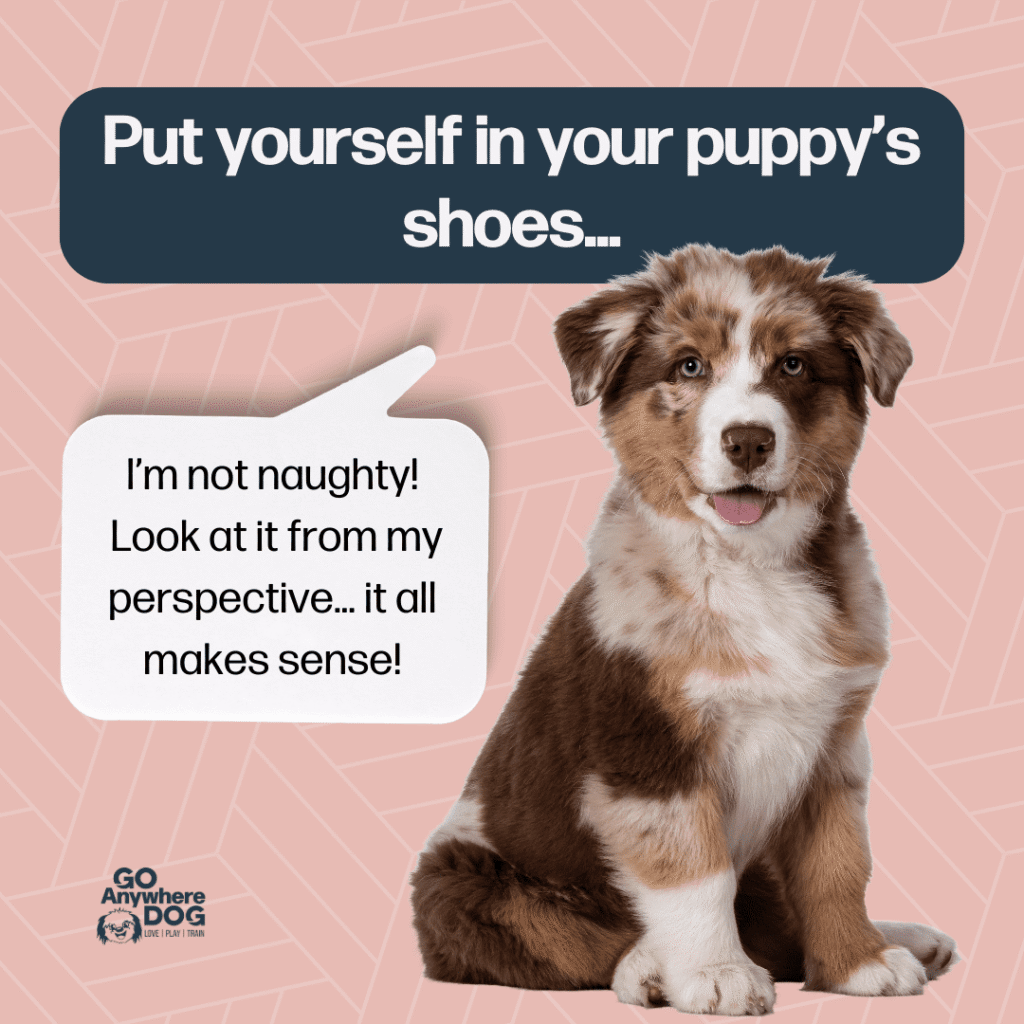

Most people think training starts with cues like sit, down, or come. But for a new puppy, the very first step toward success happens before any formal training begins.

In this video, I explain why thoughtful puppy-proofing and environment setup shape behavior from day one — and how skipping this step creates problems no amount of training can fix later.

New Puppy – Go Anywhere Dog®, Minneapolis & Twin Cities, MN, Puppy Training

New Puppy? Your First Step for Success

When a new puppy comes home, most people focus on what to teach.

Sit.
Crate.
Potty training.
Leash walking.

But the most powerful influence on a puppy’s behavior isn’t a cue — it’s the environment.

Before a puppy understands language, rules, or expectations, they are already learning. Every step they take, every object they reach, every reaction they get is shaping habits in real time.
That’s why the first step for success isn’t training.
It’s setup.

Puppies Learn From What Works — Not What We Intend

Puppies are incredible learners, but they’re not moral creatures. They don’t know what’s “allowed” or “wrong.” They simply repeat what works.

If chewing the table leg feels good → chewing continues.
If stealing a sock turns into a game → sock stealing escalates.
If roaming the house leads to accidents → house training stalls.

None of this is disobedience.
It’s reinforcement by access.

When environments aren’t intentionally designed, puppies practice the very behaviors people later try to train out of them.

Puppy-Proofing Isn’t About Control — It’s About Clarity

True puppy-proofing isn’t about locking everything down or hovering nonstop.

It’s about creating clarity.

A well-set-up environment tells a puppy:

  • what they can interact with

  • where they can succeed

  • how to make good choices without pressure

This reduces frustration for both the puppy and the human — and it allows learning to happen without constant correction.

Why Training Can’t Fix a Bad Setup

Here’s the hard truth:

If a puppy has unlimited access to temptation, training is fighting gravity.

You can teach “leave it,” but if shoes are everywhere, the puppy will still rehearse chewing.
You can work on potty training, but if supervision is inconsistent, accidents become part of the routine.
You can reward calm behavior, but if the environment is chaotic, calm isn’t accessible.

Training works best when the environment supports it.

Small Boundaries Early Prevent Big Problems Later

One of the biggest myths in puppy raising is that boundaries should wait.

In reality, early boundaries prevent confusion, not freedom.

Using play pens, gates, tethers, and thoughtfully chosen spaces helps puppies:

  • regulate their arousal

  • avoid overstimulation

  • practice rest

  • build confidence through success

Boundaries aren’t punishment.
They’re structure — and structure creates safety.

Setup Is Training (Even If It Doesn’t Look Like It)

Every moment a puppy spends in your home is a learning moment.

When the environment is designed intentionally:

  • good behavior is easy

  • mistakes are limited

  • learning happens naturally

That’s why puppy-proofing isn’t a side task.
It’s the foundation everything else is built on.

Get the setup right, and training becomes smoother, faster, and far more humane.

Skip it, and you’ll spend months trying to undo habits that never needed to form.

The Takeaway

If you’re bringing home a new puppy — or struggling with one already — start here:

Before cues.
Before corrections.
Before expectations.

Design the environment so your puppy can succeed.

That is the first step for success. Our Ultimate Puppy Training Package walks you through that setup step by step.

Until next time, have fun and enjoy your dog.
— Jody & your Dog Life Coaches

Jody Karow holding Vanna

The person behind the post

Jody Karow, CTC

Dog trainer, writer, and founder of Go Anywhere Dog®. Working professionally with dogs since 2004, and helping people understand the dog in front of them.

Meet Jody & explore more articles

Bring the learning home

You can have a person beside you.

Off-leash classes in Eden Prairie. Private puppy training and behavior help in Minneapolis and nearby suburbs. Jeannie can help you find your next step.

Talk with Jeannie