Taking Back the Words is our series on vocabulary the dog training industry broke — and why we refuse to stop using it. Some trainers throw out a word once it’s been corrupted. We’d rather take back the truth of it. Through mechanism, with a dash of humor and love.
The poster
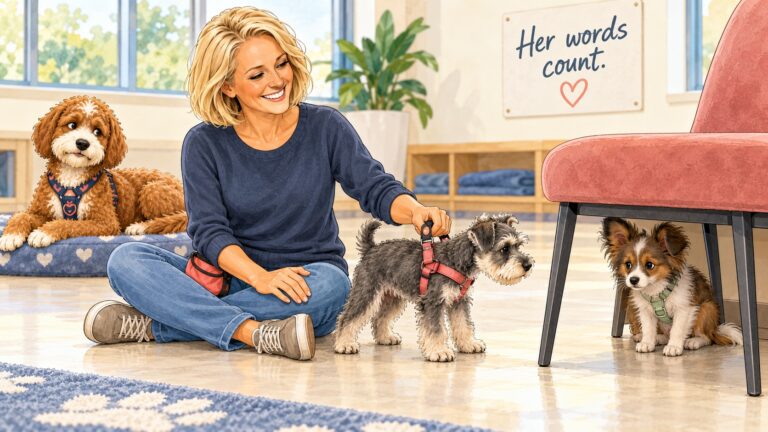
Week one of Puppy & Me. Twelve puppies, one hour, and about forty minutes in, a hand goes up.
"When will he just listen?"
And from the other side of the room, before the first answer has landed: "And when can we stop the treats?"
Every series. Weeks one through five. It’s the most common thing a new family asks us, and here’s what they get: "It’s coming." And a finger pointed at the poster on the wall — touch, spin, twirl, sit, down, leave-it, stay, peekaboo, by my side. "You’ll learn everything on that poster in 101. Except by my side — that’s week one of 201. First the foundation. It’s what makes all of that easy."
Most of the room looks reassured. Sometimes we get a very quiet snort.
And here’s the part worth holding onto: by their second class series, nobody’s asking. Not because we talked them out of it. Because the thing arrived, on schedule, and they watched it come.
A few ask a different version — when do we teach commands? That word tells us a lot about the person holding the leash, none of it bad. It gets its own post.
So yes: the "sit is overrated" people are writing a defense of obedience. Stay with us.
The people who saw it first
Obedience got corrupted from two directions at once, which is impressive even by dog-training standards. One side turned it into compliance — a dog who obeys because the alternative is unpleasant. The other side smelled the compliance and backed away from the word entirely, as if teaching a dog what a word means had become suspect. Both sides are reacting to the same corruption. Neither is describing the real thing. The real thing has a paper trail.
Columbia, 1898. Edward Thorndike put hungry cats in boxes with a latch and a dish of fish outside. The cat clawed, bit, squeezed, and eventually — by accident — hit the latch. Next trial, a little faster. Twenty trials in, straight to the latch. Nobody commanded the cat. Thorndike called it the law of effect: a behavior followed by something satisfying gets stamped in, and the useless moves fall away. Every "sit" your dog has ever done runs on that sentence.
Westchester County, 1936. Helen Whitehouse Walker, a poodle breeder tired of hearing that her dogs were only pretty, staged formal obedience tests to prove otherwise, and the American Kennel Club adopted her rules. Obedience became a sport: a ring, a judge, a score, and no food in the ring. The word got a scoreboard that year, and it has never quite gotten it back.
Harvard, 1957. Charles Ferster and B. F. Skinner spent seven hundred pages on one question — how often do you have to pay? — and found that the behavior that lasts longest is the one paid sometimes, unpredictably. Pay every time and then stop, and the behavior is gone in minutes. Pay now and then, stop, and it goes on for ages. Which is the answer to the second hand in the room, and we’ll get to it.
Hot Springs, Arkansas, 1961. Keller and Marian Breland — Skinner’s first graduate students, who went on to train thousands of animals for shows and advertisers — wrote up the ones that wouldn’t cooperate. A raccoon trained to drop coins in a bank couldn’t stop rubbing them together instead. A pig trained to carry a wooden coin kept dropping it to root at it. The trained behavior drifted, every time, back toward what the species was built to do. They called it instinctive drift, and they published it as a confession. The company they ran was the one Bob Bailey later ran — the man from the Punishment post, and the box.
Hollywood, 1962. William Koehler, head trainer for the Disney studios, published the method that sold obedience to a generation: the long line, the throw chain, the correction that arrives the instant the dog fails. It is still in print. It works, in the sense that dogs stop doing things. We spent the first post in this series on what that stillness actually is.
Precision teaching, 1996. Carl Binder, reviewing thirty years of Ogden Lindsley’s work, put a definition on the table that the dog world still hasn’t caught up with. A behavior isn’t learned when it’s correct. It’s learned when it’s correct and fast — without thinking — and only then does it do the three things you actually want: it stays after practice stops, it holds up when the person is tired or distracted, and it travels to places it was never practiced. Retention, endurance, application. That’s fluency. Everything before it is a party trick.
Nottingham, 2020. Lucy Asher and colleagues followed guide-dog puppies through puberty and measured the thing every dog parent has felt: at eight months, the same dogs who came when called at five months took longer, or didn’t — with their own carer, specifically, and more so in the dogs whose attachment to that carer was less secure. Their carers rated them less trainable at eight months than at five, and more trainable again at twelve. Adolescence, with a paper, and it came back.
Tucson, 2020. Emily Bray and colleagues tested puppies on the same tasks from eight weeks to two years and watched the skill that holds a dog still — inhibitory control — keep building across the whole span. The brakes are the last part of the car to arrive.
Eight witnesses. The cat was never commanded. The sport banned the food. The pig went back to being a pig. And the puppies flipped their carers the paw at eight months, on schedule.
What the science says
Two lines of plain mechanism, then we’ll let them talk.
Obedience is a reinforcement history with a word on top. And the word isn’t a label — it’s a prediction. "Sit" means sitting pays here. That’s why we build the behavior before we name it: your dog does the thing, owns the thing, gets paid for the thing, and only then does the thing get a word. Name it before he owns it and you’re teaching him that your words are background noise.
Binder’s fluency is our definition of trained, and we’d rather say it out loud than let a certificate imply it: hand signal or word, among distractions, at a relevant distance, for a relevant duration. Until then it’s a party trick — and we love a party trick. "Sit" at ten weeks is adorable. We just don’t bill it as obedience.
Ferster and Skinner answer the second hand. When can we stop the treats? You don’t stop paying. You stop paying every time — a different sentence. The world runs an intermittent schedule too: the counter pays in chicken now and then, the squirrel pays in chase now and then, and that lottery is the most extinction-proof arrangement there is. Your schedule has to compete with it. Thinned, never gone.
And then the part the poster can’t say. The Brelands found that the animal in front of you sets what can be built, and when. At twelve weeks the built-in program is play, bite, chew, and flee, so we build the behaviors that ride that program — touch, peekaboo, the recall game — and we hold the ones that fight it. Stay is the one that fights it. Stay is impulse control on steroids, and Bray’s puppies say the hardware for impulse control is the last thing a dog’s brain finishes. So stay gets the most time in 201 and 301 — not because it’s hard to teach, but because asking a twelve-week-old to hold still for thirty seconds isn’t obedience training. It’s a test he can’t pass, with his person as the examiner.
Asher’s dogs are the last piece. The eight-month dip is real, it’s toward you specifically, and the variable that softened it wasn’t a firmer hand. It was the bond.
Our one line, and you can keep it: a cue is only as good as the dog underneath it.
Two rooms, same mechanism
The dog. Back to the poster. Here’s the honest schedule for it: touch, leave-it and peekaboo are the most reliable by the end of 101 — not with big distractions, but very usable in the house and on leash, which is most of a puppy’s life at that age. That’s not a low bar. That’s the bar that matches the dog. The rest are usable-when-it’s-quiet, and each one gets its word only after he owns the behavior without one. Party-trick level in Puppy & Me. Usable by the end of 101. Reliable through 201 and 301, as the distractions, the distance and the duration climb. The poster isn’t a menu. It’s a promise with a schedule.
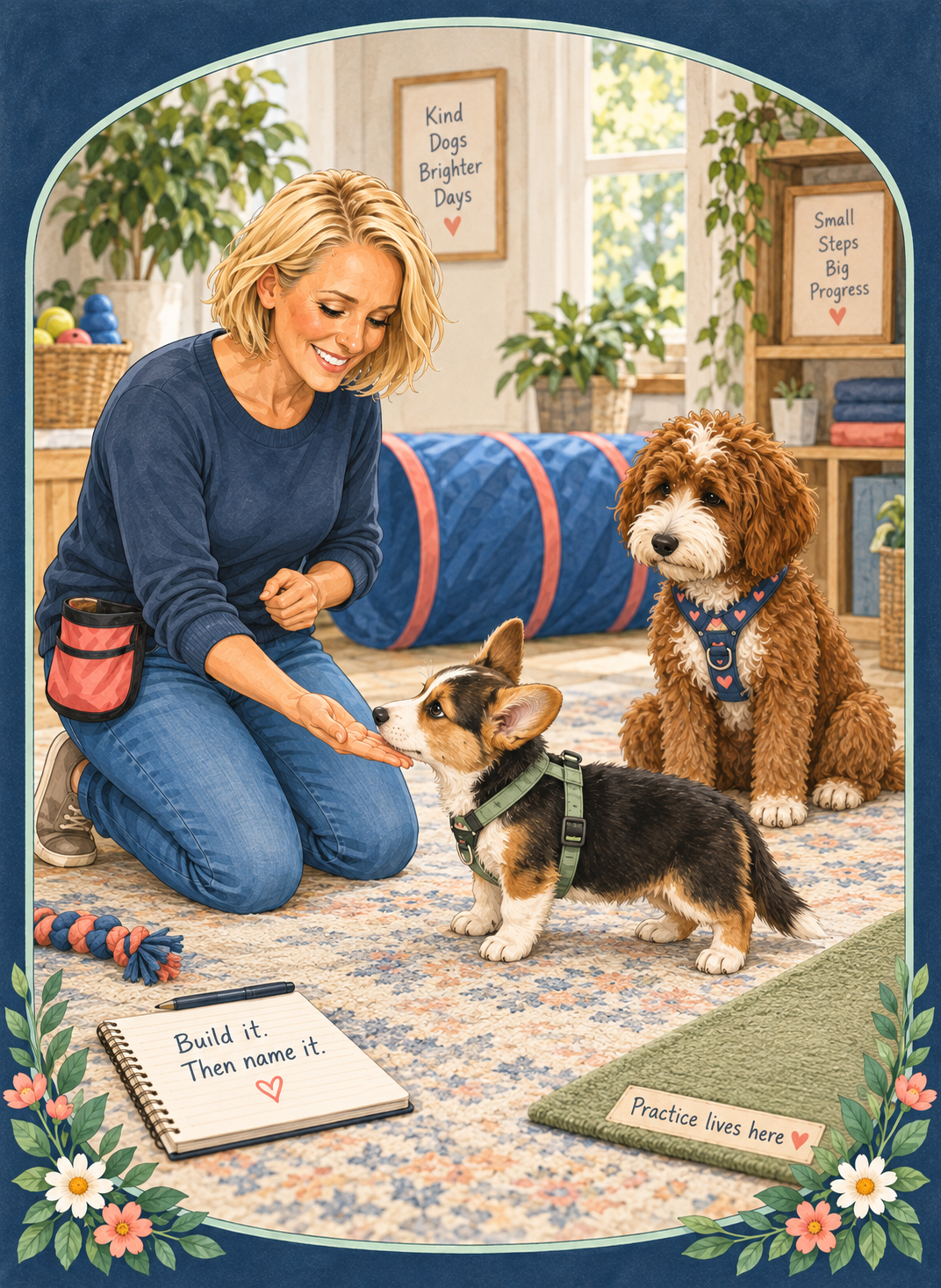
And stay — the toughest one, the impulse-control muscle. Weeks one through three of 101, nobody says the word. The mat goes down every time the trainer talks, and every touch, every down, gets paid. Week four names what weeks one through three captured. By then he’s been doing it for a month. He just didn’t know it had a name.
Here’s the candid part. Some of them never get reliability — because they don’t practice, they don’t generalize, they’re not consistent, and they don’t execute consequences. That’s about half our students. Some get lucky: easy dog. Many build their bond and a dog that turns to them when he’s unsure, and that’s enough.
The human. Driver’s ed. Parking lot, then side streets, then the freeway — and nobody hands a fifteen-year-old the keys on the interstate on day one and calls what happens next not listening. The license comes after fluency, and the test is on the road. It’s why our program ends in breweries and hardware stores instead of a final exam on a rubber mat.
The person who raised her hand in week one was right to ask. She had a baby in the car and she wanted the freeway. Same map. We just showed her where she was on it.
The prediction
He’s going to be eight months old at the park. You’re going to say his name. He’s going to look straight at you and keep going.
Someone will say stubborn. Someone will say firmer hand. Someone will say my last dog was obedient by four months — and that dog was either a unicorn or a dog who was obedient in a kitchen at four months and nobody checked at eighteen. A rare few will want what they saw at the dog show, and we get it — it’s gorgeous. It’s also a sport, with a ring, and the rules of the ring were written for a scoreboard, not a kitchen.
Here’s what’s happening at the park. Asher’s puppies did the exact same thing at the exact same age, on purpose, to the people they loved most. The dip is real, it’s scheduled, and the thing that got the dogs through it was the relationship they had going in.
So here’s the test — for any cue, any dog, ours included:
Does he have the behavior without the word? Does it work in this room, at this distance, with this much going on? What paid it the last twenty times? And how old is he?
We’re keeping the word. Obedience — the real kind. Not compliance. A shared language, taught in the order a brain can hold it, paid at the rate the world pays, and tested where life happens. Sit is overrated as a starting point. As a finish line, on a regulated, socially fluent dog snoozing under the brewery table? Sit is lovely. We’re keeping that too.
One question to take home: what are you asking him to hold that his body can’t hold yet — and what could you build today that it can?
Next in the series: the word our own side threw out. Punishment.
— Jody & your Dog Life Coaches
The stance behind the series: The Go Anywhere Dog® Manifesto. The machinery: Our Methodology. Earlier in the series: Calm · Leader · Naughty.
Want to build these skills with your own dog? Puppy classes in Eden Prairie, or in-home training across Minneapolis and nearby suburbs.
Sources
- Thorndike, E. L. "Animal intelligence: An experimental study of the associative processes in animals." Psychological Review Monograph Supplements, 2(4), Whole No. 8 (1898). Thorndike, E. L. Animal Intelligence: Experimental Studies. Macmillan, 1911 — the law of effect stated in full.
- American Kennel Club. Obedience Regulations, adopted 1936; Walker’s first tests, 1933–35, and the first AKC-licensed obedience trial, 1936. (Walker, H. W. — Carillon Kennels, Bedford Hills, NY.)
- Ferster, C. B. & Skinner, B. F. Schedules of Reinforcement. Appleton-Century-Crofts, 1957.
- Breland, K. & Breland, M. "The misbehavior of organisms." American Psychologist, 16(11), 681–684 (1961).
- Koehler, W. R. The Koehler Method of Dog Training. Howell Book House, 1962.
- Binder, C. "Behavioral fluency: Evolution of a new paradigm." The Behavior Analyst, 19(2), 163–197 (1996). Lindsley, O. R. "Precision teaching: Discoveries and effects." Journal of Applied Behavior Analysis, 25(1), 51–57 (1992).
- Asher, L., England, G. C. W., Sommerville, R. & Harvey, N. D. "Teenage dogs? Evidence for adolescent-phase conflict behaviour and an association between attachment to humans and pubertal timing in the domestic dog." Biology Letters, 16(5), 20200097 (2020).
- Bray, E. E., Gruen, M. E., Gnanadesikan, G. E., Horschler, D. J., Levy, K. M., Kennedy, B. S., Hare, B. A. & MacLean, E. L. "Dog cognitive development: A longitudinal study across the first 2 years of life." Animal Cognition, 24, 311–328 (2021; published online 2020).
- Bouton, M. E. "Context and behavioral processes in extinction." Learning & Memory, 11(5), 485–494 (2004) — see the Naughty post; the second learning stays in the room it was learned in.