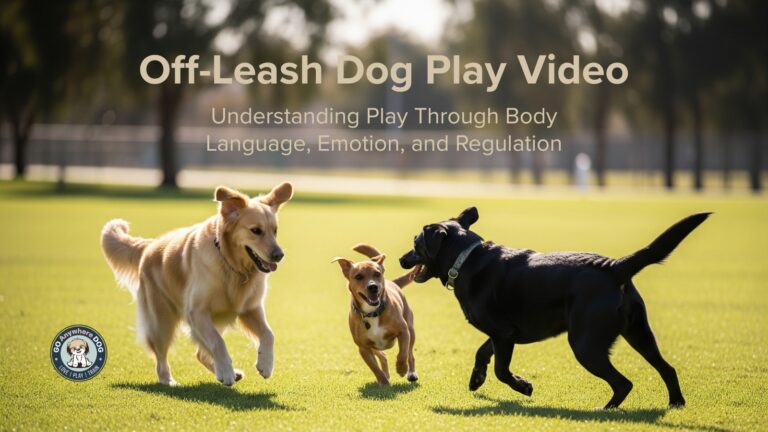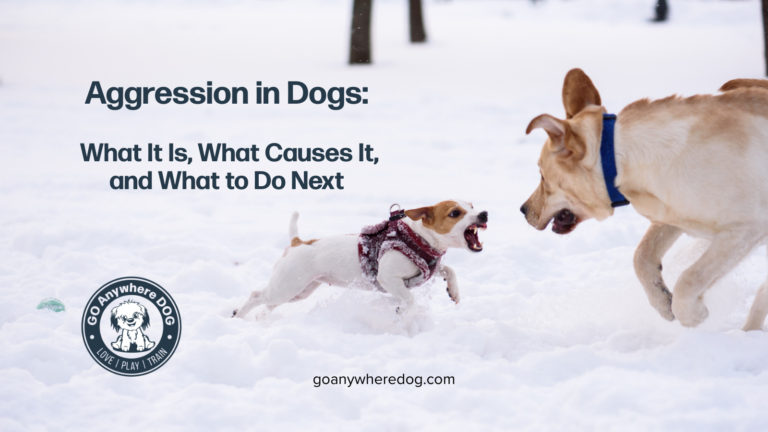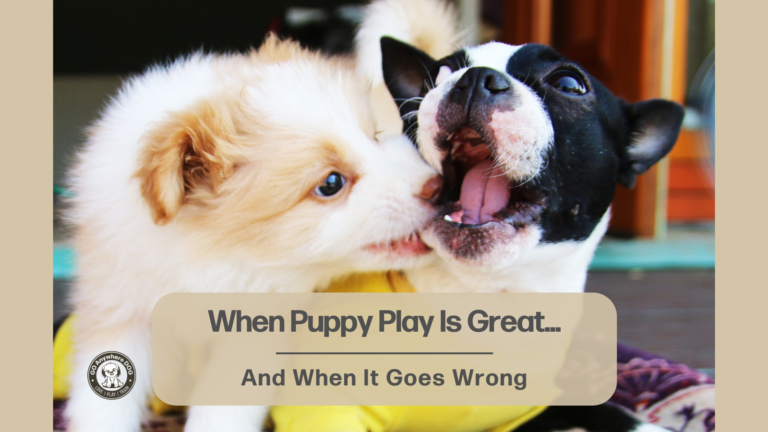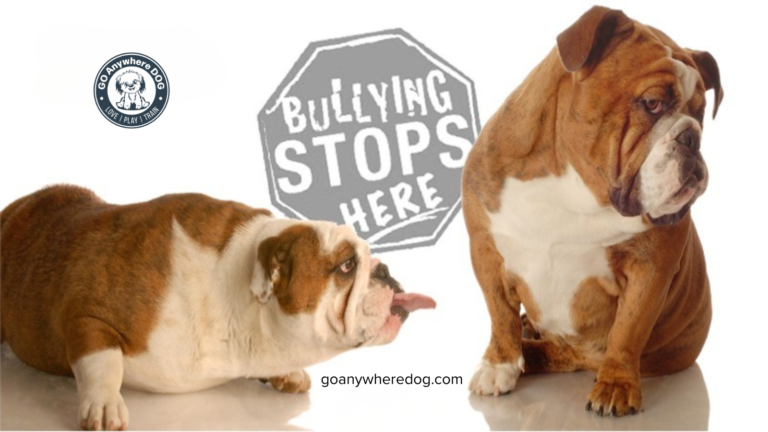
You’ve seen it at the dog park. Two dogs, one game. One is having the time of his life. The other keeps getting knocked over, keeps ducking behind a bench, keeps looking for a way out.
And somebody says it. They’re fine. They’re just playing.
Maybe they are. Maybe they aren’t. Here’s the thing: nobody asked the dog on the bottom.
We do. Every class, every level, from Puppy & Me through Life Skills 301. It’s called a dog play consent test. I learned it from my teacher, Jean Donaldson, founder of The Academy for Dog Trainers, and it might be the most important thirty seconds in our room.
How the dog play consent test works
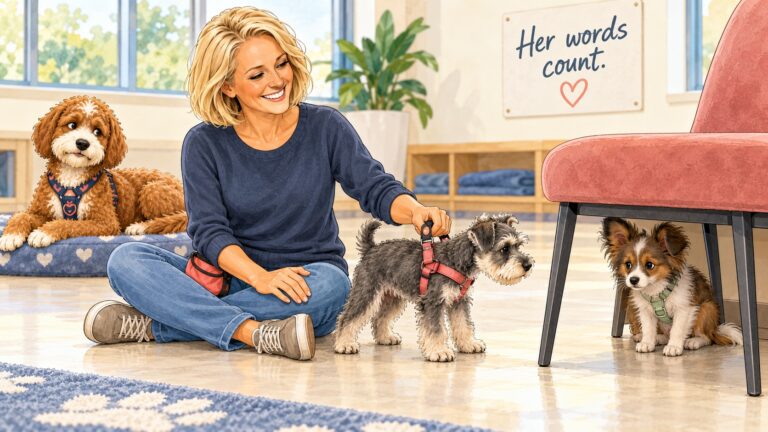
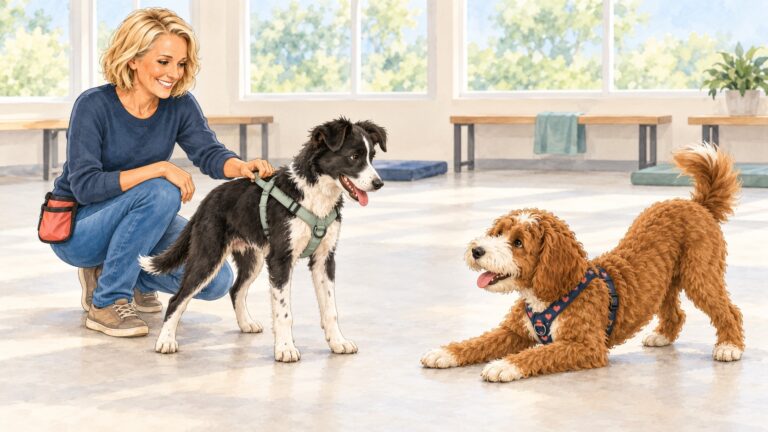
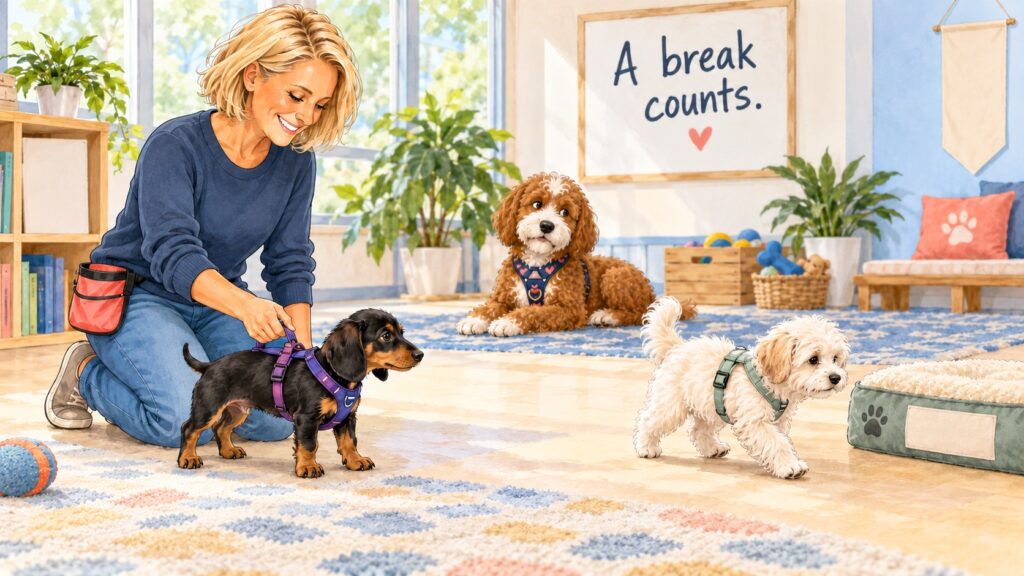
When one dog looks like he might be coming on too strong, we pause him. Call him away if you can, or gently hold his harness or collar if he’s comfortable with that handling. A few calm seconds, no scolding. The other dog stays free to move. This is a check during play, not a way to break up a fight.
Now the other dog, the underdog, gets to vote with her feet.
Option one: she comes back toward him, offering the signals that say let’s play. The bow. The bounce. The loose, wiggly body. Maybe a little paw slap at the ground. That’s a yes. Let him go and the game goes on.
Option two: she uses the moment to get out. She shakes off, sniffs the floor, trots to her person, finds somebody else. That’s a no, or a not right now. The game with that partner is over for now, and that’s okay.
Either answer is a good answer. The point isn’t which one she picks. The point is that she gets to pick. She answers the question for herself, every time.
A yes isn’t the whole answer.
Little ones are still learning how to play. I see some puppies dive right back in on every single consent test, including the puppy who has spent the last five minutes on the bottom of the pile.
On paper, that’s a yes. It isn’t the whole answer.
The test asks the puppy. The adults in the room still have to watch the game. A puppy who is consistently pummeled, rolled, flattened, or pinned too long needs us to look closely at how she’s coping, whether or not she keeps signing back up. Coming back for more doesn’t erase everything we just watched.
So when a puppy throws herself back in on test after test, we don’t just let the vote stand. She may need gentler playmates for a while. Not less play. Different play. Partners who let her practice the whole conversation without getting overwhelmed every time.
That’s the job of the grown-ups in the room: honor the vote, and read past it.
Dogs check in with each other, too.
Scientists have been watching dogs ask each other this question for a long time.
In 1995, ethologist Marc Bekoff studied play in domestic dogs, wolves and coyotes and looked closely at the play bow: front end down, back end up. He found bows weren’t just how play starts. They showed up right before or right after the rough stuff, like a bite with a head shake, the moves that could be mistaken for a real fight. His read: the bow is punctuation. It tells the other dog what I just did, or am about to do, is still play.
In other words, dogs check in with each other constantly. Good players keep asking, Still okay? Still having fun?
Bekoff later argued that animals negotiate their play, and that individuals who don’t play fairly may have trouble finding willing partners. Play runs on a running, mutual yes.
The consent test gives us another way to look for that yes. We pause the game long enough for the quieter dog to answer out loud.
What the pause can teach
Before we teach any skill, we ask one question: Is he upset? An upset dog is still learning, but it may not be the skill we planned. He’s also learning how the room feels. If the room feels frightening, that association can become part of the lesson.
The trouble is, from across the room, an overwhelmed dog and a happy dog in a pile of puppies can look a lot alike. The consent test helps us check our reading. We let the dog tell us, and then we check her answer against everything else we see.
And the asking itself teaches something. In 2016, Steven Maier and Martin Seligman looked back at fifty years of research that began with dogs and later relied heavily on rodents. They revised their famous theory: passivity in response to prolonged aversive events was not necessarily learned. Learning that an action could control the event could prevent that response and protect against some effects of later stress.
Their review concerned laboratory stress, not puppy consent tests. What I take into our classroom is the importance of giving a dog an action that works.
Now watch a puppy in the consent test. She gets overwhelmed. She leaves. And it works. The game stops, her person is there, nothing bad follows. That’s the lesson we want her to learn: I can say no, and it holds. When leaving works, she has an option before she needs to ask more forcefully, perhaps with a snap.
And when a puppy does need to growl, snarl, or air snap, here’s why we listen to the warning—and how we help.
The dog being held back has something to learn too. When play gets too much for his partner, the fun pauses. If the friend offers a fresh invitation, he gets another chance to play more gently.
Researchers Erika Bauer and Barbara Smuts found a link between self-handicapping—actions that give up an advantage during play—and play signals. They also found that play did not need a perfect fifty-fifty balance. One dog being on top more often isn’t the whole answer either. We watch comfort, invitations, breaks, and what happens when the game resumes.
That’s the skill we’re building in him: play big, check in, and make it worth coming back to.
And the humans learn the most of all. After a few weeks, parents stop asking us are they okay? They know how to ask the dogs. That’s the difference between looks fun and is fun.
Here’s why we never stop running it.
A dog’s social life keeps changing long after puppy class. Dogs reach social maturity at different ages—roughly one to three years, with plenty of individual variation. Jean taught us three changes to watch for: they may play less, get pickier about who they play with, and get less tolerant of behavior they don’t like.
Think about what that means without the consent test. A grown dog who has never had a polite way to say no, and never been asked. A grown dog who has never learned that a pause is not a threat. Or a grown dog who spent puppyhood on the bottom of the pile, saying yes when she meant help. Those missed opportunities can leave a dog with fewer practiced ways to handle a difficult interaction. We want to give him more options before trouble starts.
Now think about a dog who has run the consent test hundreds of times, with grown-ups reading the game around it. He’s practiced asking, taking no for an answer, leaving a game that isn’t fun, and coming back to one that is. As he gets choosier, those are useful skills to have. They’re practice, not a guarantee that he’ll never struggle.
That’s the preparation we want to give a dog before the brewery patio, the cabin, the family reunion. A Go Anywhere Dog® isn’t a dog who loves every dog. It’s a dog who knows how to handle the ones he doesn’t.
Pet, then pause.
The principle doesn’t stop at other dogs. You can ask your own dog the same question. Pet, then pause and take your hands away. Does he lean back in, nudge your hand, ask for more? That’s a yes. Does he shake off, move away, look elsewhere? He’s done for now. Let him be done.
Every time you honor his answer, you give him another reason to trust you.
Try the consent test during dog play
Next time play starts to look lopsided, in class, during a suitable playdate, or in your living room:
- Pause the dog who’s coming on strong. Call him away, or gently hold his harness or collar if he’s comfortable with that handling. A few calm seconds. No scolding.
- Watch the other dog. Bow, bounce, wiggle back in? Or shake off and go?
- Honor the vote, and read past it. A no means the game is over for now. A yes means the game goes on, unless she’s the one who keeps ending up flattened. Then it’s time to find her a gentler friend for a while.
If your dog is the one coming on strong, that’s not a character flaw. He’s a baby with a lot of enthusiasm and not much of a brake. The consent test is one way we help him practice using one.
A dog who gets to answer the question for himself, with grown-ups listening to the whole answer, gets practice being heard before he has to shout.
See the consent test in class
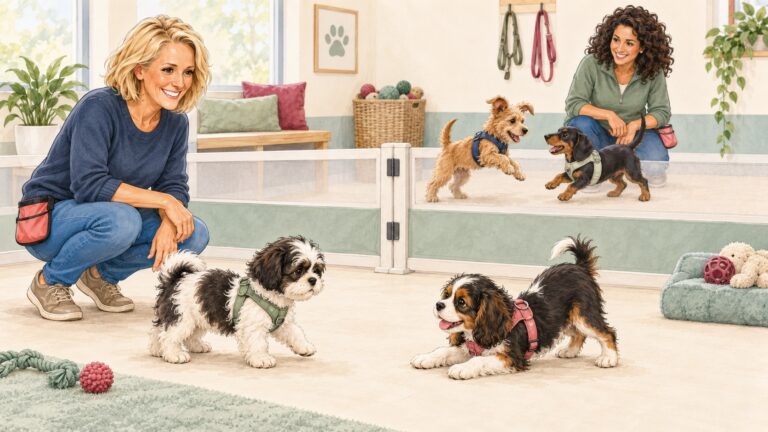
Want to see it live? Classes meet at our Eden Prairie school. Every one of our classes, Puppy & Me through Life Skills, runs off-leash play with the consent test built in, in rooms split so puppies play with partners who match them. Here’s why we never stop the play. Questions? Ask Jeannie.
Jody & your Dog Life Coaches
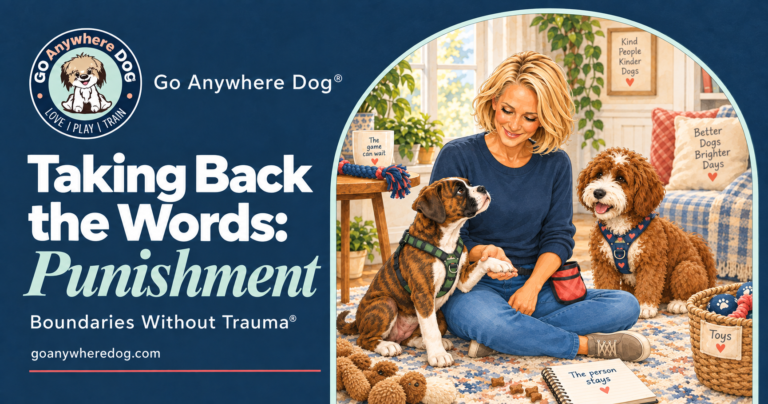
Related: Why Go Anywhere Dog® splits the class, and then splits the room · Why Puppy Play Looks Great… Until It Doesn’t · Taking Back the Words: Calm · Taking Back the Words: Punishment
Sources
American Animal Hospital Association. Age and behavior. 2015 AAHA Canine and Feline Behavior Management Guidelines. Read the guidelines.
Bauer, E. B., & Smuts, B. B. (2007). Cooperation and competition during dyadic play in domestic dogs, Canis familiaris. Animal Behaviour, 73(3), 489–499. Read the source
Bekoff, M. (1995). Play signals as punctuation: The structure of social play in canids. Behaviour, 132(5–6), 419–429. Read the source
Bekoff, M. (2001). Social play behaviour: Cooperation, fairness, trust, and the evolution of morality. Journal of Consciousness Studies, 8(2), 81–90. Read the source
Donaldson, J. The consent test, and social maturity in dogs, as taught in coursework at The Academy for Dog Trainers. Jody’s recollection of Academy coursework; visit The Academy for Dog Trainers.
Maier, S. F., & Seligman, M. E. P. (2016). Learned helplessness at fifty: Insights from neuroscience. Psychological Review, 123(4), 349–367. Read the source
The Pet Rescue Resource. Consent Test SOP. Read the procedure.