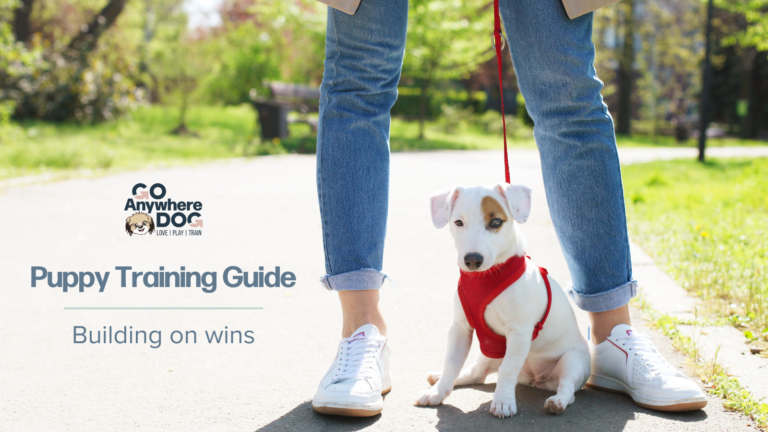
It’s week two. A puppy has had a scare. Maybe a bigger puppy bowled him over, maybe a chair scraped the floor. He’s pressed against his person’s legs, shaking.
She reaches down for him.
And from the chair next to her, her husband says it. Not mean. Just certain.
Stop coddling him.
She freezes. Hand halfway down. You can watch it happen: whatever she was about to do, she can’t do it now. Anything I say to her in that moment won’t land, because she isn’t in a place where anything can land.
So I don’t say anything to her.
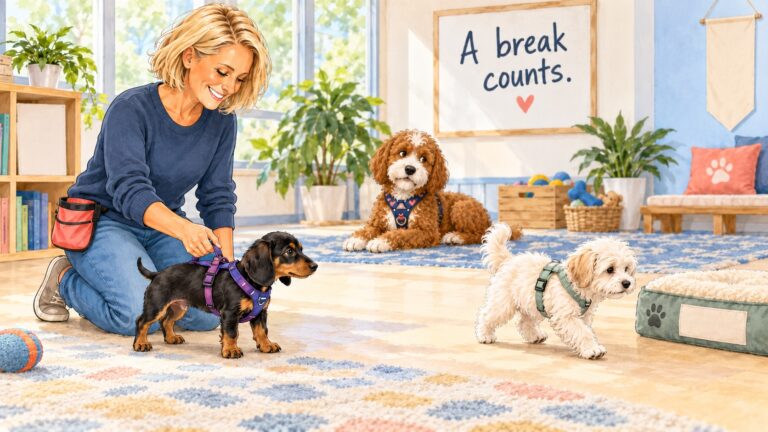
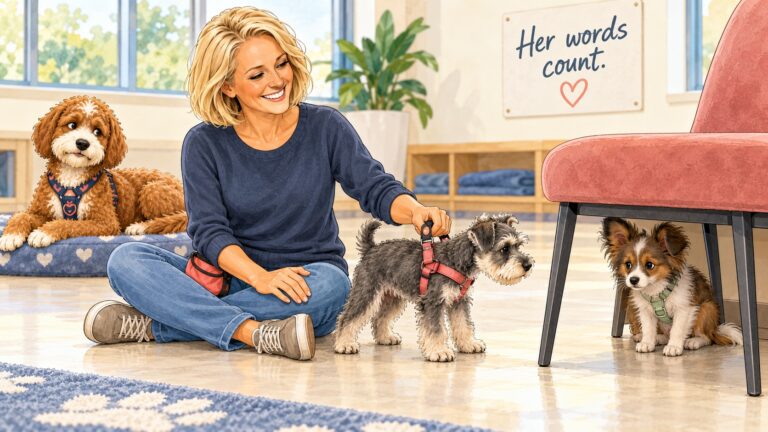
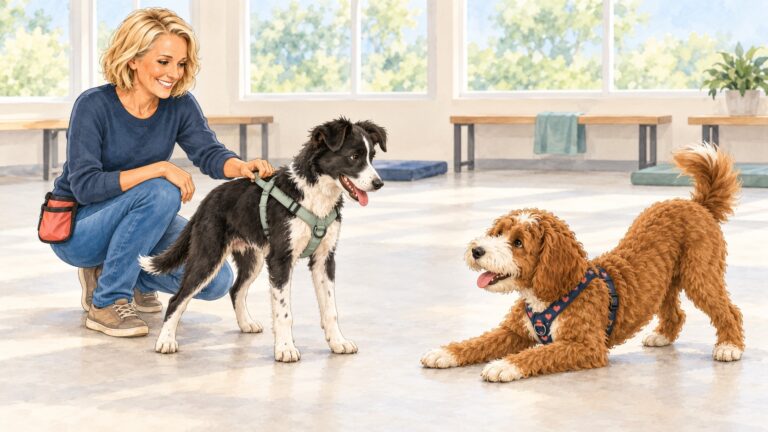
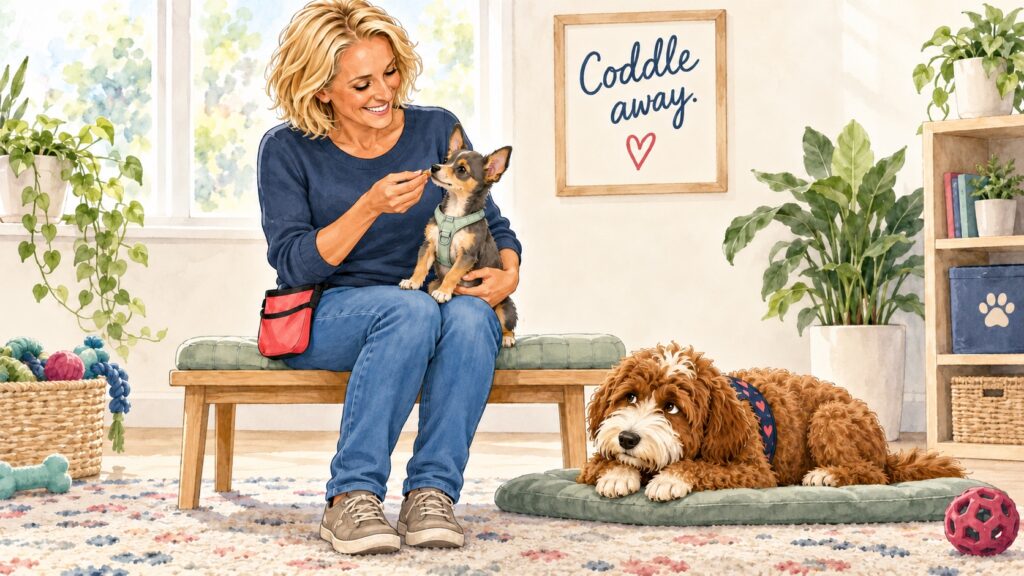
With a puppy who’s comfortable being picked up, I scoop him up myself, supporting his body. I coo at him like a baby, because he is one. And the moment he can take a treat, he gets one. Then another. If being held makes him more worried, we help another way: space, a quiet spot, and a person nearby if he wants one.
And the whole room watches him settle.
Then I turn to everybody, not to her and not to him, and I explain what just happened.
Does comforting a scared puppy reinforce fear?
Most of us were handed this one. Don’t comfort him, you’ll make it worse. Ignore it and he’ll learn to get over it. Suck it up, buttercup. It sounds like tough love. It sounds like the responsible thing.
It comes from a misunderstanding of how learning works.
The idea goes like this: if you give a scared dog attention, you’re rewarding him for being scared, so he’ll be scared more. That confuses an emotional response with a behavior we might teach for a cookie.
But fear isn’t a choice. It’s an emotion. It’s his nervous system sounding the alarm. Fear can change through learning, and attention can affect what a dog does. That doesn’t mean a gentle response rewards the feeling of fear. Holding a toddler who is afraid of the dark doesn’t make comfort the enemy, either.
What comfort can do is answer the alarm.
What the research says about a safe person
Here’s what happened when researchers looked at that support.
In 2013, Márta Gácsi and colleagues in Budapest studied adult dogs facing an unfamiliar person who approached in a threatening way. The rise in heart rate was smaller when the owner was present. Among dogs that barked or growled at the stranger, the order mattered, too: meeting the stranger with their owner first appeared to soften the heart-rate response during a later encounter without the owner in that same test.
Read that one again. A familiar person could buffer the response to a threat. The researchers compared that safe-haven role with parents and infants. This was a short experiment with adult dogs, not evidence that one cuddle changes a puppy’s whole future. But it gives us a reason to take that familiar person seriously.
In 2017, Erika Csoltova and colleagues in France studied dogs during two standardized veterinary exams. In one condition the owner was present but didn’t interact. In the other, the owner petted and talked to the dog. Dogs made fewer attempts to jump off the table with that contact, and the heart-rate response was smaller. The exams still produced signs of stress in both conditions. Comfort helped; it didn’t make the exam disappear.
That’s what this kind of so-called coddling can do. It can help lower the alarm.
My friend and colleague Zazie Todd, a social psychologist and dog trainer, explores helping fearful dogs in Bark! and on her site, Companion Animal Psychology. The blanket rule that comforting a scared dog makes the fear worse doesn’t hold up. For many dogs, being near their person helps.
Safety gives learning room
Here’s the part I want families to carry into the rest of his life.
A scared puppy may struggle with sit or come. His attention is pulled toward a much more urgent question: Am I safe?
He is still learning. He may be learning what to avoid, what predicts something scary, or whether anyone helps. It may be a very different lesson from the one we meant to teach.
So when you comfort him, you’re making room for the training. You’re answering Am I safe? with Yes, I’ve got you. As he feels safer, we can ask for the small next thing he can actually manage.
And here’s the long game we’re working toward: a dog who knows he can come to you. A dog who sees something scary on a walk and can turn toward you for help. That takes repeated experiences, thoughtful training, and sometimes individual support. Week two, on the floor, with a puppy who welcomes your arms, is one place to begin.
The people need a safe room, too
When I explain it in class, I don’t talk about that couple. I talk about mammals.
In many mammals, a familiar caregiver can help buffer a young animal’s response to stress. The details differ across species and individuals. But needing support isn’t a character flaw. It’s a familiar part of being small in a big world.
Nobody in the room is wrong for having heard don’t coddle him. We were all handed it. But now everybody in the room has seen the other version with their own eyes. They just watched a puppy go from shaking to taking treats in about a minute.
Some of them go home and think about it. Some of them think about more than the puppy.
How to comfort your scared puppy
Comforting your puppy isn’t complicated. A few things help it work:
- Keep your response steady. Soft voice, slow hands. You don’t have to feel perfectly calm to help; aim for movements and contact your puppy finds reassuring.
- Offer the kind of contact your puppy wants. Small puppy who enjoys being held? Pick her up gently and support her body. Bigger puppy? Sit nearby if that helps, and let him lean in or move away. If he stiffens, struggles, turns away, or growls, give him space instead of holding tighter.
- Food is one clue, not a verdict. Taking a treat can be encouraging, but a scared puppy may still eat. Refusing food can have other causes, too. Read his whole body. If he’s worried, add distance from whatever frightened him or leave the situation; don’t use treats to pull him closer.
- Let him go back out on his own feet. Comfort is the safe base, not a cage. When he’s ready, he’ll look back out at the world. Let him. (Here’s what that looks like with a shy puppy.)
Coddle away. Watch the puppy.
Next time your puppy is scared, and someone tells you to stop coddling him, start here:
- Help him feel safer. Add distance, use a soft voice, offer gentle contact if he wants it, and a treat if he can take it.
- Watch what happens. Does the shaking slow? Does he lean in, then look around? Does he take the next treat faster than the first?
- Let his response guide you. If he doesn’t settle, change the situation or leave. You don’t have to keep him there to prove a point to the room.
It’s always okay to offer comfort to your dog when he’s upset. Let him show you what feels comforting. Sometimes that’s your arms. Sometimes it’s your company at a little distance. Sometimes it’s going home.
Coddle away.
Help with your puppy’s big feelings
Want to see how we handle big feelings in the room? Our puppy classes and Life Skills meet at our Eden Prairie school. Questions? Ask Jeannie.
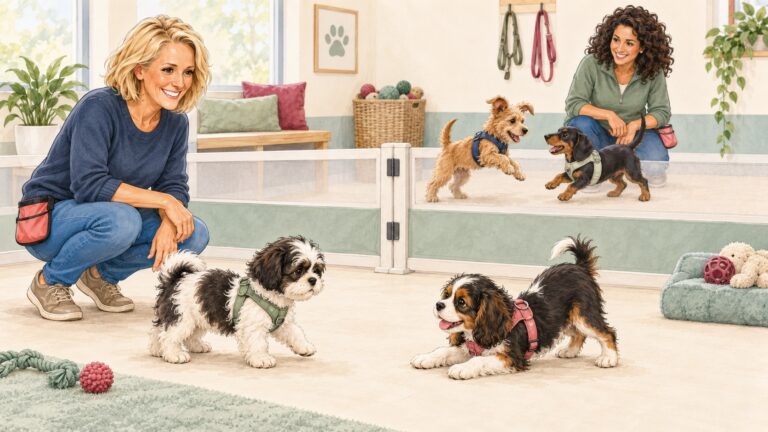
For little learners, our small-breed groups are for puppies expected to weigh 25 pounds or less as adults. The support continues through every class level.
If your puppy keeps struggling to recover, our private behavior help comes to your home in Minneapolis and nearby suburbs. A sudden change, signs of pain, or distress around touch deserves a veterinary check, too.
Jody & your Dog Life Coaches
Related: A growl, a snarl, an air snap: your puppy using her words · The consent test: read the whole answer · Taking Back the Words: Calm · Taking Back the Words: Leader
Sources
- Csoltova, E., Martineau, M., Boissy, A., & Gilbert, C. (2017). Behavioral and physiological reactions in dogs to a veterinary examination: Owner-dog interactions improve canine well-being. Physiology & Behavior, 177, 270–281. Read the study abstract
- Gácsi, M., Maros, K., Sernkvist, S., Faragó, T., & Miklósi, Á. (2013). Human analogue safe haven effect of the owner: Behavioural and heart rate response to stressful social stimuli in dogs. PLOS ONE, 8(3), e58475. Read the study
- Todd, Z. (2024). Bark! The Science of Helping Your Anxious, Fearful, or Reactive Dog. Greystone Books. See also Companion Animal Psychology: https://www.companionanimalpsychology.com/