Skip to the article

Training foundations · Video lesson

How to Motivate Your Puppy (The Real Drivers of Engagement)

Look at what makes practice worth joining for the puppy in front of you.

In This Video

Motivation is your dog's answer to the question “why should I?” In this video you'll see why there is no training without it, why fear and frustration are poor motivators, and how reward-based training makes you the source of all the good stuff in your dog's world. Food, play, toys, praise and attention all count; your job is to find what your dog values most and pay the right price for the behavior you want.

Key Moments

  • 0:01 — No motivation, no training
  • 0:21 — Your dog's question: “Why should I?”
  • 0:49 — Two ways to answer why, and why fear loses
  • 1:03 — Reward-based training: be the source of the good stuff
  • 1:34 — Dogs learn what brings the reward, just like us
  • 2:05 — Food, play, toys, praise and attention
  • 2:36 — Every species has its price: dogs do what works for dogs
Full Transcript

Okay folks, let's talk motivation. Before we begin training we must understand this: if there is no motivation, there is no training. Motivation is your dog's answer to “why?” And behavior change? If you want to change your dog's behavior, then you've got to give them a good reason.

When you give your dog a request, imagine him asking, “Why should I?” Let's just imagine your dog's chasing a squirrel. Really fun stuff if you're a dog. You call him to come back to you. Now your dog's got a big decision to make: do I keep chasing that squirrel, or do I go back to my owner? When you make that call, your dog is thinking, “Why should I? What's in it for me?”

Now, that why question can be answered in a couple of ways. We can teach him that if he doesn't come back, something bad happens. Or, even less effectively, we can teach him that if he eventually comes back after we've been yelling through what seems like forever, something bad happens: we get mad. Which isn't motivation to come to you in anyone's book.

Or we can teach him that if he comes running back the moment he hears that call, something wonderful happens, leaving that squirrel back in the dust. That's what reward-based training is all about. We give him the best reason in the world to do what we asked, because it produces the best results for him. You aren't the source of fear; you're the source of all the good stuff in the world. That's how training based on the giving or withholding of the good stuff works, as your dog sees it.

And in that sense they're not so different from us. It's just learning what brings the reward. If you had a job in a factory painting cars, and you were told if you paint the cars blue you get paid, if you paint them red you don't, what are you going to do?

Which brings us back to the big motivator for your dog. If you think about it, you probably already know what dogs think are great: it's food, play, toys, praise and attention. All the things that get that tail wagging. Some are super awesome to your dog, showing it with big, energetic wagging. Some are just so-so, more like a half tail wag. Working out what your dog puts in his top list of faves can be one of the greatest joys of having a dog.

Most dogs love food. What's just everyday, and what's a gourmet treat? We've put together a food tips video of what treats are real winners for most dogs and how to prepare them. Because when we're thinking about changing behavior, what it comes down to is this: every species, dogs and humans alike, has its price. If we want to change behavior, you have to pay the right price.

So here's what we've got: dogs do what works for dogs. Let me repeat this: dogs do what works for dogs. You'll hear me say it often, because it's just that important, and just that simple. But best of all, it really pays off.
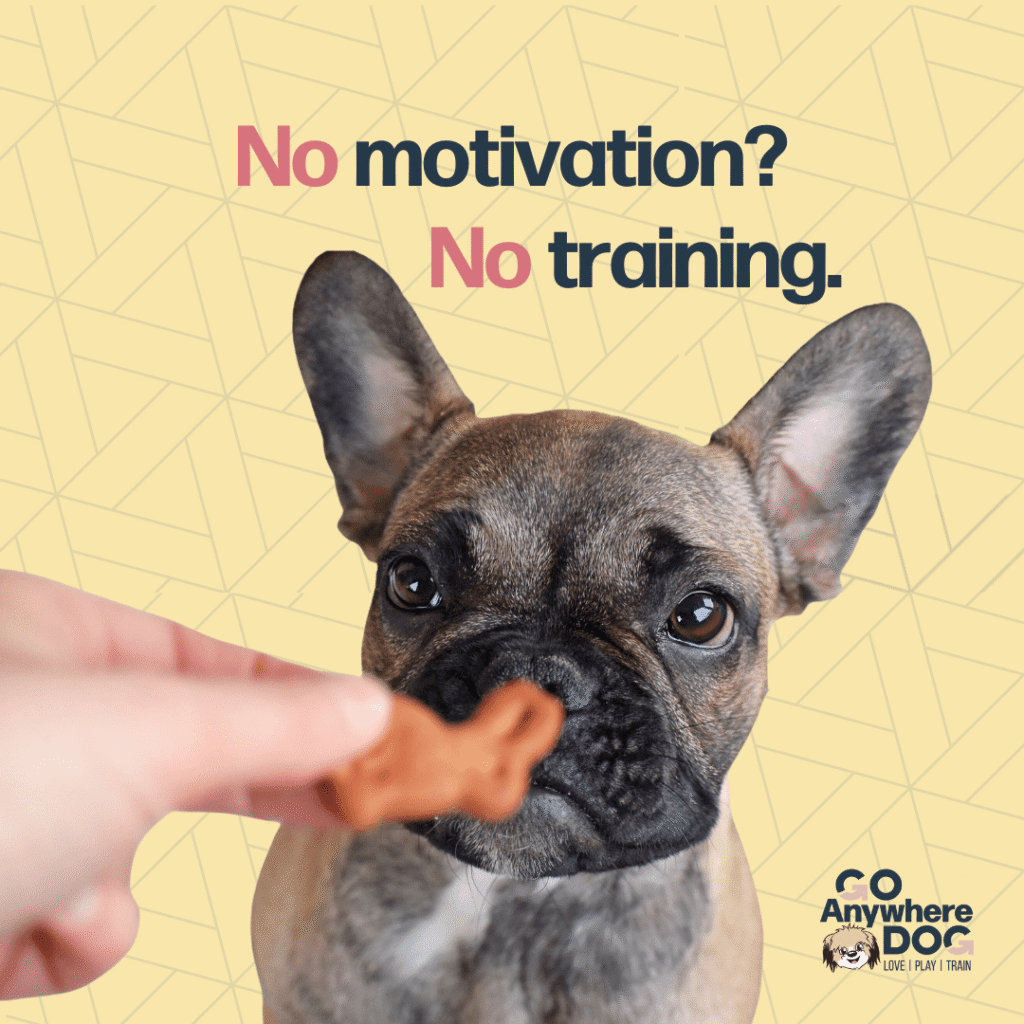

Most people think dog training starts with cues and corrections. The truth is: training starts with motivation — the internal engine that makes a dog want to participate at all.

In this video, we break down what truly motivates dogs, why motivation matters more than repetition, and how emotional safety, clarity, and predictability create engagement that feels good for both dog and human.

How to motivate your dog – Go Anywhere Dog®, Minneapolis & Twin Cities, MN, Dog Training

How to Motivate Your Puppy

Training doesn’t happen in a vacuum — it happens inside the dog.

Not the physical dog.
The emotional dog.

And that’s where motivation lives.

Motivation isn’t a bucket you fill with treats.
It’s a moment-by-moment decision engine that answers:

  • Is this worth my attention?

  • Can I predict success?

  • Am I regulated enough to participate?

  • Do I feel safe here?

If the answer to those questions isn’t “yes,” nothing else matters — not the cue, not the reward, not the timing.

Training problems are almost always motivation problems in disguise.

Motivation Isn’t About Treats — It’s About Value

People talk about motivation like it’s a magic treat bag you pull out when behaviors fail.

That’s a surface view.

Real motivation comes from:

  • successful experiences

  • predictable outcomes

  • emotional regulation

  • clarity of expectation

  • trust in the human partner

Treats are feedback.
Not incentives.

They tell the dog:

“That choice worked here.”

But a dog still has to want to engage in the first place.


Engagement Comes Before Obedience

If your dog looks at you like you’re speaking another language, it isn’t being stubborn — it’s over threshold.

A dog that is:

  • excited

  • dysregulated

  • overwhelmed

  • habituated to chaos

…cannot access what you want them to learn, no matter how tasty the treat is.

Motivation thrives in a foundation of:

  • predictable context

  • manageable stimulation

  • clear expectations

When those are present, suddenly everything you ask feels worth doing.

Why Motivation Fails

Motivation doesn’t disappear — it shifts.

Motivation drops when:

  • the environment is too chaotic

  • criteria jump too fast

  • expectations outpace emotional readiness

  • the dog isn’t given a clear choice

  • the session feels pressured

At that point, behavior isn’t meaningless — it’s feedback:

“I’m not confident this will work.”

Instead of repeating what works, the dog disengages.

That’s not defiance —
that’s self-preservation.

What Actually Motivates Dogs

Real motivation is built on:

1. Emotional Regulation
A calm dog is a thinking dog. A dysregulated dog is not.

2. Predictability
Dogs repeat patterns that make sense and feel safe.

3. Clear Feedback
Rewards tell dogs:

“Yes — that action led to a good outcome.”

4. Controlled Environment
If the world is louder and more tempting than your cues, you lose every time.

Motivation Is Invited, Not Given

You don’t give motivation.
You invite it.

You create learning conditions where the dog’s nervous system can say:

“Yes — I want to try this.”

That’s the real first step in any training system.

The Takeaway

Stop looking for motivation.
Start creating it.

When a dog feels safe, clear, predictable, and successful — that’s when they choose to engage. And that choice is the foundation of all learning.

Puppies starting under 16 weeks begin in Puppy & Me, and dogs 16 weeks to a year start in Life Skills 101 — both at our Eden Prairie school. For dogs of any age, we also come to you with in-home training.

Until next time, have fun and enjoy your dog.
— Jody & your Dog Life Coaches

Jody Karow holding Vanna

The person behind the post

Jody Karow, CTC

Dog trainer, writer, and founder of Go Anywhere Dog®. Working professionally with dogs since 2004, and helping people understand the dog in front of them.

Meet Jody & explore more articles

Bring the learning home

You can have a person beside you.

Off-leash classes in Eden Prairie. Private puppy training and behavior help in Minneapolis and nearby suburbs. Jeannie can help you find your next step.

Talk with Jeannie