It happens in our classroom more often than you’d think.
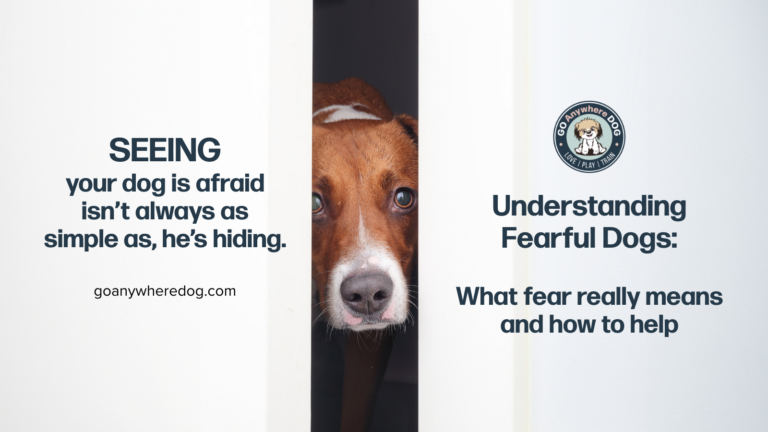
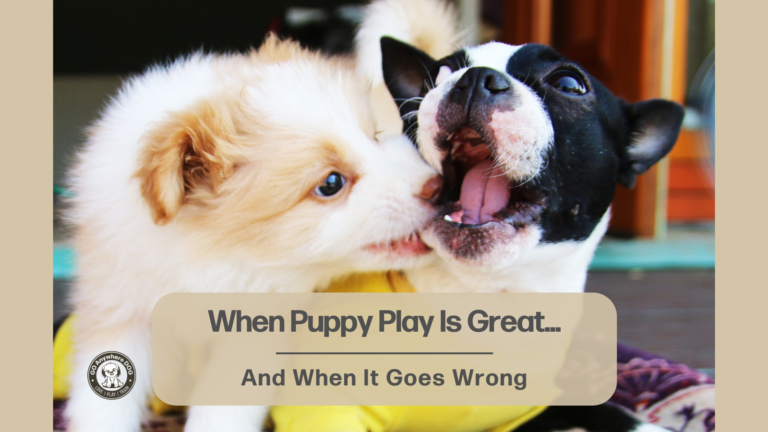
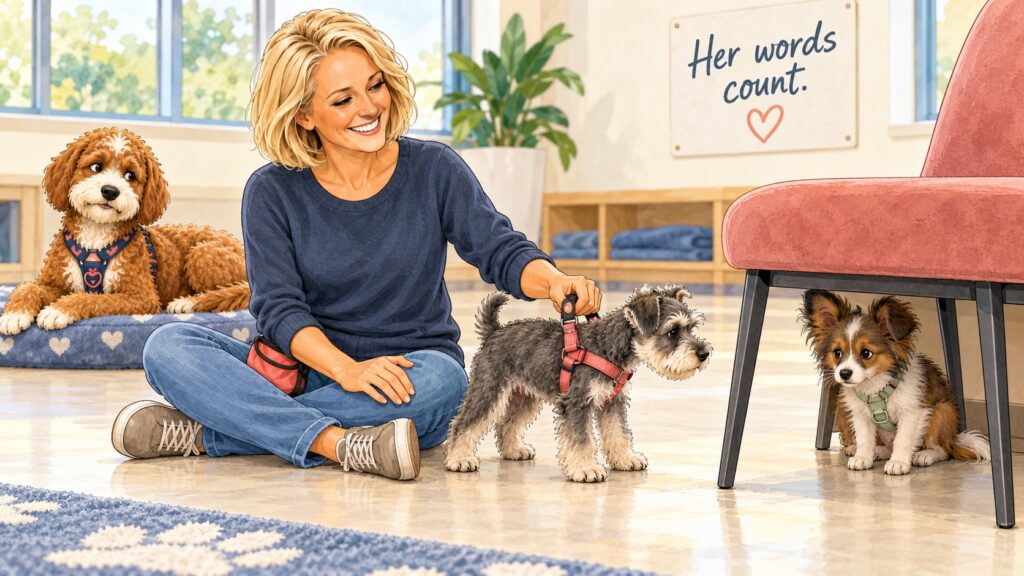
A shy puppy has found the safest spot in the room: under a chair. She’s watching. She’s not ready to join the party yet. Then another puppy, happy and curious and completely clueless, trots right up to say hi.
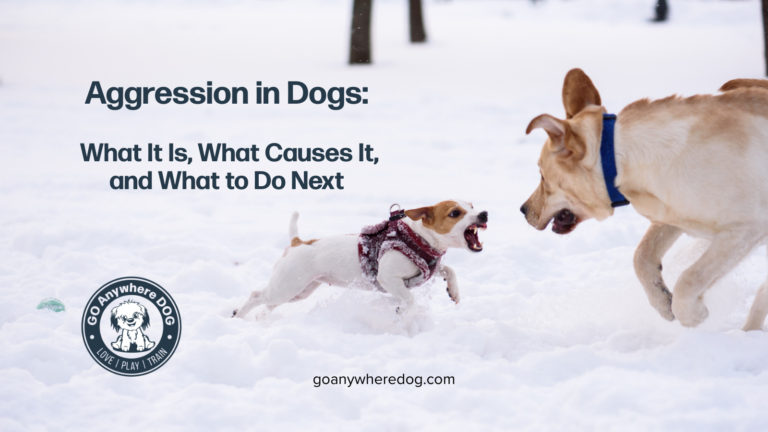
And the shy puppy growls. Lips pull back. Teeth. Maybe a quick snap at the air.
The whole room freezes. And almost every parent has the same instinct, fast and hot: No! We don’t do that!
Let’s talk about that instinct. Because that moment, right there, is one of the most important teachable moments in all of puppyhood. And scolding is exactly the wrong lesson.
Why we don’t punish puppy growling
Ian Dunbar has an analogy I’ve never forgotten: punishing a growl is like taking the ticker out of a time bomb. In his writing on body language, he describes the risk of suppressing the warning while leaving the dog upset. The growl is information. Silencing it doesn’t necessarily change what the dog is warning us about. It can leave us with less warning next time.
Dunbar isn’t the only one saying it. Veterinary behaviorist Kendal Shepherd developed the canine Ladder of Aggression, a teaching picture of responses to stress or threat. Small, quiet signals sit toward the bottom: yawning, licking lips, turning away. Walking away, stiffening, staring, growling, snapping and biting also appear.
It isn’t a fixed sequence every dog follows. Dogs can skip signals or move quickly between them, and a yawn or a lifted paw doesn’t tell us everything by itself. We read the whole dog and the situation.
Think of those signals as sentences. A growl may be the dog saying it louder because quieter signals haven’t worked—or because something suddenly feels too close.
Punishing it risks teaching the dog that this warning isn’t safe to use. That’s information we want to keep.
What the research found about confrontation
There’s a second reason to avoid confrontation, and it shows up in the data.
In 2009, Meghan Herron, Frances Shofer and Ilana Reisner studied 140 owner surveys from a veterinary behavior referral service. Owners reported what they’d tried before seeking help and whether their dogs had responded aggressively. Among dogs whose owners had tried hitting or kicking, 43 percent were reported to respond aggressively. Among those whose owners had tried growling at them, the figure was 41 percent.
Think about that. Growling back was met with an aggressive response in about four out of ten dogs whose owners tried it. This was a survey of dogs brought for behavior help, not a controlled experiment or a prediction for every puppy. But it gives us a very practical reason not to meet a warning with a threat.
For a scared dog, a scolding can become one more scary thing in a room that was already too much.
What the puppy under the chair is telling us
Here’s what I want every parent in our room to hear in that growl:
I’m scared. I need them to back off.
That’s not a bad puppy. That’s useful communication. We take it seriously and give her room. Growls can happen in other contexts, including play; here we’re talking about the worried puppy trying to keep a visitor away.
My teacher, Jean Donaldson, founder of The Academy for Dog Trainers, calls this proximity sensitivity: a dog who isn’t comfortable with another dog or person getting too close. In my rooms, after fifteen years of watching this play out, this pattern in a worried puppy often looks like:
I’m not ready yet. I don’t feel safe in this whole place yet.
Not I hate dogs. Not I’m aggressive. Just: Right now, this moment, you are too much for me. Please back off until I’m ready.
That puppy isn’t broken. She’s normal. And honestly? She’s smart.
First, the grown-ups help.
First, the grown-ups step in. Not to correct the puppy who growled. To help her.
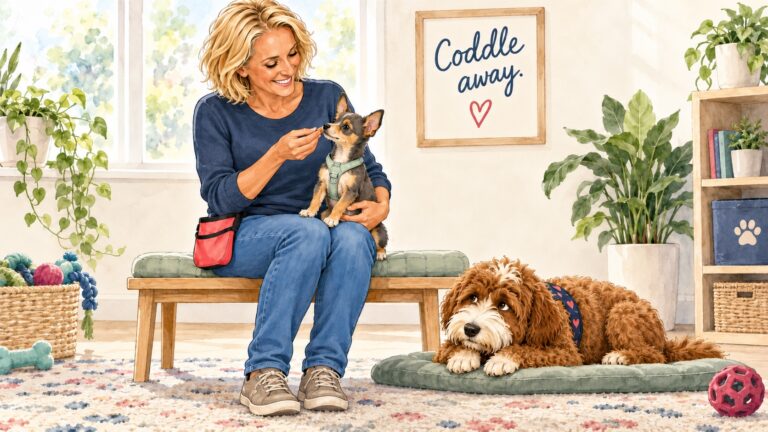
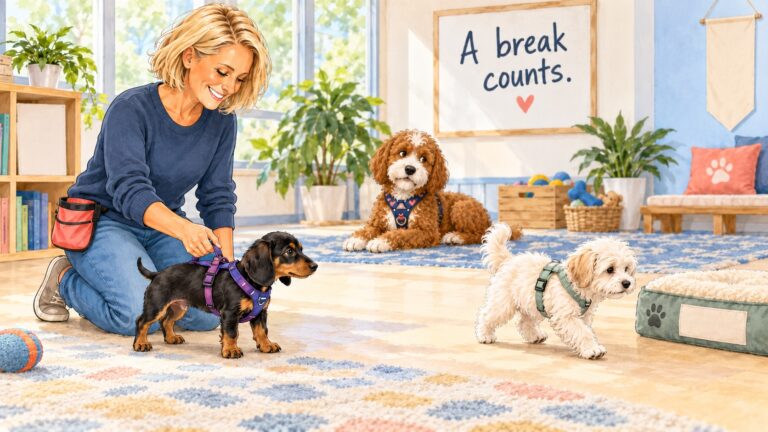
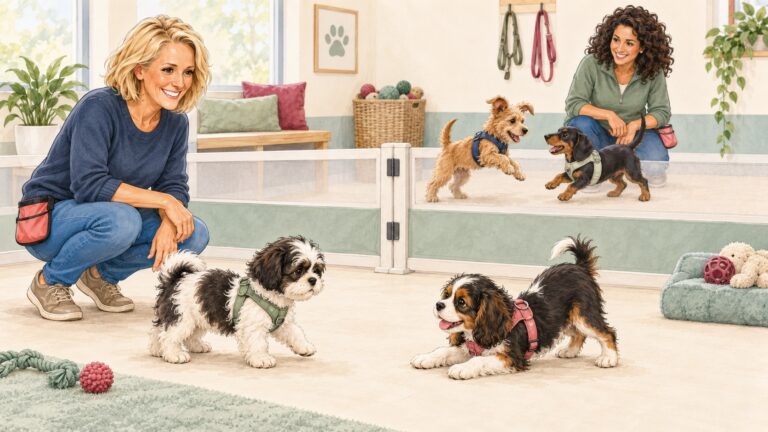
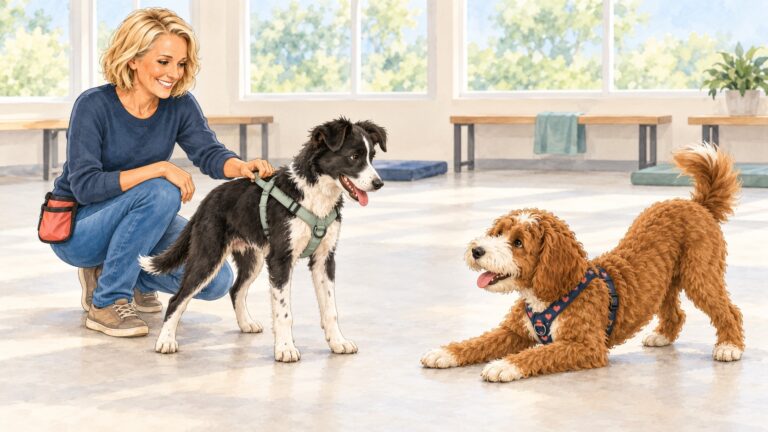
In our supervised classroom, that often means sitting on the floor near her, if she’s comfortable with us there. We leave her a clear way out. When another puppy wanders over, an adult greets or calls him away before he gets into her space. If he’s comfortable with gentle harness handling, we may pause him at a distance while the worried puppy stays free to move.
We manage the approach early. We don’t reach between dogs who are snapping, grab the frightened puppy, or block her exit. If either puppy is already too upset, we create more distance or use a barrier and let everyone settle.
Then do it again. And again. Every time, your puppy gets the same answer: Being near doesn’t have to mean being in my face. My people see me. They see that I’m scared. They’ve got me.
She doesn’t have to handle it alone. That’s the whole lesson we want her to learn: My person notices. My person helps me feel safe. With repeated experiences of support, looking for you can become another option when she’s worried.
And if you’ve been told that helping will make the fear worse, here’s why it’s okay to comfort your scared puppy.
That’s how we work toward less worried growling: by reducing the need for it.
Her feet, her pace.
We never coax. No luring her out from under the chair. No “come on, he’s nice, go say hi.” Coaxing can feel kind, but a cookie can draw a worried puppy closer than she’s ready to be. We don’t use food to pull her into a greeting she would otherwise avoid. She comes out when she’s ready. Her feet, her pace.
Watch the whole conversation.
Here’s the part I love. In our classroom, I often see a progression as a puppy becomes more comfortable. This is a pattern I’ve noticed, not a checklist every puppy has to complete.
First, she sniffs the wake. The other puppy turns to go, and she sniffs the air where he just was. Curious, from a safe spot, on her terms.
Then, the long neck. Muzzle stretched out, nose working, sniffing the other puppy from a distance. Sometimes she’s ready to get a little closer.
Then, sometimes, the paw. A front paw lifts toward the other puppy. Alongside a softer body and a playful approach, it may be part of an invitation. A lifted paw can also accompany uncertainty, so it never gets a green light all by itself. We keep watching.
And sometimes, the burst. After time with support and space, she takes off. Full-out zoomies, around and around the room. Running alone doesn’t tell us she’s comfortable, though. We keep reading her body and what happens next.
It’s one of the best things you’ll ever see.
The zoomies still need grown-ups.
Here’s what can happen with that burst. Other puppies see a runner and join the chase, whether or not she wanted company.
And if they all take her up on it, the scared kid who just found her courage suddenly has a whole pack in pursuit. That can overwhelm her all over again.
So our team knows: when the shy puppy breaks out into zoomies, we’re at the ready to slow the other puppies down.
Until we see loose bodies, playful invitations, pauses, and willingness to come back, we keep making space. The consent test helps us check, and we still read the whole game. The entire room, watching out for the scared kid.
The waiting is hard for the people.
I’ll be honest: the waiting is often the hardest part for the people.
Every parent in that room wants their puppy to be normal. They watch the puppy in the middle of the pile having the time of her life, and they look under the chair at theirs, and it hurts.
A cautious puppy isn’t a failed puppy. Watching first, asking for space, and approaching gradually can all be part of figuring out a new room. Some puppies warm up quickly. Others need smaller steps and more support. We don’t leave a puppy frightened week after week and call it patience; we adjust the setup and bring in individual help when she needs it.
Your patience gives us room to find what helps her.
I’ve been watching this exact scene for fifteen years. The science gave me the foundation. Watching the dogs, and watching their people, taught me the rest. Everything we do here, how we run the room, how we split it, how we train our Dog Life Coaches, has been shaped by both, so every puppy and every parent gets the best possible shot at doing well.
And it’s why our rule in every class is simple: we never punish a growl, a snarl, or a snap. We listen to it, and we help.
What to do when your puppy growls
Next time your puppy growls, snarls, or snaps at the air:
- Pause your instinct to scold. Take one breath.
- Ask: what is she telling me? Too close? Too fast? Too much?
- Create space safely. Call the other puppy away or use distance and a barrier. Stay nearby if your puppy welcomes your presence; keep hands out from between upset dogs.
- Don’t coax. Let her come back out on her own four feet.
- Watch the whole dog. Sniffing, a softer body, and a voluntary approach may show growing comfort. A lifted paw or zoomies alone aren’t permission to send a playmate over.
Growls, snarls and air snaps are part of a dog’s language. We want to hear the quieter words, too.
When she uses them, the right answer is the one we say in class every time:
Good puppy.
And then we change the situation. Listening means helping.
Help for a puppy who needs more space
If something feels bigger than a puppy who needs a minute, a growl that’s getting more frequent or a dog who’s skipping straight to a snap, that’s what our private behavior help is for. And if you want to see how we run the room, puppy classes and Life Skills meet at our Eden Prairie school. Questions? Ask Jeannie.
A sudden behavior change, pain, or sensitivity to touch also deserves a veterinary check.
For little learners, our small-breed groups are for puppies expected to weigh 25 pounds or less as adults. Every puppy deserves support that fits the puppy in front of us.
Jody & your Dog Life Coaches
Related: Why we keep off-leash play at every level · The consent test: read the whole answer · Why Go Anywhere Dog® splits the class, and then splits the room · Taking Back the Words: Calm · Taking Back the Words: Punishment · Aggression in dogs
Sources
Donaldson, J. Proximity sensitivity, as taught in coursework at The Academy for Dog Trainers. Jody’s recollection of Academy coursework; visit The Academy for Dog Trainers.
Dunbar, I. (2006; published online 2007). Body Language. Dog Star Daily. Read the article.
Herron, M. E., Shofer, F. S., & Reisner, I. R. (2009). Survey of the use and outcome of confrontational and non-confrontational training methods in client-owned dogs showing undesired behaviors. Applied Animal Behaviour Science, 117(1–2), 47–54. Read the study abstract.
Shepherd, K. Keeping ourselves safe near dogs: Teacher notes, Appendix 2, p. 8. Association for the Study of Animal Behaviour. Read the resource.