In This Video
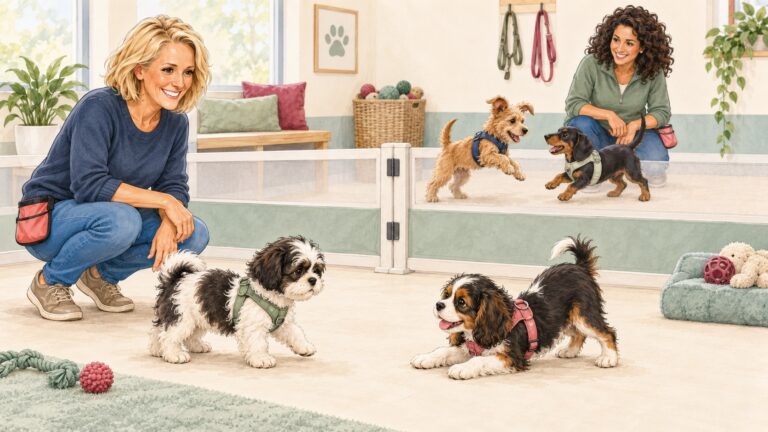
Off-leash play is one of the great joys of dog life, and one of the most misunderstood. This video explains what normal play looks like (play bows, play faces, self-handicapping, role reversals and activity shifts), how to use a consent test when you're unsure, how to handle humping, the five most common play problems (proximity sensitivity, play-skill deficits, bullying, resource guarding and predatory drift), why dogs play less as they mature, and five behaviors that set your dog up for success at daycare and the dog park.
Key Moments
- 0:00 — How off-leash play began with Buddha
- 2:03 — What's normal: play is rehearsal of life behaviors
- 3:03 — Play signals: play bows, play faces, bouncy moves
- 4:34 — Self-handicapping
- 5:06 — Role reversals
- 6:09 — Activity shifts and short breaks
- 7:45 — When in doubt: the consent test
- 9:16 — Humping in play
- 11:23 — Five common play problems
- 16:02 — Why your dog used to play nice and now doesn't
- 17:03 — Set your dog up for success
- 18:07 — Five behaviors for daycare and the dog park
Full Transcript
Off-leash dog play: dogs playing with dogs. Welcome to off-leash dog play. This is hands-down my favorite topic. Eleven years ago, I was walking my dog Buddha several times every day. I didn't have a fenced-in yard, and I lived with a heavy heart that I could not allow him off leash to enjoy the outdoors and run free until his little heart was content.
One day on our walk, just blocks from our home, I saw several dogs along the way, their humans attached, all headed in the same direction. So I decided to follow and see where they were headed. A few short steps into Minnehaha Park, they all entered a gate with a sign: Off-Leash Dog Park. I looked down at Buddha and squealed in delight. I couldn't get that leash unclipped fast enough. My sweet little boy's legs could hardly keep up with his enthusiasm, and it sent him tumbling. He didn't care; he popped back up and ran some more. From that moment, I promised him he would enjoy the outdoors free of a leash every day for the rest of his life.
Dog parks have so many benefits for both us and our dogs. The joy I see on the faces of both people and dogs is priceless. Along with that joy, I have witnessed the worry, frustration and concerns that ultimately rise whenever we're faced with something new and don't know how to navigate it. Just like when you put a lot of humans together in any confined space, incidents arise that make us question what we can do to help everyone get along. This video is aimed at helping you understand dog-dog play and the common problems that get in the way of the fun.
Here's what we'll cover in this video: what's normal and what's not; we'll talk about sex (humping); what to do when in doubt; common play problems; why your dog used to play nice and now doesn't; and teaching five behaviors for success at daycare and the dog park.
So, what's normal and what's not? Play is the rehearsal of important life behaviors. Important life behaviors for dogs include play fighting, play fleeing, play chasing and play courtship, which we'll talk about more in a bit. Despite our dogs receiving most of their food in a bowl delivered by us, much of their play revolves around the elements they would need to get food in order to survive without us. They will stalk, chase, grab, bite and shake their playmate, all in a toned-down way from the real thing. Yet it's all still the same moves they would use in a real fight.
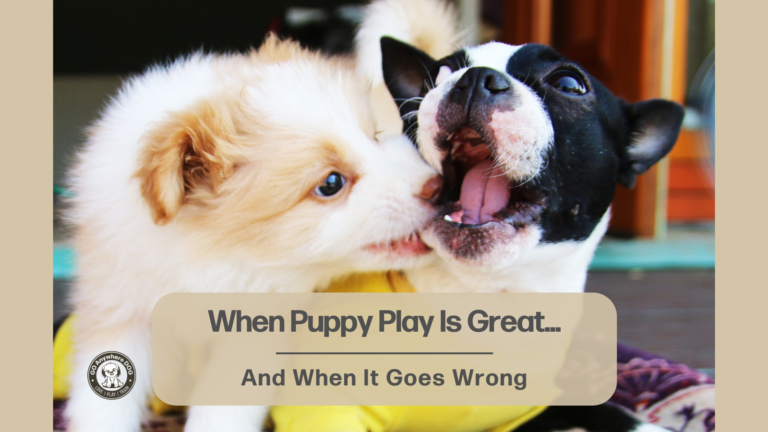
So if it's the same actions and moves as a fight, how do they know when another dog comes at them that it's not intended as a real fight? Or, even more importantly, how do we know when to intervene or not? Dogs have a communication system between each other to let each other know: okay, I'm going to jump on you and bite at you, but I'm just playing. The play bows we think are just simply adorable serve a very important purpose. A play bow can act as an invitation to play, or as a signal to let their playmate know this attack I'm about to do is all play, dude.
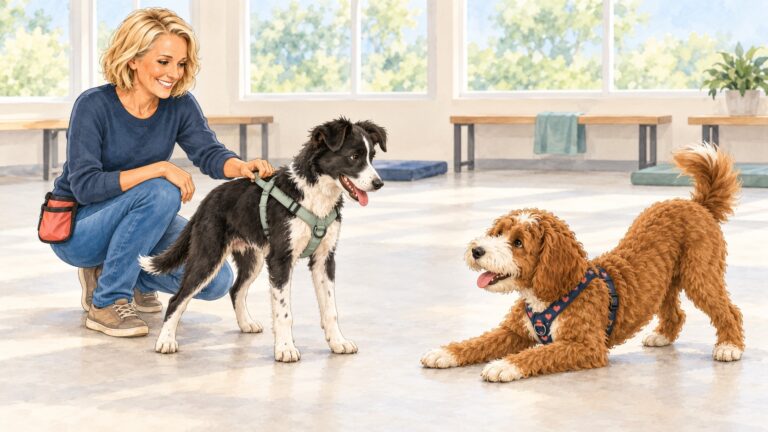
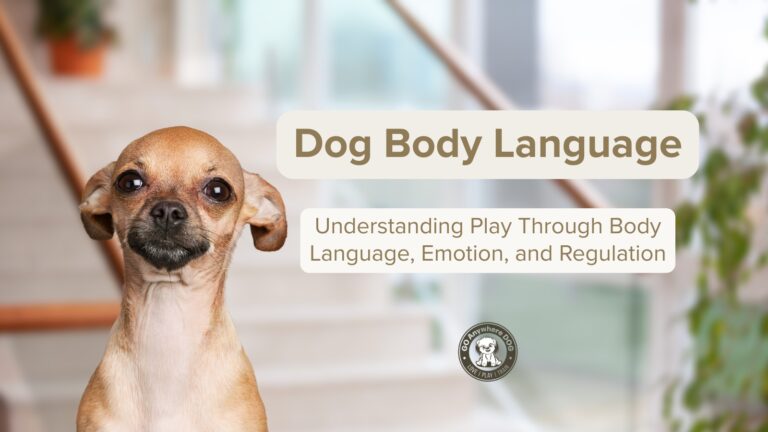
Along with play bows, you'll see play faces, which look a lot like a big, happy, open-mouth grin; high paw raises; very bouncy movements; and various play vocalizations. The moves are bouncy and exaggerated. Their bodies remain loose, and elbows are very bendy, not stiff or tense. Play is great fun when both dogs are in full agreement that this is indeed still play, and what the other dog is dishing out is still fun for both participants. Just as we keep a close eye on young children during play, since sometimes one player can go too far for the other, the same needs to apply to dogs.
Here are the things you'll want to watch for that help keep play fun. First up, we've got self-handicapping. This is how those same fight moves are also used in play. It's the same actions, but they're reduced greatly in the level of force. Bites are open-mouthed punches, and jaw pressure is fantastically reduced. Every move is dialed down and adjusted to the size and play style of their playmate. Some dogs are magnificent self-handicappers, allowing them to play with most any dog. Some dogs lack skill in how much they're able to self-handicap and aren't appropriate for play with those that are young or small, or that simply don't care for that hard level of play. Just like we don't care for everyone's style as playmates, neither do dogs. It's important to understand this: not all dogs should or have to play together.
Next, we've got role reversals. Much like with kids, fights often come about when one of the players is not taking turns. With dogs, we're watching for changes in who's on the bottom and who's on top. Is only one dog throwing out all the play bites, or are they both shifting from one to the other? Are there breaks from chasing? Who's getting chased, and who's the chaser? When dogs become very familiar with one another, you may see one dog on the bottom for a very long time. Usually the play moves are extremely dialed down in this type of play, and neither dog is too aroused or amped up. Unless we have super-gentle, not-all-out wrestling between dogs that know each other really well, we want to see lots of role reversals. With dogs that have little history together, you want to see them take turns.
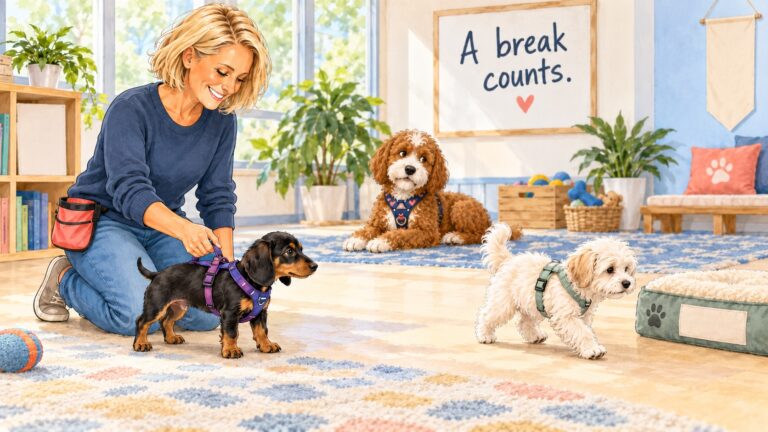
Next, we want to see activity shifts. Play goes best when dogs are switching up the game: one moment they're chasing, the next wrestling and play biting. They take brief pauses and resume the current game, or change it up a bit to a different style of play. Short little breaks and shifting to another style of play help keep many dogs from getting overwhelmed. For instance, one dog being pinned for just too long: think of a big brother or friend holding you down on the ground and not letting you up. After too long, it starts to get stressful and is no longer any fun.
Through all of this, the players are loose, with bendy elbows, have soft and floppy play faces, and are delivering lots of those play signals, like play bows and exaggerated moves. Whenever your dog first initiates play with an unknown dog, you'll want to keep a close eye and observe: are the elements of good play present? If not, with this particular dog, move along and find a more compatible playmate for your pup.
What to do when in doubt. Sometimes you may be unsure: is my dog having fun, or is he scared? Is that dog being just too rough for him? Pay very close attention here, because I'm giving you the most simple way to know for sure: the consent test. When you're in doubt, a consent test is your best route to knowing for sure.
A consent test is simply going in, taking the dog who appears to possibly be too rough by the collar, and pulling him away from the play for just a bit. Just move him back a few feet and hold him there by the collar. Leave the dog you're unsure about free to make a choice. If he comes bounding back at the restrained dog, it was play; they're both having fun. Let them go play again. If he goes away from the restrained dog, avoids him, tries to hide or goes off to play elsewhere, he's made his choice clear.
If your dog and another dog are playing quite rough, it's totally okay to do continued consent tests. It also gives them a break to de-escalate just a bit. If your dog is the one in question, and you think he may be playing too rough, pull your dog out of the play for a moment and let the playmate make her choice. If the rough player in question is not your dog, ask that dog's parent if they would mind getting their dog for a moment so you can see your dog's choice. When doing a consent test, it's always best for that dog's own person to be the one to pull the dog out. If your dog is engaging with a dog and you're concerned about the play, but their person is nowhere in sight, gather up your dog and move on, away from the dog in question.
Let's talk about sex. Humping. You know what I'm saying. Wow, does humping ever make most people feel uneasy. This one simple action of play gets some people really upset, and it can be complicated to navigate in off-leash dog play. You're going to have to determine what's right for you. Be considerate of how others feel about it and respect their personal feelings.
Humping is, no question, a normal part of play. Think about it: if play is rehearsal of important life behaviors, why would humping be the only thing left out? Just like fighting in play, it's not the real thing. And just like fighting, it can sometimes go too far, leading to a real fight. My best recommendation for you is to ignore mounting or humping behavior as long as it's short and it changes up, just like the role reversals we're looking for in any other type of play. If it goes on for too long, get in there and do a consent test. You'll know in moments whether both dogs were having fun. If one dog is persistent in humping efforts, it's no different than any dog being too persistent or stuck in any particular play mode. Gather your dog and move on to another playmate, or go enjoy a little walk or hike in the park.
Common play problems. After 11 years of regular participation at the dog park and managing thousands of dogs in off-leash play at daycare, I've seen some of the very same problems come about that create issues in play. I searched for a long time for a good breakdown of these issues, what to do and how to treat them. Once I began my studies with Jean Donaldson at the Academy for Dog Trainers, I was elated to learn her breakdown of these play issues, along with precisely what to do and how to treat them. Everything resonated with my experience. Here are the five most common behavioral issues that get in the way of enjoyable play.
First up, we've got proximity sensitivity. Some dogs have a social bubble, just like some of us. They're uncomfortable with strangers coming too close; sometimes this extends to loved ones too. Often you'll see this when another dog charges up too quickly, comes on too strong or just gets too close, up in her face. Most dogs with proximity sensitivity will growl, snarl or snap when another dog crosses their boundaries. It's completely normal and okay for your dog to communicate to another dog through growling, snarling or snapping to please back off. If your dog goes to the point of pinning another dog or biting, keep them out of the park and seek professional assistance first.
Play-skill deficit. I refer to these dogs as a one-trick pony. They often get stuck in one mode of play and quickly go over the top, tipping into a fight. They play this way with all dogs. They wrestle and hold another dog down, pinned for much too long, often escalating rapidly and lacking any role reversals. Or they thrust play-biting jabs over and over. Often the playmate gets frustrated or angry with their style of play and attempts to communicate “enough.” You'll see it more frequently with the various bully breeds, or dogs with a high frequency of arousal and excitement. If your dog has a play-skill deficit and has tipped into many fights, professional counsel can help modify it for many, but not all.
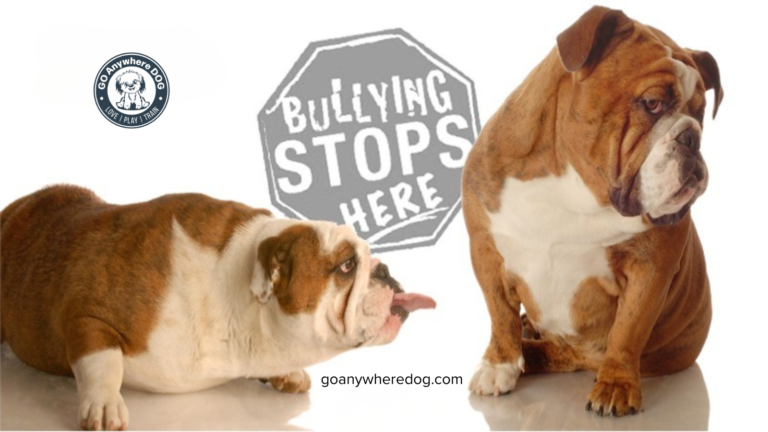
Bullies. These dogs play great with most dogs, showing lots of appropriate play skills, but they target specific dogs, pretty much like a kid that bullies certain kids. It can be a particular look or personality type of another dog that they specifically target. The interaction with their target dog goes very quickly to a fight, and they frequently pin them to the ground with thrusting threats of biting. Just like bullying with kids, bullying with dogs can have a great impact on the recipient's mental and behavioral health. Don't let your dog be a bully, and don't let your dog get bullied. There are personality types in dogs that tend to get bullied more often, too. Your dog being on either end of this needs to be addressed, and I recommend professional counsel for both. Bullies can often be modified by applying appropriate consequences for any sign of this behavior.
Resource guarding. Resource guarding can crop up a lot in off-leash play. We touched on the types of guarding we see in dogs in the aggression video. Some dogs will guard toys, food or loved ones at the dog park. This is completely normal. If your dog simply growls and shows teeth to back another dog away, this is acceptable communication. If your dog goes further, going after another dog that approaches, you'll want to either manage this by keeping him away from the objects that trigger it, or find other exercise and enrichment opportunities for him.
Predatory drift. Predatory drift is when one dog runs or squeals and triggers a prey response in another dog. The actions of the dog running or squealing are too similar to those of prey, and this triggers the prey-driven dog into a sequence of behaviors related to the hunt. Though not frequent, the outcome of predatory drift can be death, from the grab and shake, or catching, of what triggered this prey drive. Prevention is the only route. Big dogs with small dogs is the number one area where this occurs. Don't ever let large dogs chase, in a flat-out run, small dogs they could potentially pick up and shake. If your dog is a finisher of prey, and has killed rabbits, birds, squirrels or such, don't ever give your dog access to really small dogs.
Why your dog used to play nice and now doesn't. Most young children love to play, and play with anyone who will play with them. The same goes for dogs. As dogs reach social maturity, between the ages of one and a half and three years old, three things are noted among many: a reduction in play (they play less overall); more selectiveness in playmates (they know who they enjoy playing with and who they don't); and less tolerance of youngsters that lack polished social skills, or of dogs with a particular play style they just don't enjoy.
This is completely normal, and it's important to simply know your dog. What does she tolerate well, and what doesn't she? Respect this about her, and provide opportunities she enjoys, while trying not to put her in situations she no longer finds fun.
Set your dog up for success when playing with other dogs. First, get those ya-yas out. Before your dog goes someplace with opportunity for hard play with other dogs, make sure your dog is not bursting with energy and super high-strung. Many people take their dogs to the dog park as the only way to run out all those ya-yas. The problem is, many of these dogs come on much too strong until they've expended some of that energy. If this is familiar for your dog, try playing a game of fetch or tug, or get out for a run, before heading to the park or daycare. You'll set your dog up for much greater success at having fun with friends, rather than causing mayhem for everyone. Some dog parks have great opportunities for hiking: take the hiking trails first, and then join the meetup spot for play later.
Teach touch, sit, stay, leave it and a supercharged recall. Sitting at gates, waiting to enter, rather than jumping up and getting all amped up. A simple request of “leave it” when your dog approaches a dog you know it often doesn't go well with. A call of “touch” to gain your dog's interest in playing with you and take a moment's break from play that was heating up too much. And the safest dog at the park or daycare is the dog with a spot-on recall, giving you the ability to call your dog directly to you, no matter what concern may arise when you're out enjoying life together.
Get yourself over to the Teach section and practice those five behaviors to fluency with your dog. It won't take long. You'll learn how to incorporate practice into everyday life, and quality of life for both you and your dog will skyrocket. Those five behaviors open up many doors for participating in loads of fun. Have fun, and play safe.