Taking Back the Words is our series on vocabulary the dog training industry broke — and why we refuse to stop using it. Some trainers throw out a word once it’s been corrupted. We’d rather take back the truth of it. Through mechanism, with a dash of humor and love.
The puddle
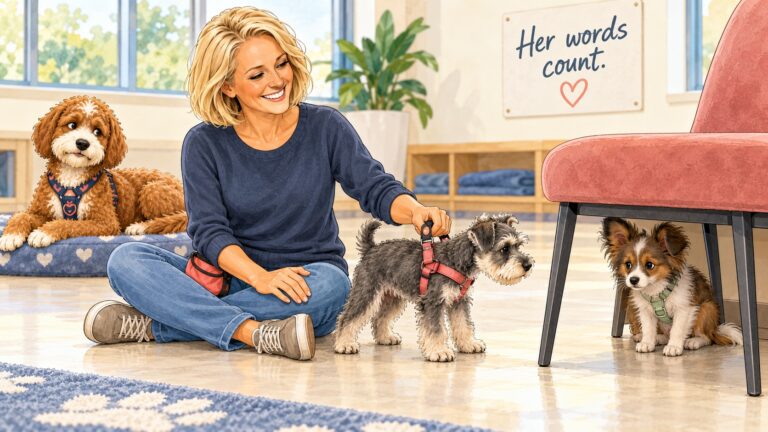
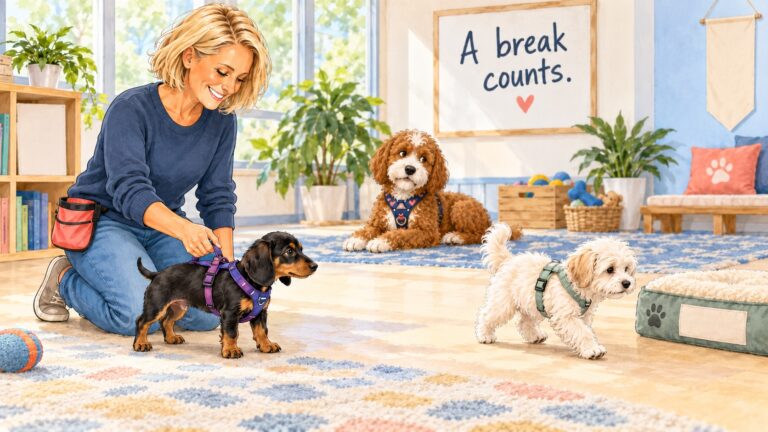
Mid-class, right in the middle of the mat, a puppy squats.
His person’s face does the thing. You know the thing. Mortified. And the apology starts before the puddle’s finished: He knows better. I’m so sorry. He never does this at home.
Here’s what she gets: "I’m sorry, we haven’t shared my biggest rule yet. You’re not allowed to be embarrassed in this room by your puppy. You didn’t birth him."
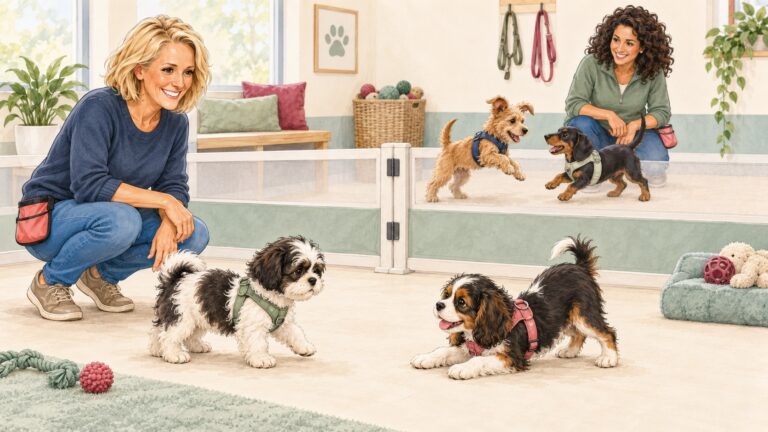
The room laughs. Paper towels arrive from three directions. Somebody scoops up the other puppies. And then the real lesson happens — because now, and only now, she can hear it.
Hold onto that order. The laugh isn’t decoration. Embarrassment is what makes "he knows better" so attractive: it moves the failure from the parent to the dog. Take the embarrassment away and the parent can finally hear the true sentence, which is he doesn’t know yet.
The people who saw it first
A note on the word before the witnesses. The training industry didn’t corrupt "naughty." It banned it. Say it in certain circles and you’ll get the vocabulary lecture: dogs can’t be naughty, there’s no moral agency, please say "displaying undesired behaviors" like a civilized person.
Meanwhile you just watched your puppy make eye contact with you, pause for effect, and eat the couch. You’re going to call that naughty. So would we. It’s affectionate — it’s what you call a being you love who’s currently a menace, and nobody says "naughty" about a dog they’ve given up on. We keep the word. We just renovate what’s inside it, and the renovation has a hundred years of paperwork.
Pavlov’s lab, 1927. His dogs, trained to a tone, drooled at neighboring tones too — less and less as the pitch moved away. What an animal learns, it learns near where it learned it. Move far enough and the learning fades out.
A pigeon lab, 1956. Norman Guttman and Harry Kalish trained pigeons to peck a key lit one exact color, then changed the color. The further it drifted from the training wavelength, the less the pigeons pecked. They drew the curve. A new room is a different wavelength.
Seattle, 1979 — then forty years in Vermont. Mark Bouton spent a career on one finding, and it’s more precise than "dogs don’t generalize." The first thing an animal learns travels. The second thing — the not-doing, the rule that overrides the first — stays tied to the room it was learned in. Teach a rat to fear a tone, then teach it in a second room that the tone is safe, and the fear is gone in that room only. Walk it back to the first room and the fear is back. The new rule never left the building. The override isn’t something the animal carries in its pocket. It’s a rule plus the room.
The pediatricians, 2003. The American Academy of Pediatrics opens its page on toilet-training regression with a mother’s story: her daughter did great for two weeks, then started at a new child-care center — and it was like she’d forgotten everything. The Academy’s list of common causes starts with a change in setting. Nobody in that story says the toddler knows better.
New York, 2009. Alexandra Horowitz tested the "guilty look." Fourteen dogs, a forbidden treat, owners out of the room, then back in — sometimes told the truth about what their dog did, sometimes not. The look had nothing to do with whether the dog had eaten the treat. It followed the scolding. And the guiltiest faces in the study belonged to dogs who hadn’t touched the treat and got scolded anyway.
Budapest, 2012. Julie Hecht, Ádám Miklósi and Márta Gácsi ran it again with sixty-four dogs. Same result — and the owners couldn’t tell from the greeting whether their dog had broken the rule. Without a scolding, there was no guilty look at all.
Six witnesses. The learning stays where it was learned. The guilt is on your face, not his.
What the science says
The parent thinks the dog has a rule: don’t pee inside. The dog has a place: when I’m here, this is where I go. He learned it in a kitchen, in a routine, on a surface, with a certain person taking him to a certain door. Change any of it and the behavior isn’t in the new room yet. That’s not defiance. That’s Guttman’s pigeons at a different wavelength.
And house-training is Bouton’s second thing exactly. The first thing he ever learned — when you’re full, go — travels everywhere he goes. The second — hold it, and go there — is the override, and the override stays home.
"He knows better" needs the dog to be carrying the rule around. He isn’t. He’s carrying a reinforcement history, and it has an address. The dog who "knows better" is a dog who knows a kitchen.
And the face you take as proof — the low head, the whites of the eyes, the slink — is the same behavior Horowitz filmed on innocent dogs. It’s his read of you. In the Leader post we watched the puppy check his person’s face to decide whether the world was safe. This is that, pointed the other way: your face says trouble, so his body says please don’t. Not a confession. A weather report.
So here’s what’s actually inside the word, every time:
Naughty is normal. Chewing, digging, stealing, jumping, peeing on the rug — that’s not a defect in your dog. That’s a dog. You brought a young predator-scavenger into a house full of upholstery. He’s not breaking rules. He’s crushing his job description.
Naughty is rehearsed. Behaviors repeat because they pay. Counter-surfing pays in chicken. Jumping pays in attention — even the mad kind, which to a puppy is just the loud version. He’s a brilliant little economist with no morals and excellent memory.
Naughty is a want with nowhere to go. The digger needs to dig somewhere. The 7pm maniac has a body full of unspent puppy. A need showing up out of uniform.
Naughty is ungeneralized. He knows it here. He hasn’t learned it there. Every new room is a new question.
Once you know what’s inside it, "naughty" stops being a verdict and becomes a diagnostic: what’s paying, what’s missing, what hasn’t been taught — and what hasn’t been taught here. Every naughty moment comes with its own instructions.
Our one line, and you can keep it: he doesn’t know better. He knows a kitchen.
Two rooms, same mechanism
The dog. Back to the puddle. Everyone wants to know the tell — the signal that says he needs to go. Here’s the honest answer: that’s a myth. The true tell looks exactly like a gazillion other things a puppy does. Sniffing looks like sniffing. Wandering looks like wandering. Wait for the tell and you’ll clean a lot of floors.
So we don’t teach the tell. We teach when.
Whenever he wakes up — and ask yourself what you do first when you wake up. Within fifteen minutes of eating or drinking. After any intense play or zoomies, the moment it stops. Those three run the bladder; you don’t read the dog, you read the clock. And in any place he hasn’t proven himself yet: a good outside period before you walk in the door, and then every hour on the hour until he’s built a history there.
He is only just learning when I’m here, this is where I go. Somewhere along the way he’ll also build a way of telling you. You don’t wait for it. You run the schedule, and you let him be right, in room after room, until "here" means everywhere.
Which brings us to Thanksgiving. Don’t go to grandma’s assuming he’ll know not to pee in her house. He hasn’t learned not to pee inside. He’s learned where to go at yours. Grandma’s is a new wavelength, and the only thing that travels there with him is what you pack.
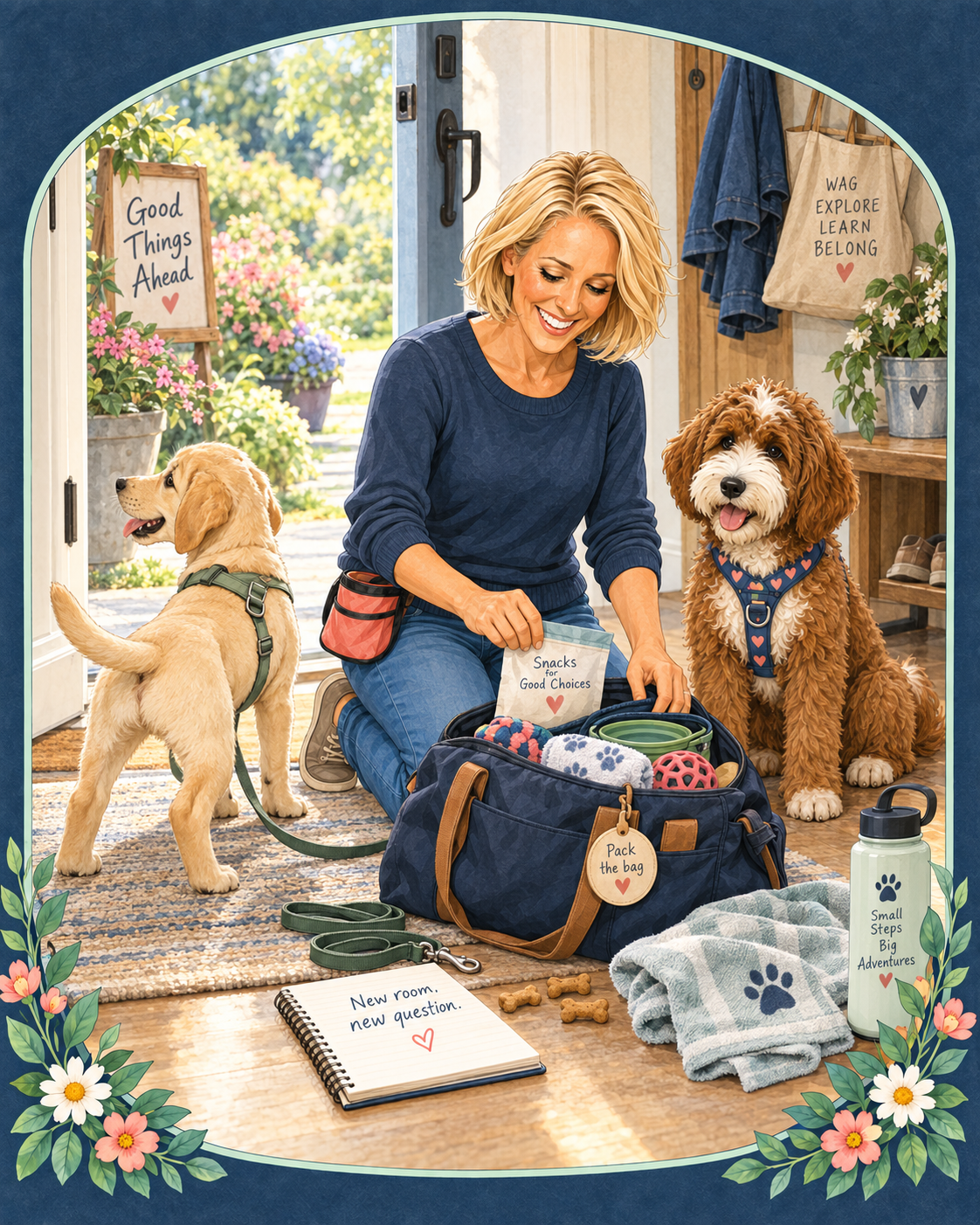
The human. So pack it. We tell every family the same thing: it’s no different from a human infant — you don’t leave home without the diaper bag. Snacks. Poop bags. A small spray bottle of disinfectant and microfiber cloths. Puppy pacifiers — chewies — and toys. All outings. Diaper bag equals prepared parent.
Look at what’s in it and you’ll see the whole post. The snacks pay the right spot in the new room. The pacifier gives the want somewhere to go that isn’t grandma’s table leg. And the spray bottle and cloths mean the accident costs nothing — no drama, no loud voice, no guilty face — so the puppy never learns that grandma’s living room is where people get scary. You didn’t birth him. But you brought him home, and you carry for him what you’d carry for the one you did.
And the toddler in the Academy’s story — two weeks of success, then a new building, then accidents? Same wavelength problem. Same fix. Nobody handed her a lecture. Somebody handed her a routine and a bag.
The prediction
You’re going to take him to grandma’s. He’s going to pee on the rug. And someone at that table — possibly grandma — is going to say he knows better.
Here’s what actually happened. You moved the wavelength and left the bag in the car.
Pavlov’s dogs faded at the neighboring tone. Guttman’s pigeons stopped at the new color. Bouton’s animals lost the new rule when the room changed. The Academy’s toddler forgot everything at the new daycare. Horowitz’s guiltiest dogs were the innocent ones. Your puppy knows a place. He’ll learn the next one exactly the way he learned this one — if you bring the pieces.
So the test, and it works on the couch, the counter, the rug, and the rest of it:
Where did he learn it — and is he there now? When did he last wake, eat, drink, or zoom? What paid the last time he did it, and who paid it? Is the bag in the car?
We’re keeping the word. Naughty. Say it in class — we’ll laugh with you, because it’s funny and he is. Just know that around here it doesn’t mean bad dog. It means normal dog, unpaid invoice, unmet need, or new room. All four are fixable.
The couch, less so. Sorry about the couch.
One question to take home: if he only knows what’s been taught in this room, what have you packed for the next one?
Next week: the word we’re supposedly against. Obedience.
— Jody & your Dog Life Coaches
The stance behind the series: The Go Anywhere Dog® Manifesto. The machinery: Our Methodology. Earlier in the series: Calm · Leader.
Want help setting up the room for your own puppy? Puppy classes in Eden Prairie, or in-home training across Minneapolis and nearby suburbs.
Sources
- Pavlov, I. P. Conditioned Reflexes: An Investigation of the Physiological Activity of the Cerebral Cortex (trans. G. V. Anrep). Oxford University Press, 1927 — the lectures on generalization and differentiation of conditioned stimuli.
- Guttman, N. & Kalish, H. I. "Discriminability and stimulus generalization." Journal of Experimental Psychology, 51(1), 79–88 (1956).
- Bouton, M. E. & Bolles, R. C. "Contextual control of the extinction of conditioned fear." Learning and Motivation, 10, 445–466 (1979). Bouton, M. E. "Context and behavioral processes in extinction." Learning & Memory, 11(5), 485–494 (2004) — extinction "generates new learning that is especially context-dependent."
- American Academy of Pediatrics. "Potty Training Regression." HealthyChildren.org (from Guide to Toilet Training, AAP, 2003).
- Horowitz, A. "Disambiguating the ‘guilty look’: Salient prompts to a familiar dog behaviour." Behavioural Processes, 81(3), 447–452 (2009).
- Hecht, J., Miklósi, Á. & Gácsi, M. "Behavioral assessment and owner perceptions of behaviors associated with guilt in dogs." Applied Animal Behaviour Science, 139(1–2), 134–142 (2012).