When I first opened a training school, I called it DogSense Unleashed. That name was for me. It’s what I cared about: dogs making sense.
Go Anywhere Dog® came later, when I finally saw what families wanted.
They wanted their dog at the park with friends. At daycare. At the family cabin. On the patio, at the brewery, in the hardware store. Everywhere was turning dog-friendly, and people wanted their dogs to come along for all of it.
And nobody was teaching the dogs how.
What I watched instead was people yelling at their dogs for having big feelings in places nobody had prepared them for.
Dogs needed a classroom for real life.
Before all this, I spent years running a dog daycare. Up to 125 dogs a day. It taught me something fast: no one was training dogs for the lives they were actually living in the 21st century.
Training had grown up around the competition ring and the backyard. Heel. Sit. Stay. A dog alone with one person. But the dogs walking through my door weren’t living that life. They were living in a social world, with other dogs, all day long, and almost none of them had been taught a single social skill.
And the explanations people reached for were stuck in another century, too. That dog is just bad. That one is dominant. That one’s an alpha.
I’d spent years in child daycare before dogs. When I hired trainers to help teach my team, they saw dominance on my floor. I saw toddlers. The same grabbing, the same “MINE,” the same play that got too rough. Not bad dogs. Not dominant dogs. Dogs being dogs, who needed to learn good social skills, exactly the way the two-year-olds did.
(The whole story of that floor is coming in the last post of our Taking Back the Words series. It deserves its own room.)
Off-leash puppy class has a birthday.
In the early 1980s, veterinarian and behaviorist Ian Dunbar started teaching puppies off leash in Berkeley, California. Before that, school was mostly for dogs over six months, on leash, drilling obedience for the ring.
What gets left out of that story is Dunbar’s own warning. Puppy class was never meant to be the end of it. He’s written that dog-dog problems tend to show up early in adolescence, often right when walks and play dates drop off, and that socialization “must continue indefinitely.” He also noted it often heads downhill fastest for very small and very large dogs.
Puppy class cannot be the finish line. And dogs need chances to practice off leash beyond it.
We never stop.
Relationships are learned.
For a long time, the go-to explanation for dogs squabbling was rank. Every dog trying to climb a ladder.
In 2009, John Bradshaw and colleagues at the University of Bristol looked hard at that idea. They studied a group of dogs living together at a rehoming center and found relationships between particular pairs of dogs, but no overall pecking order. Their conclusion: what dogs have learned from each other, plus how much they value the thing in front of them, explains dog-dog conflict better than dominance does.
Read that again with a daycare floor in mind. Relationships are learned. Which means they can be taught. Which means they need a classroom.
Play isn’t a break from learning.
Neuroscientist Jaak Panksepp mapped PLAY as one of the core emotional systems built into the mammal brain, sitting right alongside fear and care. It’s not something we permit. It’s something every puppy, and every child, is wired to do.
Child development researchers Anthony Pellegrini and Peter Smith reviewed physical activity play in kids and described rough-and-tumble play as a distinct social activity. They were careful about what the evidence could prove: benefits for reading emotions were still uncertain.
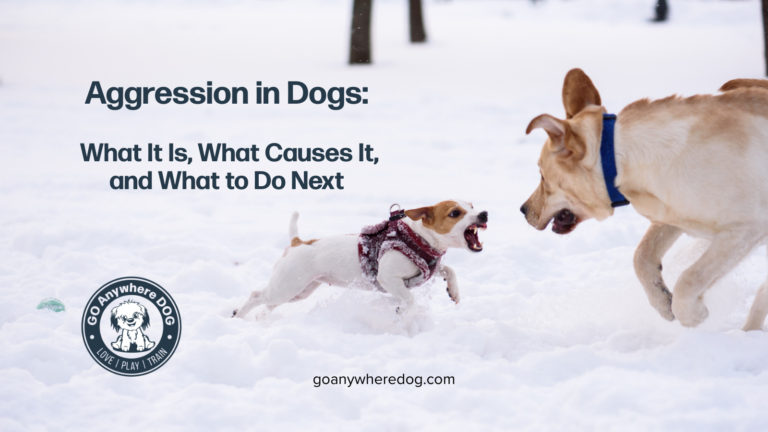
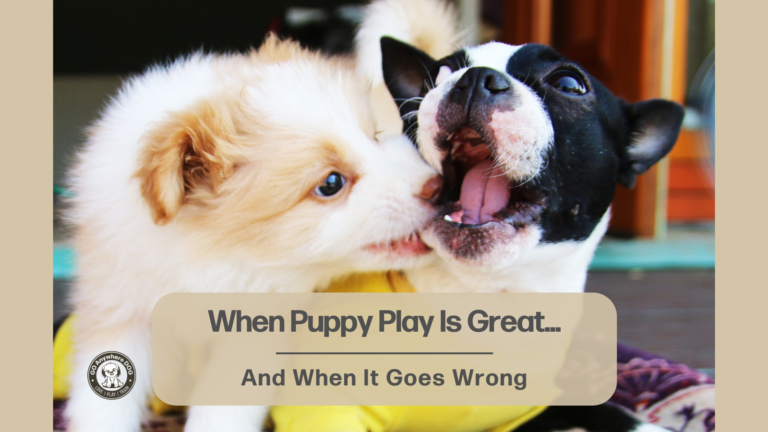
What I learned running daycare was easier to see: play-fighting and real fighting can look alike from across the room and very different up close. You have to watch the whole conversation.
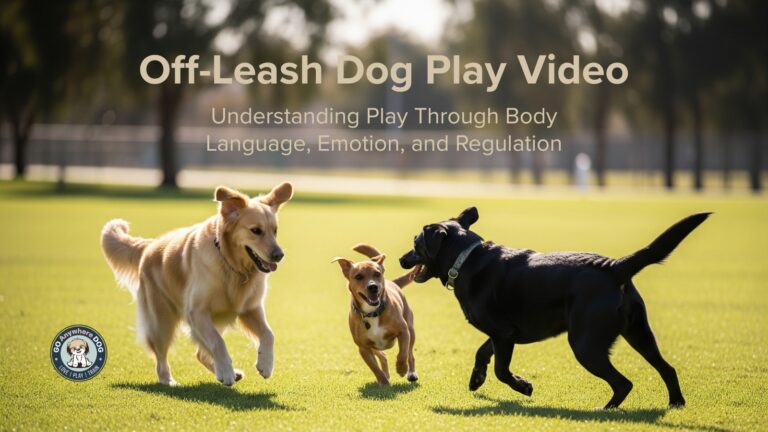
I see that same need to watch closely in dogs. Off-leash play is where they learn to ask, to answer, to say “too much,” and to come back after a pause. You can’t teach that to a dog on a leash six feet from every other dog. (More on why in our manifesto.)
Social learning doesn’t finish at sixteen weeks.
Here’s the part most people don’t know: a dog’s social life doesn’t finish at sixteen weeks. It changes.
Dogs reach social maturity at different ages—roughly one to three years, with plenty of individual variation. My teacher, Jean Donaldson, founder of The Academy for Dog Trainers, taught us three changes to watch for:
- They may play less.
- They may get pickier about who they want to play with.
- They may get less tolerant of behavior they don’t like.
That’s when dog-dog issues can show up. That’s when we get the phone call.
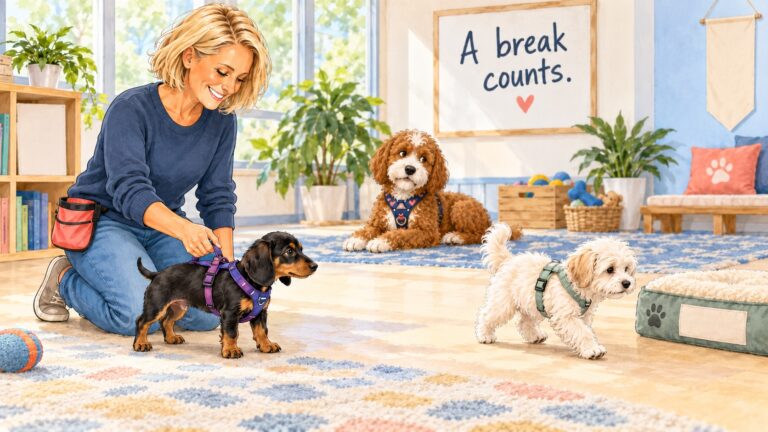
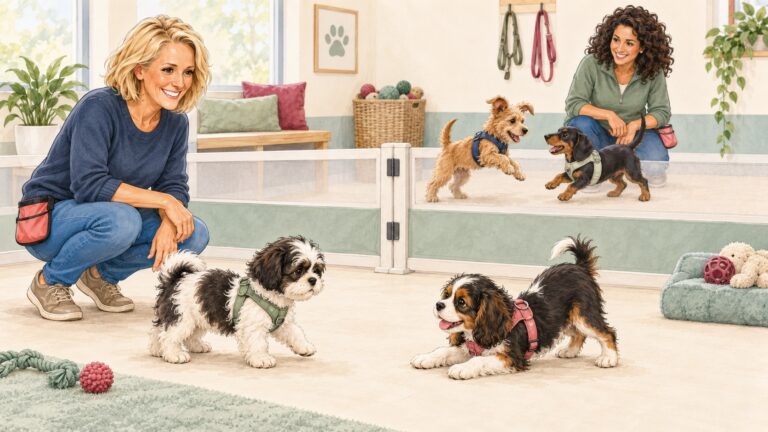
So every class in the GAD program, from Puppy & Me through Life Skills 301, keeps off-leash play in it, with the room split by size, age, play style and how much worry we see when a dog walks in. Puppies practice the language. Adolescents practice it while their brains and hormones are rearranging the furniture. And by the time they reach social maturity, they’ve had repeated practice at reading another dog, taking a break, and coming back on good terms.
And the play makes everything else work. We stop and start it all class long, on purpose, because a dog has to be allowed up to learn how to come back down. The skills come too. Obedience is a lot easier to build on a dog who isn’t spending all his energy wondering about the dog across the room.
The consent test: let the other dog answer.
We run this in every class, at every level. It’s called a consent test. Read the full guide to the test—and why a yes isn’t the whole answer.
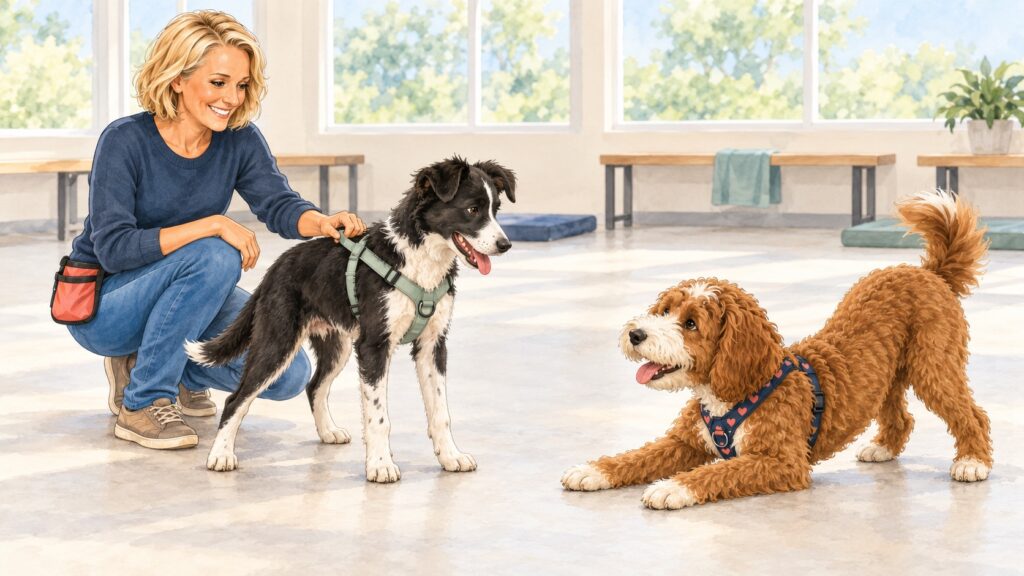
When one dog looks like he might be coming on too strong, we gently hold him back. Now the other dog, the underdog, gets to vote with her feet.
Does she come back toward him, offering the signals that say let’s play? The bow, the bounce, the loose wiggly body. Or does she use the moment to get out?
Either answer is a good answer. What matters is that she gets to give it. She answers the question for herself, every time.
The same listening matters when the answer gets louder: what we do when a puppy growls, snarls, or air snaps.
You can run it at the park, too. If play starts to look lopsided, hold your dog back for a few seconds and watch the other one. If she comes back with a loose, playful invitation, she wants more. If she leaves, she’s asking for a break. Honor it. (Here’s what that slide looks like.)
It’s the same question we ask the littlest puppies in the room: whose feet are moving?
Your dog lives in a social world. He deserves to be taught how to live in it. Not just at sixteen weeks. All the way up.
Off-leash dog classes in Eden Prairie
Classes meet at our Eden Prairie school. Puppy & Me for puppies under 16 weeks. Life Skills 101 for puppies 16 weeks to under a year. Off-leash play in every one. Not sure where to start? Ask Jeannie.
Jody & your Dog Life Coaches
The stance behind it: our Manifesto. The machinery: our Methodology.
Sources
American Animal Hospital Association. Age and behavior. 2015 AAHA Canine and Feline Behavior Management Guidelines. Read the guidelines.
Bradshaw, J. W. S., Blackwell, E. J., & Casey, R. A. (2009). Dominance in domestic dogs—useful construct or bad habit? Journal of Veterinary Behavior, 4(3), 135–144. Read the source
Donaldson, J. Social maturity in dogs, as taught in coursework at The Academy for Dog Trainers. Jody’s recollection of Academy coursework; visit The Academy for Dog Trainers.
Dunbar, I. (2010, March 2). It’s all about adolescence. Dog Star Daily. Read the source
Dunbar, I. (2012, January 3). Happy birthday puppy training: Time for another paradigm shift in puppy raising. Dog Star Daily. Read the article
Panksepp, J. (1998). Affective Neuroscience: The Foundations of Human and Animal Emotions. Oxford University Press. Read the chapter on rough-and-tumble play.
Pellegrini, A. D., & Smith, P. K. (1998). Physical activity play: The nature and function of a neglected aspect of play. Child Development, 69(3), 577–598. Read the source