Taking Back the Words is our series on vocabulary the dog training industry broke — and why we refuse to stop using it. Some trainers throw out a word once it’s been corrupted. We’d rather take back the truth of it. Through mechanism, with a dash of humor and love.
The scruff
It’s the third time the puppy has jumped on the woman next to him, and this time his person has had it. Hand on the scruff. Face down into his face. The voice nobody uses in public.
The room goes quiet the way rooms do when everyone is waiting for the lecture.
Here’s what happens instead. The trainer walks over and says: "Oh my goodness, he got you upset. Let me show you another way to handle that behavior — one that’ll get you the actual results you want."
No lecture. No vocabulary correction. Thirty seconds later there’s a puppy in a pen, a parent who just learned something, and a room that exhaled.
Notice what we didn’t do. We didn’t scruff the parent for scruffing the puppy. Hold onto that. It’s the whole post.
The people who saw it first
Punishment is the word our own side threw out. Somewhere in the last thirty years, "good trainers don’t punish" became the membership card, and anyone who said otherwise got sorted into the other camp — the shock collar, the alpha roll, the man with the calm voice and the box on the dog’s collar.
That sort was built on real science. It was just built on half of it.
A rat lab, 1944. William Estes shocked rats for pressing a lever. The pressing stopped — and when the shock stopped, the pressing came right back, in full, as if the rats had learned nothing except to be afraid. His study became the evidence for nearly everything the field would later say about punishment.
Harvard, 1953. B. F. Skinner defined punishment to include presenting an aversive event or withdrawing a positive reinforcer. His chapter discusses shock research and examples such as fines and social withdrawal. That history gives us an essential job: name the actual procedure, the behavior it changes and its effects on the learner. The label alone cannot do that work.
A lab in 1962. Harold Weiner had adults press a button for points, then introduced a point cost per press. Responding changed and recovered after the cost was removed. Taking something away can change behavior. What that costs the learner is another question, and it belongs in our assessment too.
1965. Harold Leitenberg asked the question the field is still confused by: is losing your turn — time-out from the good stuff — actually aversive? His answer, from the lab: yes, in the technical sense. An animal will work to avoid it — and the studies that followed him found it would keep working to avoid it even when the avoiding cost it food. That’s what the word means in a laboratory. It has nothing to do with pain.
1966. Nathan Azrin and Werner Holz reviewed punishment research, including procedures that deliver aversive stimulation. The effects of those procedures matter. They do not let us treat every possible loss of access as identical to a shock, or pronounce every loss harmless.
1972. Alan Kazdin took stock of a decade of response cost — points, tokens, privileges taken away, in clinics and classrooms — and found a procedure that reliably reduced behavior and kept the people in the room.
A hotel bar in Vermont, 2013. Bob Bailey — who spent a career training animals for the Navy and chickens for anyone willing to learn — walked past a table of the field’s brightest names to sit with two Minnesota dog trainers until two in the morning. It was the most candid conversation we’ve ever had with anyone in this profession. What he said: everything he taught applied to an animal in the box. Controlled environment, professional timing, every contingency in the trainer’s hands. Take the animal out of the box, and the world starts paying for behavior too. He knew it. Most of the field still pretends otherwise.
These witnesses give us distinctions worth keeping: how a procedure changes behavior, what else it teaches, and what happens when the animal leaves the controlled setting. Those questions belong together.
What the science says
Two different things, one word. Here’s the mechanical difference, and it’s the only part you need.
Delivered. Something arrives — pain, a scare, a hand in the face. The body files the arrival, and it files what was standing there when it arrived: the person. That’s classical conditioning doing what it does. The person becomes a signal for the thing, and the suppression Azrin and Holz catalogued follows that signal around the house. Quiet, on credit.
Subtracted. Something desirable leaves: the game, the opportunity, access to play. That is still an experience. The dog can form associations with the person and the way it happens. We make the limit brief and understandable, keep a workable alternative available, and watch what the learner does next. Losing the game can provide useful feedback; its implementation matters.
The label tells you the procedure. The learner tells you its effects.
And here is why the world belongs in the plan. The counter pays in chicken, the squirrel pays in chase, the other dog pays in attention. Some of those payoffs are intermittent and worth trying for again. Reinforcement builds our wanted response; thoughtful management and appropriate loss of access help address the competing ones. “No consequences” does not stop consequences. It leaves the environment handing them out.
For a consequence attached to a missed cue, relevant fluency matters: can the dog perform the response to the hand signal or word, with these distractions, distance and duration? So does present capacity. Confusion calls for teaching; distress calls for support. Protection and developmentally appropriate social boundaries do not wait for that cue-training milestone. We can stop rough play now while teaching better play.
Our one line, and you can keep it: punishment means the behavior went down. It does not tell you what the experience cost. We measure the response and protect the learner.
Two rooms, same mechanism
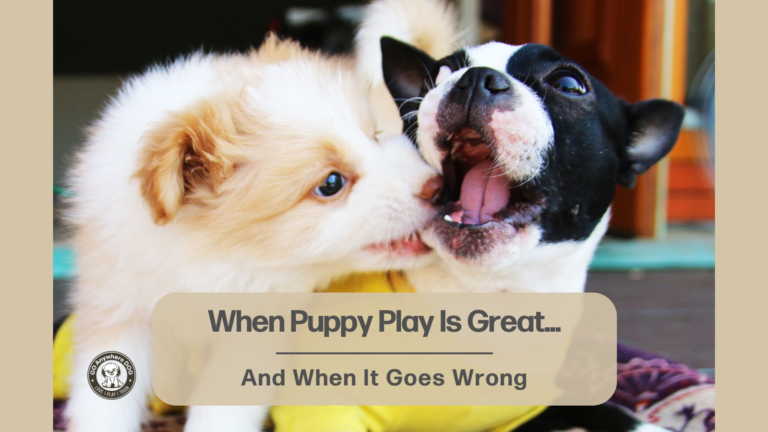
The dog. A hard bite can end a game from the beginning. Puppies arrive with different histories; we teach gentle interaction while protecting skin. A brief pause removes access to the activity that was paying. We make the next chance manageable and reinforce softer play. We do not need pain or intimidation to make teeth-on-skin a boundary.
A consequence for not performing a taught cue comes after fluency: hand signal or word, among distractions, at the distance and duration that matter. Fluent in the kitchen at two feet is not fluent at the park at thirty. We do not charge a learner for a response we have not built there. Meanwhile, management, safety and social boundaries remain in place.
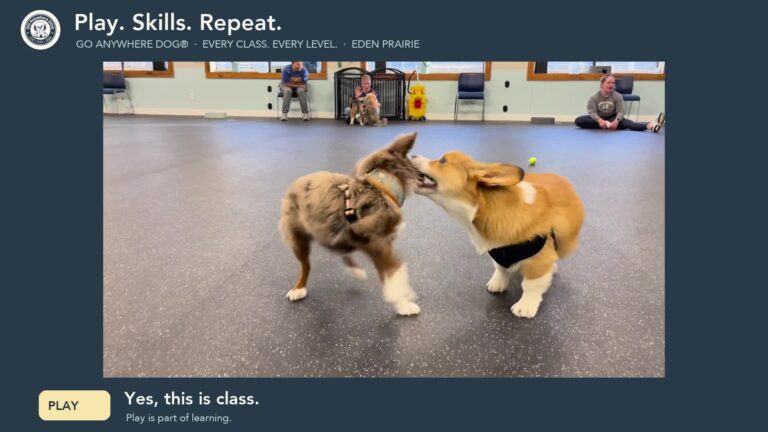
In class, the consequence is the room. Jumping on people, playing too rough, escalating — all three are paid for by access to people and dogs, so that’s what leaves. Thirty seconds held by the parent: freedom and play gone, person still in hand. Later, if it’s needed, one minute in the time-out pen: no people, no dogs. It’s remarkably effective, and for a reason that has nothing to do with the clock. The thing removed is the exact thing that was paying.
A time-out has to work for the mammals actually present. If the parent can comfort a distressed puppy, they can join while play stays unavailable. If the parent is embarrassed or angry, both may need breathing space. We adjust the separation, supervision and next attempt rather than leave a panicking dog to struggle. The rest of the room needs protection too. We preserve safety and connection; proximity depends on what helps.
Read both ends of the leash. Protect the whole room.
The human. A parking ticket can change where you park without teaching you a better parking skill. It is an ordinary example of response cost, not proof that losing something never distresses anyone. Meaning, magnitude, history and the available next response all matter.
Now the parent from the scruff. The human needs a usable exit ramp from their own surge, and the room needs the rough interaction to stop. A time-out can do both. We weigh frustration, safety and the realistic alternatives in front of us, then keep watching. Escalating panic, unsafe handling or an adult unable to help calls for a changed plan. We are aiming for a better next attempt, not winning a contest over who can endure the most.
The prediction
Someone is going to tell you time-outs are cruel. Someone else is going to tell you he needs a firm hand. They’re using the same word, and neither one has separated what arrives from what leaves.
One person will say time-outs are cruel. Another will say the dog needs a firm hand. Neither slogan reads the room. Ask what was removed or delivered, what response changed, what else the learner is experiencing and whether the plan leaves a workable route forward.
So here’s the test for any consequence — anyone’s, ours included:
Did something arrive, or did something leave? Did he still have a way to win? Could he come back to the game — and did his person stay findable?
We’re keeping the word. Punishment — the real kind: the behavior went down, and the dog is fine. Precise, and nuanced, because we’re not fitting your dog to a belief. We’re meeting the dog in front of us, and the person holding the leash, knowing how behavior actually works — with the fallout ledger open on the table.
One question to take home: What is teaching the next repetition? Your response, the other dog, the access to play and the relief after a break all belong in the answer. The world keeps teaching. We help you take a thoughtful part in it.
Next week, the other anchor: how we set the boundary before it’s ever tested. It’s on the door.
— Jody & your Dog Life Coaches
The stance behind the series: The Go Anywhere Dog℠ Manifesto. The machinery: Our Methodology. Earlier in the series: Calm · Leader · Naughty · Obedience.
Want help making room for better choices with your own dog? Puppy classes in Eden Prairie, or in-home training across Minneapolis and nearby suburbs.
Sources
- Estes, W. K. "An experimental study of punishment." Psychological Monographs, 57(3), Whole No. 263 (1944).
- Skinner, B. F. Science and Human Behavior. Macmillan, 1953 — ch. 12, "Punishment." Defines punishment as either presenting a negative reinforcer or withdrawing a positive one; the chapter discusses both aversive stimulation and withdrawal of positive reinforcement.
- Estes, W. K. & Skinner, B. F. "Some quantitative properties of anxiety." Journal of Experimental Psychology, 29(5), 390–400 (1941) — conditioned suppression: shock paired with a signal.
- Weiner, H. "Some effects of response cost upon human operant behavior." Journal of the Experimental Analysis of Behavior, 5(2), 201–208 (1962).
- Leitenberg, H. "Is time-out from positive reinforcement an aversive event? A review of the experimental evidence." Psychological Bulletin, 64(6), 428–441 (1965). Kaufman, A. & Baron, A. "Suppression of behavior by timeout punishment when suppression results in loss of positive reinforcement." Journal of the Experimental Analysis of Behavior, 11(5), 595–607 (1968) — timeout functions as aversive even when avoiding it costs the animal reinforcement.
- Azrin, N. H. & Holz, W. C. "Punishment." In W. K. Honig (Ed.), Operant Behavior: Areas of Research and Application, 380–447. Appleton-Century-Crofts, 1966.
- Kazdin, A. E. "Response cost: The removal of conditioned reinforcers for therapeutic change." Behavior Therapy, 3(4), 533–546 (1972).
- Ferster, C. B. & Skinner, B. F. Schedules of Reinforcement. Appleton-Century-Crofts, 1957.
- Bob Bailey, in conversation, Vermont, 2013 — the authors’ own record; no published source.