The Go Anywhere Dog® Training Manifesto

Sit is overrated.
Your dog is not.

One of our trainers, Ashley, started saying it in class: "Sit is overrated."

Clients laugh. Then they look at us like we might be serious.

We're serious.

Braver dogs. Happier humans.

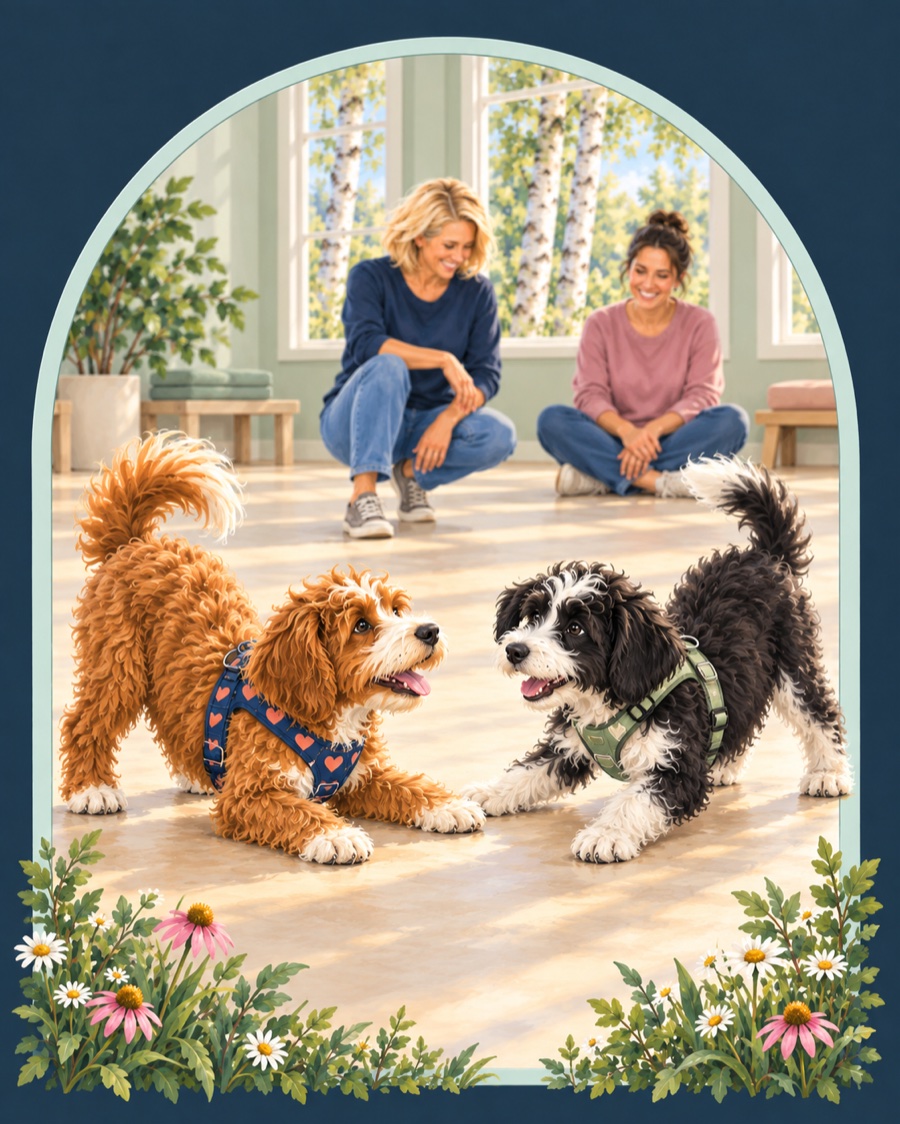
Two puppies play freely while a trainer and learner watch in a welcoming puppy school.
The dog first.Room to play.Skills for life.

01 · Our dog training philosophy

So we
teach life.

The guests. The leash.
The world.

Go Anywhere Dog® is a puppy and dog training school in Eden Prairie, serving Twin Cities families. Our philosophy starts with emotional safety, makes room for play, and builds the skills dogs need in everyday life.

We're not an obedience school. We're the place your dog learns to be okay — in a brewery, at the vet, when the doorbell rings, when a toddler grabs his tail, on a patio in July when someone drops a french fry two feet away.

Fifteen years. Thousands of dogs. One truth: calm is learned, not innate.

Go Anywhere Dog® was built on a simple observation that most of dog training still ignores: the dogs who struggle aren't the ones who never learned sit. They're the ones who never learned to settle. Nobody calls us because their dog won't sit. They call us because their dog can't handle life — the guests, the leash, the world.
02 · What’s different

The dog first.
Then the behaviors.

Sit is a party trick
with good PR.

Everyone teaches sit. Sit is easy. Sit is a party trick with good PR.

Here's what fifteen years of phone calls taught us: a dog who can sit but can't regulate looks great at eight months and falls apart at eighteen. And we know, because those are the calls we get. Twenty months old, "he knows better," pulling and barking and losing his mind — and somewhere in the house there's a certificate from a puppy class that taught him sit, down, and stay.

Obedience built on a dog who can't settle doesn't hold. It looks fine for a while. Then adolescence arrives and collects.

The right order

  1. 01The dog
  2. 02The behaviors

So we run the build in the right order: the dog first. The nervous system. The social skills. The whole emotional range — because we don't pick one feeling and label it "good dog." Excitement gets to happen here; the way back down gets learned. Then the behaviors. And they stick, because now there's a dog under them who can actually do them.

Sit still gets taught, for the record. It's just not the point. It was never the point.

03 · Play is the language

Let puppies
speak puppy.

Walk into most puppy classes and here's what you'll see: six puppies, six leashes, six feet apart. For an hour. Every week.

That's not socialization. That's a room full of babies being told to hold still.

Play is a puppy's language. It's how they learn bite pressure, how to read another dog, how to say "too much" and hear "okay" back. Silence that language during the one window it's supposed to develop, and you don't get a neutral outcome — you get deprivation with a certificate.

And it's worse than nothing, because the leash is teaching the whole time. A young puppy's brain is built to flee first — moving away is his best tool when something's too much. Clip him to six feet of leash and you've taken the tool away. Now every dog he sees is a dog he can't reach and can't retreat from. Strain, frustrate, get louder, repeat — week after week, the class builds the exact wiring that shows up at eighteen months as the dog who "goes crazy when he sees other dogs." The class designed to socialize him installed the opposite.

In our rooms

Off leash.
On purpose.

By sizeBy play styleRead live

Our classes run off leash. Real play, in a room split by size and play style so nobody gets pummeled, with trainers reading the room live and teaching you from what's actually happening — because your puppy's play is the lesson plan.

The leash comes back, of course. But it comes back onto a dog who has social skills instead of social frustration. That's the difference between a dog who's managed around other dogs and a dog who's fine around other dogs.

04 · Who it’s for

Life happens.
Bring your dog.

Patios.Trails.Road trips.Under the table.

The family with the new puppy who wants a dog they can take places — not a dog who performs in the living room and unravels in the parking lot. If your picture of dog ownership includes patios, trails, road trips, and a dog snoozing under the table while life happens around him, you're our people.

Every breed. Every size. Every family. The room is split so nobody gets pummeled, and the path is mapped from first snack to final rosette.

Go anywhere isn't the promise. It's the result.

The stance has a method

Boundaries
Without Trauma®.

Want to see the machinery behind the stance?

Emotional safety. Emotional regulation. Skill development. An earned tool. Real-world reliability.

Explore the Go Anywhere Dog® Methodology

Start here

Start where
your dog is.

Start where your dog is. Puppy & Me if he's little. Life Skills 101 if he's not. Either way, the destination is the same: a dog who can go anywhere, and a person who knows exactly how they built him.

Sit is overrated.
Your dog is not.

— & your Dog Life Coaches