I can’t go into some of the big box pet stores anymore.
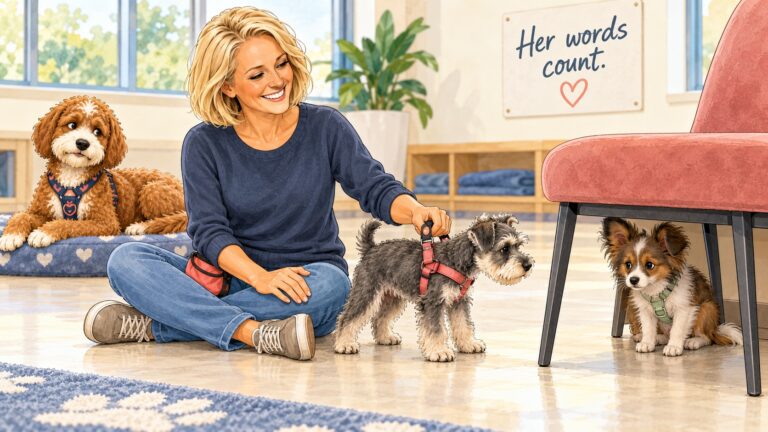
It’s their puppy playgroups. A full-grown boxer and a few other big dogs romping around the floor, having a wonderful time. And under a chair, alone, a little shih tzu puppy. Trembling.
Standing nearby is the puppy’s person. I can see on their face that they’re uncomfortable with what’s happening to their puppy. And someone is telling them: this is normal.
Every time, I want to rescue two beings: the tiny puppy under the chair, and the human who knows something’s wrong and is being told not to trust it. When you know what you’re seeing, it’s too painful to witness and say nothing.
So here’s me saying something.
When a puppy feels threatened by size, or by being pummeled by a bigger, older or more boisterous puppy, there’s a sequence. It’s the same almost every time.
First, she tries to climb your leg. That’s not clingy. That’s her asking the one safe thing in the room for help.
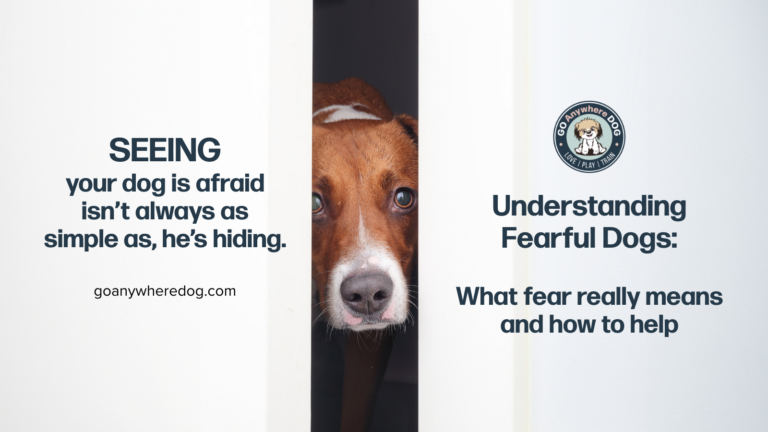
If nobody tends to her, she hides. Under the chair, behind the bench, in the corner. Trembling.
It’s heartbreaking. And hardly anyone recognizes it. Most people chalk it up to “small dog neurosis,” as if that’s just how little dogs come.
It isn’t. That’s a puppy who asked for help, didn’t get it, and solved the problem the only way she had left.
Puppy class is younger than most people think.
In the early 1980s, veterinarian and behaviorist Ian Dunbar started teaching off-leash puppy socialization classes in Berkeley, California. Before that, school was mostly for dogs over six months, and school meant on-leash obedience drills built for the competition ring. His idea was radical for its time: puppies learn about other dogs by playing with other dogs, and that window doesn’t wait.
It caught on everywhere. Then, over the years, many puppy classes quietly put the leashes back on. Dunbar himself wrote in 2010 that puppy classes were seldom taught off leash.
For a small puppy that leaves two bad options. A leashed class, six feet apart, where nobody gets to say anything to anybody. Or a free-for-all where the conversation belongs to whoever is biggest.
We run a third option.
There’s data behind the small-dog reputation.
A 2013 study led by Paul McGreevy at the University of Sydney looked at owner reports on 8,301 dogs across 49 breeds. Across breeds, reported problem behaviors went up as average height went down: more fear of other dogs, more touch sensitivity, more separation trouble, more aggression toward their own people.
Here’s the part that usually gets left out. That study ran on owner reports, and the authors themselves said the biological basis for those patterns remains to be determined. We know small dogs are reported to struggle more. We don’t know they’re built to.
A 2010 Austrian study by Christine Arhant and colleagues went looking for the why. They surveyed over a thousand dog owners and found that people with small dogs were, on average, less consistent with them, and did less play and training with them. Inconsistency hit small dogs harder than big ones, and punishment-based handling was tied to more fear and anxiety in the small dogs. The researchers’ own conclusion: small-dog owners could see real improvement by being more consistent and by regularly playing and training with their dogs.
Read those two together and “small dog neurosis” starts to look a lot like a small dog who keeps getting put under the chair.
At GAD, play isn’t recess. It’s the curriculum.
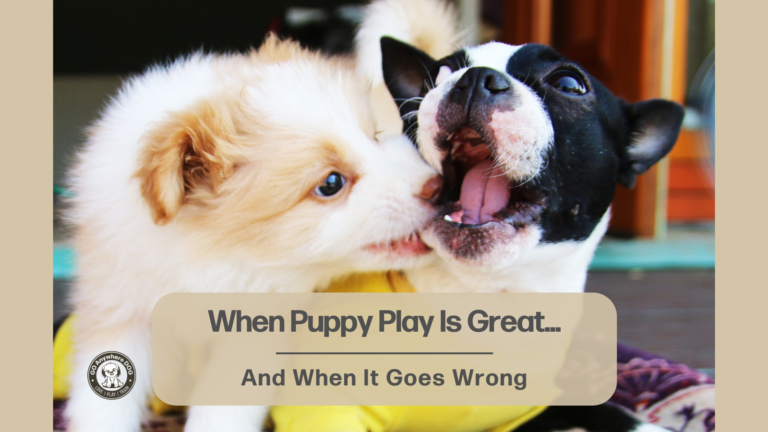
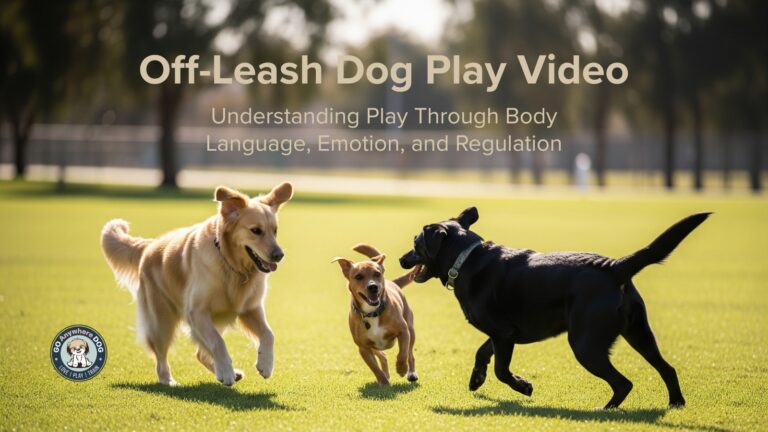
Off-leash play is how puppies learn their own language: how to ask, how to answer, how to say “too much,” and how to come back after a pause.
But play only teaches when both puppies get to practice the whole conversation.
Erika Bauer and Barbara Smuts filmed pairs of dogs playing and coded who did what. Play was rarely a fair 50/50. The dog with the advantage, older or higher-ranking, did more of the chasing and tackling. The dog without it did more of the accommodating: flopping over, softening, making themselves smaller, and sending more of the “this is still play” signals.
In a puppy room, size is an advantage too. I’ve spent over 15 years watching those rooms. Put a nine-week shih tzu in with a fourteen-week Lab and the little one spends the session accommodating, or climbing a leg, or under the chair. She gets very good at making herself small and almost no practice at anything else.
That’s not a social skill. That’s a survival strategy. It works in the wild. It doesn’t work so well at the vet, the patio, or grandma’s.
Small dogs get skipped. Not here.
That climbing-then-hiding sequence is the very thing that led me to split the class and the room. And it isn’t just puppy class. The whole GAD program runs this way, from Puppy & Me through every Life Skills level.
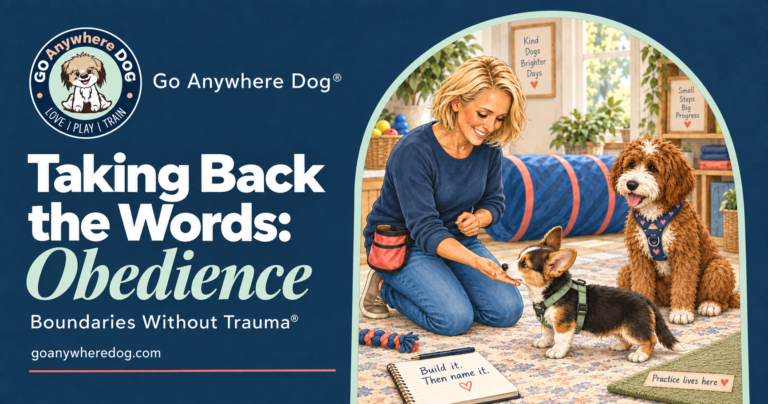
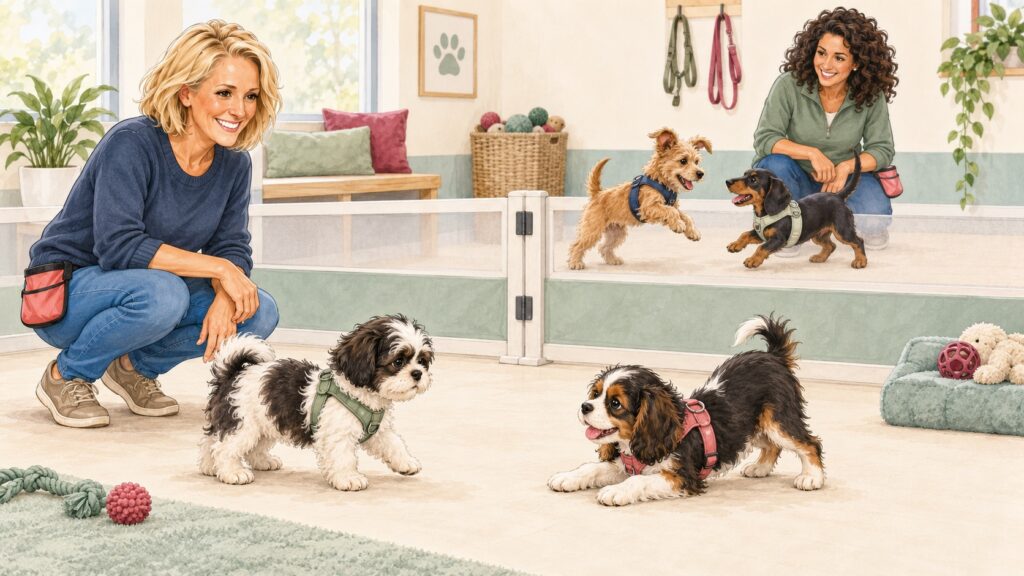
The class. Every class is split by size: small, and medium/large. Small means a dog expected to be 25 pounds or less as an adult. (Puppies aren’t there yet. We go by where they’re headed.)
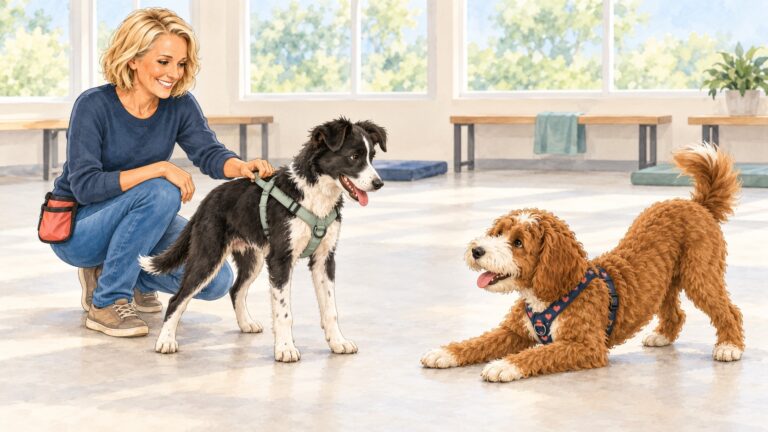
The room. Even within the small breed class, the room is divided in two. Size isn’t the only thing that tips a game, so we sort by all of them: size, age, play style, and how much fear we see when a puppy walks in the door. A boisterous little terrier can pummel a timid little Cavalier just fine. And the puppy who arrives already worried doesn’t get matched with the one who arrives ready to party.
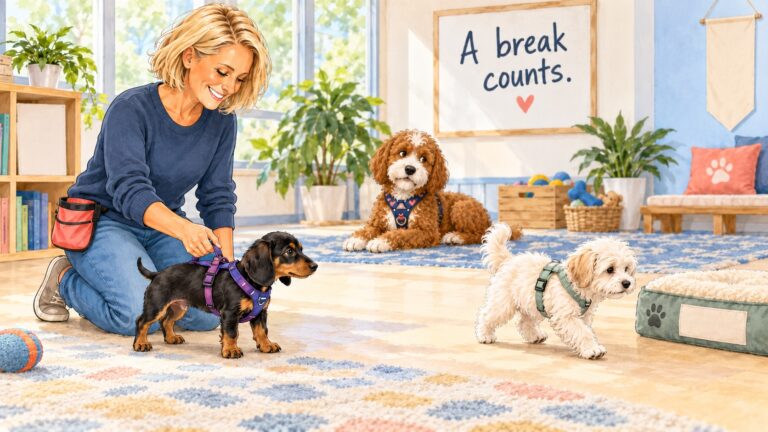
The people. Every class is off leash, capped at ten puppies with two Dog Life Coaches, and the coaches are watching the thing that matters most: is anyone upset? When a puppy climbs your leg, we don’t tell you it’s normal. We help you tend to her.
If that worried puppy growls when another puppy gets too close, we protect her space instead of scolding her warning.
And yes, if she welcomes being held, pick her up. Comforting an upset puppy is always okay. That’s you answering when she asked, with the kind of support she wants. Then, once she’s settled, we help her get back to playing on her own four feet.
Play still gets loud here, on purpose. Big feelings are normal, and so is the excitement. Our job is to help every puppy go up, come back down, and be okay at every stop.
Whose feet are moving?
Here’s the one thing to watch next time your little one meets another dog, in class or anywhere else.
If your puppy is choosing to approach, sniff, back off, and come back on her own, she’s learning. If she’s climbing your leg, hiding, or being chased down, she’s not learning the social part, no matter how many times someone tells you it’s normal. The marker isn’t whether she ends up near the other dog. It’s whether she got there by her own choice. Our dog play consent test puts that choice into practice—and helps us read the whole answer.
And if your gut says something’s wrong with what’s happening to your puppy, trust it. You’re probably right.
A small puppy deserves what every puppy deserves: a room where her feet get a vote.
Small breed puppy classes in Eden Prairie
Small breed Puppy & Me classes meet at our Eden Prairie school. Under 16 weeks on the first day, start any week, $185 for five classes. See puppy class times → Already 16 weeks or older? Life Skills 101 runs the same small breed split. Not sure which group fits? Ask Jeannie. She’s a real person, and she’s very good at this.
Jody & your Dog Life Coaches
Sources
Arhant, C., Bubna-Littitz, H., Bartels, A., Futschik, A., & Troxler, J. (2010). Behaviour of smaller and larger dogs: Effects of training methods, inconsistency of owner behaviour and level of engagement in activities with the dog. Applied Animal Behaviour Science, 123(3–4), 131–142. Read the study.
Bauer, E. B., & Smuts, B. B. (2007). Cooperation and competition during dyadic play in domestic dogs, Canis familiaris. Animal Behaviour, 73(3), 489–499. Read the study.
Dunbar, I. (2012, January 3). Happy birthday puppy training: Time for another paradigm shift in puppy raising. Dog Star Daily. Read the article.
Dunbar, I. (2010, September 23). Science-based dog training (with feeling): How dog training transcends learning theory. Dog Star Daily. Read the article.
McGreevy, P. D., Georgevsky, D., Carrasco, J., Valenzuela, M., Duffy, D. L., & Serpell, J. A. (2013). Dog behavior co-varies with height, bodyweight and skull shape. PLOS ONE, 8(12), e80529. Read the study.