
New Puppy? Your First Step for Success (It’s Not Training Yet)

Most people think training starts with cues like sit, down, or come. But for a new puppy, the very first step toward success happens before any formal training begins.

In this video, I explain why thoughtful puppy-proofing and environment setup shape behavior from day one — and how skipping this step creates problems no amount of training can fix later.
New Puppy – Go Anywhere Dog®, Minneapolis & Twin Cities, MN, Puppy Training

New Puppy? Your First Step for Success

When a new puppy comes home, most people focus on what to teach.

Sit.
Crate.
Potty training.
Leash walking.

But the most powerful influence on a puppy’s behavior isn’t a cue — it’s the environment.

Before a puppy understands language, rules, or expectations, they are already learning. Every step they take, every object they reach, every reaction they get is shaping habits in real time.

That’s why the first step for success isn’t training.
It’s setup.

Puppies Learn From What Works — Not What We Intend

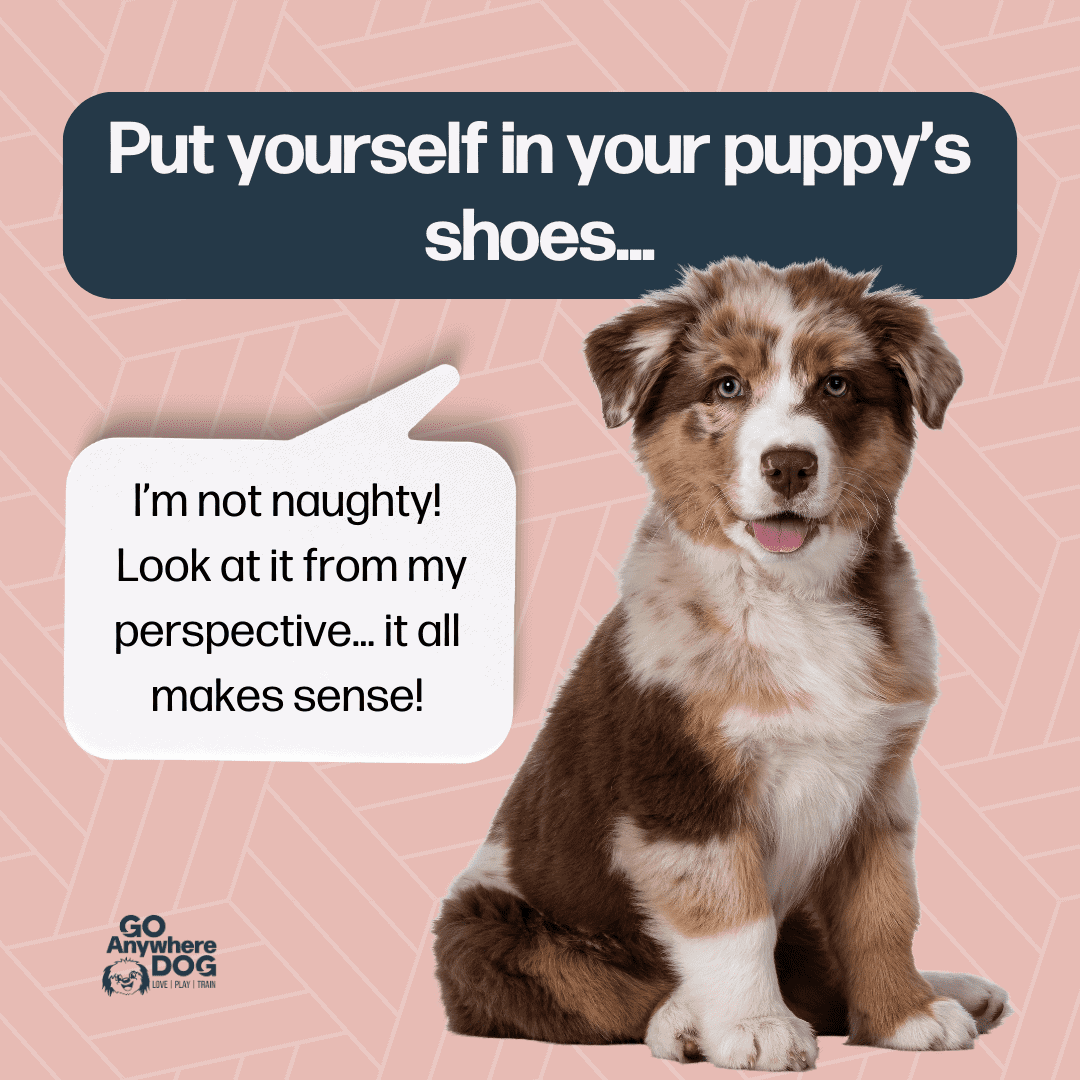
Puppies are incredible learners, but they’re not moral creatures. They don’t know what’s “allowed” or “wrong.” They simply repeat what works.

If chewing the table leg feels good → chewing continues.
If stealing a sock turns into a game → sock stealing escalates.
If roaming the house leads to accidents → house training stalls.

None of this is disobedience.
It’s reinforcement by access.

When environments aren’t intentionally designed, puppies practice the very behaviors people later try to train out of them.

Puppy-Proofing Isn’t About Control — It’s About Clarity

True puppy-proofing isn’t about locking everything down or hovering nonstop.

It’s about creating clarity.

A well-set-up environment tells a puppy:

  • what they can interact with

  • where they can succeed

  • how to make good choices without pressure

This reduces frustration for both the puppy and the human — and it allows learning to happen without constant correction.

Why Training Can’t Fix a Bad Setup

Here’s the hard truth:

If a puppy has unlimited access to temptation, training is fighting gravity.

You can teach “leave it,” but if shoes are everywhere, the puppy will still rehearse chewing.
You can work on potty training, but if supervision is inconsistent, accidents become part of the routine.
You can reward calm behavior, but if the environment is chaotic, calm isn’t accessible.

Training works best when the environment supports it.

Small Boundaries Early Prevent Big Problems Later

One of the biggest myths in puppy raising is that boundaries should wait.

In reality, early boundaries prevent confusion, not freedom.

Using play pens, gates, tethers, and thoughtfully chosen spaces helps puppies:

  • regulate their arousal

  • avoid overstimulation

  • practice rest

  • build confidence through success

Boundaries aren’t punishment.
They’re structure — and structure creates safety.

Setup Is Training (Even If It Doesn’t Look Like It)

Every moment a puppy spends in your home is a learning moment.

When the environment is designed intentionally:

  • good behavior is easy

  • mistakes are limited

  • learning happens naturally

That’s why puppy-proofing isn’t a side task.
It’s the foundation everything else is built on.

Get the setup right, and training becomes smoother, faster, and far more humane.

Skip it, and you’ll spend months trying to undo habits that never needed to form.

The Takeaway

If you’re bringing home a new puppy — or struggling with one already — start here:

Before cues.
Before corrections.
Before expectations.

Design the environment so your puppy can succeed.

That is the first step for success.

Share:

Facebook
Twitter
Pinterest

Social Media

Be Your Puppy's Hero
Puppy school cartoon dogs branding graphic

The Go Anywhere Dog® Guide:
Be Your Puppy’s Hero

Hero Moments:
The Only Ones That
Matter Early On
 A hero moment is not when you teach a skill. It’s when you protect safety without need for proving anything.
jody-karow-founder-go-anywhere-dog-scaled.jpeg – Go Anywhere Dog®, Minneapolis & Twin Cities, MN, Dog Training

Jody Karow - CTC

Founder & Lead Dog Life Coach — Go Anywhere Dog®

Helping dogs — and their humans — master the social skills that make a Go Anywhere Dog®. Science-based. Play-driven. Boundaries without trauma®.

Jody Karow is the founder and lead trainer at Go Anywhere Dog® in Eden Prairie, serving families across the Minneapolis metro. With 20+ years of hands-on experience, Jody’s special sauce is social skills—the confidence, play etiquette, and emotional regulation that turn a good puppy into a Go Anywhere Dog®. Her method blends behavioral science with joyful practice: trust first, skills second, obedience that lasts.

Her work sits at the intersection of behavioral science, emotional intelligence, and real-world practice, helping families raise calm, joyful dogs who can truly go anywhere with them. Jody’s guiding principle is simple and unwavering: build trust before obedience. Because the best-behaved dogs aren’t managed—they’re connected.

When she’s not teaching puppies the art of polite play, Jody mentors fellow trainers, writes about dog-human relationships, and explores the trails around the Minneapolis metro with her own Go Anywhere Dogs by her side.

On the Blog
Woman training puppy while using the best time to train her puppy
Training Foundations

The Best Time To Train Your Puppy Or Dog

The Best Time to Train Your Puppy or Dog (And Why It’s Not What You Think) The Best Time to Train Your Puppy or Dog (And Why It’s Not What You Think) “When is the best time to train my puppy or dog?” It

Read More »
Preparing your home for bringing home a new puppy
Training Foundations

New Puppy? Your First Step for Success (It’s Not Training Yet)

Most people think training starts with cues like sit, down, or come. But for a new puppy, the very first step toward success happens before any formal training begins. In this video, I explain why thoughtful puppy-proofing and environment setup shape behavior from day

Read More »
Puppy training begins with motivation
Training Foundations

How to Motivate Your Puppy (The Real Drivers of Engagement)

Most people think dog training starts with cues and corrections. The truth is: training starts with motivation — the internal engine that makes a dog want to participate at all. In this video, we break down what truly motivates dogs, why motivation matters more

Read More »
Video Thumbnail: Easiest Dog Training Method...Yummy Kongs! – Go Anywhere Dog®, Minneapolis & Twin Cities, MN, Dog Training
Life With Dogs

Yummy Stuffed Kongs (How to Use Them Right)

Stuffed Kongs are a staple in dog training and enrichment — but most people use them simply as treats. The truth? They’re powerful tools for building motivation, regulating arousal, and shaping meaningful engagement. In this video, I walk through how to use stuffed Kongs

Read More »
Dog display aggressive behavior, barking, growling, snarling and lunging, video teaches what you need to understand and know
Behavior & Emotion

Aggression in Dogs: What It Is, What Causes It, and What to Do Next

Aggression in dogs is one of the most misunderstood—and emotionally charged—topics in dog behavior. For many families, it brings fear, confusion, and an urgent desire for answers. In this video, we break down what aggression actually is, what commonly causes it, how to recognize

Read More »
Explore The Category of Your interest

Puppy Development

Early experiences shape confidence, coping, and resilience for life. This category explores how puppies learn long before formal training begins — and why early understanding matters more than early obedience.

Dog Body Language

Understanding how dogs communicate through posture, movement, facial expression, and subtle physical signals — so behavior makes sense in real time.

Behavior & Emotion

Behavior isn’t random. It’s driven by emotion, history, and context. These posts help you understand what dogs are feeling when behavior shifts, escalates, or seems confusing.

Fear & Stress

Fear isn’t defiance — it’s communication. This category focuses on recognizing fear early, understanding stress responses, and responding in ways that increase safety rather than escalation.

Training Foundations

Clear expectations, motivation, and learning principles that make training effective without force or intimidation. These pieces focus on why learning works — not just how.

Life With Dogs

Play, routines, enrichment, and real-world living. This category looks at how dogs fit into human lives with joy, structure, and realism.